

West London has a rich collection of historic churches representing medieval parish life, Tudor rebuilding, Georgian architecture, Victorian Gothic Revival and later conservation. These buildings preserve evidence of changing communities, architecture, worship, local government and urban development across uk/local/ealing/">Ealing, Hounslow, Hillingdon, Kensington, Richmond and nearby districts.
- What makes the historic churches in West London important?
- Which historic churches are the oldest in West London?
- How did medieval parish churches shape West London?
- Which West London churches have Grade I or Grade II* status?
- What can visitors see at St Mary the Virgin Perivale?
- Why is St Nicholas Church important in Chiswick?
- What is significant about St Mary’s Church in Ealing?
- What makes St Mary’s Church in Hanwell historically significant?
- Why is St Mary Abbots important in Kensington?
- How did Victorian church building change West London?
- What architectural features should visitors look for in historic West London churches?
- How are historic churches in West London protected?
- How can visitors explore historic churches in West London responsibly?
- Why do historic churches remain relevant to West London today?
- Which historic churches are best for understanding West London’s architectural history?
What makes the historic churches in West London important?
Historic churches in West London are important because they preserve centuries of architectural, religious and community history. Buildings such as St Mary’s Perivale, St Nicholas Chiswick, St Mary’s Hanwell and St Mary Abbots Kensington retain significant historic fabric.
West London developed from rural villages, market settlements, riverside communities and estates into a densely populated part of Greater London. Parish churches often formed the architectural and social centre of these settlements.
The surviving churches represent different historical periods. Medieval churches preserve early stonework, timber roofs, towers and parish layouts. Georgian churches demonstrate changing architectural preferences and population growth. Victorian churches reflect the rapid expansion of West London during the nineteenth century.
Historic England records protected churches through the National Heritage List for England. Listed buildings receive statutory protection because of special architectural or historic interest. Listing grades include Grade I, Grade II* and Grade II.
Several West London churches have Grade I or Grade II* status. St Mary the Virgin in Perivale is Grade I listed. Its surviving structure includes probable thirteenth-century fabric, a sixteenth-century west tower and a seventeenth-century south porch.
Other churches demonstrate the importance of Victorian architecture. St Mary’s Ealing is a Grade II* listed building designed by S. S. Teulon between 1866 and 1873. Historic England identifies its Romanesque character, retained wall tablets and earlier building fabric.
These buildings are therefore architectural records as well as active religious sites.
Which historic churches are the oldest in West London?
The oldest historic churches in West London include churches with medieval origins at Perivale, Ruislip and Chiswick. Their surviving fabric varies by building, but several sites retain structures or architectural elements dating from the medieval period.
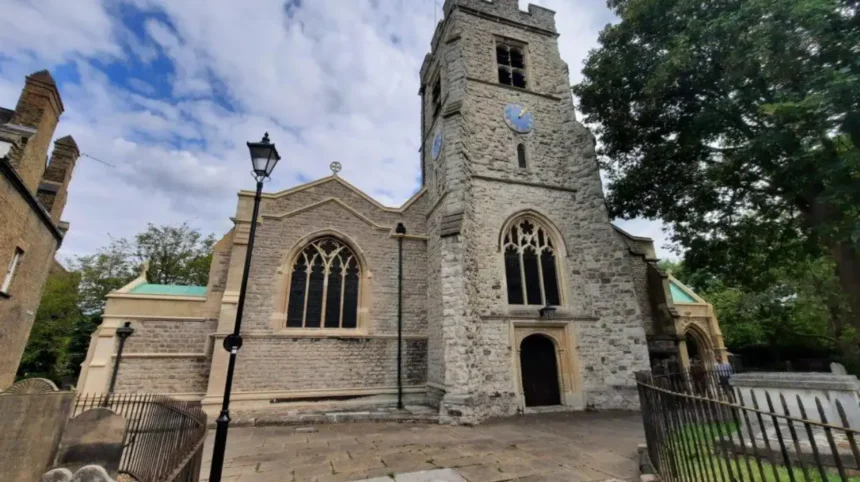
St Mary the Virgin at Perivale is one of the most significant examples. Historic England dates the main church probably to the thirteenth century. The west tower dates from the sixteenth century, while the south porch dates from the seventeenth century.
The building is particularly valuable because it retains multiple periods within a relatively compact structure. Its medieval character includes a thirteenth-century low-side window, a fifteenth-century timber nave roof and later medieval windows.
St Nicholas in Chiswick also has a long history. Historic England’s archaeological assessment of Hounslow records documentary evidence for the church around 1181 and states that the church had probably been established by that period. Its fifteenth-century west tower survives from the medieval building.
The current St Nicholas building is largely nineteenth century. Most of the church was rebuilt between 1882 and 1884, while the medieval tower remained. The church is Grade II* listed and stands within the Old Chiswick Conservation Area.
St Mary’s in Ruislip also preserves extensive medieval fabric. Historic England identifies a late thirteenth-century chancel, a thirteenth-century section of the nave arcade, a fifteenth-century west tower and a sixteenth-century south porch.
These examples show why church age should not be judged only by the date displayed on the present building. A church rebuilt during the nineteenth century can still contain much older fabric.
How did medieval parish churches shape West London?
Medieval parish churches shaped West London by providing permanent religious centres within agricultural villages and settlements. Their churchyards, roads, towers and parish boundaries influenced local development and preserved evidence of communities that existed before modern London expanded westward.
Medieval West London contained villages and agricultural landscapes rather than the continuous urban environment visible today. Parish churches served populations distributed around farms, manors, roads, rivers and village centres.
The church was an important fixed point within this landscape. A parish church provided regular worship, burial space and a location for community administration. Churchyards also preserved archaeological evidence through monuments, graves and historic boundary arrangements.
St Mary the Virgin in Perivale demonstrates this rural heritage particularly clearly. The church stands within an area transformed by twentieth-century suburban development, but its medieval building preserves the character of an earlier settlement. Historic England classifies it as Grade I.
St Nicholas Chiswick provides another example. Old Chiswick developed as a rural linear settlement beside the River Thames. Fishing, boatbuilding and river transport were important local activities before large-scale residential development. The village developed around St Nicholas and its churchyard.
The relationship between church and settlement remains visible in the street patterns around several historic churches. Church Street in Chiswick and Perivale Lane around St Mary’s demonstrate how historic religious sites remain embedded in modern urban geography.
These buildings therefore provide evidence of West London before suburban expansion.
Which West London churches have Grade I or Grade II* status?
Several important West London churches have high listed-building status. St Mary the Virgin Perivale is Grade I, while St Mary’s Ealing, St Mary’s Hanwell, St Mary Abbots Kensington, St Nicholas Chiswick and St Mary the Virgin Putney are Grade II examples.*
Grade I represents buildings of exceptional interest. Grade II* identifies particularly important buildings of more than special interest. Grade II covers buildings of special architectural or historic interest.
St Mary the Virgin at Perivale has Grade I status. Its significance derives from its medieval fabric, architectural survival and historic development.
St Mary’s Ealing is Grade II*. The present church was designed by S. S. Teulon and constructed between 1866 and 1873. Its Romanesque design incorporates an earlier church structure. Historic England records the building as a robust composition with a significant interior and surviving historic memorial features.
St Mary’s Hanwell is also Grade II*. The church dates from around 1841 and was designed by George Gilbert Scott and William Bonython Moffatt. Its Early English style uses flint with stock-brick dressings and includes a broach spire. A later chancel was added in 1898.
St Mary Abbots in Kensington is Grade II*. The church was rebuilt between 1869 and 1872 to designs by Sir George Gilbert Scott. The building uses a Geometrical Gothic design with a substantial tower and spire. Its churchyard railings are included within the listed designation.
St Mary the Virgin in Putney is another Grade II* church. Its surviving fabric includes a fifteenth-century tower and early sixteenth-century Bishop West Chapel. The church also has an important connection with the Putney Debates of 1647.
What can visitors see at St Mary the Virgin Perivale?
St Mary the Virgin Perivale contains probable thirteenth-century fabric, a sixteenth-century weatherboarded west tower, a seventeenth-century porch and a medieval timber roof. Its Grade I listing recognises the church as an exceptional survivor of historic parish architecture.
The church stands on Perivale Lane in the London Borough of Ealing. It represents one of the clearest examples of medieval church architecture surviving within modern West London.
Historic England identifies the main building as probably thirteenth century. The west tower dates from the sixteenth century. The south porch dates from the seventeenth century.
The west tower is especially distinctive. It is three storeys high, weatherboarded and covered by a tiled pyramid roof. A sundial dated 1818 is also recorded.
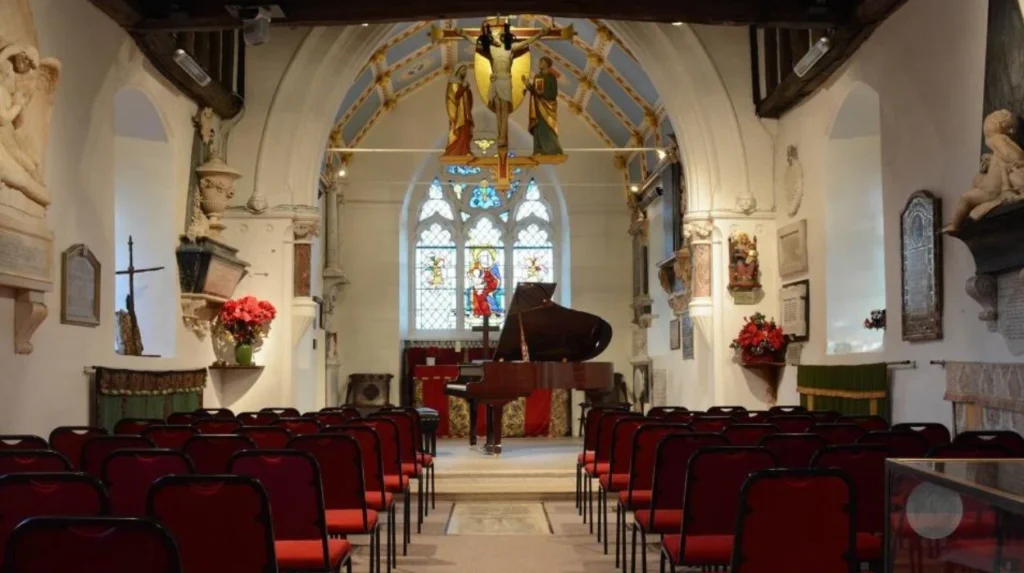
The nave contains a king-post roof dating from the fifteenth century. A king-post roof uses a central vertical timber supporting the principal roof structure. This surviving roof provides direct evidence of medieval construction methods.
The church also contains a thirteenth-century low-side window in the south wall of the chancel. Later medieval windows survive in the nave.
The combination of early masonry, timber construction and later additions makes the building valuable for architectural study.
Why is St Nicholas Church important in Chiswick?
St Nicholas Church is important because it preserves a medieval tower within a largely nineteenth-century church and remains closely associated with the historic village of Chiswick. Documentary evidence records the church by about 1181, while the tower dates from the fifteenth century.
St Nicholas stands on Church Street in Old Chiswick near the River Thames. Its setting reflects the historic structure of the settlement.
Historic England’s archaeological assessment identifies St Nicholas as the centre of Old Chiswick’s historic development. The church was associated with a settlement shaped by fishing, boatbuilding and river transport.
The current church largely dates from the late nineteenth century. The tower is older and provides a visible connection with the medieval parish.
The Church of England’s Church Heritage Record identifies St Nicholas as a Grade II* listed building and places it within the Old Chiswick Conservation Area.
The church therefore illustrates a common pattern in historic English parish architecture. A building can retain a medieval core while undergoing substantial rebuilding to accommodate changing congregations and nineteenth-century architectural expectations.
Its location also makes it important for understanding the historic relationship between Chiswick village, the Thames and local transport routes.
What is significant about St Mary’s Church in Ealing?
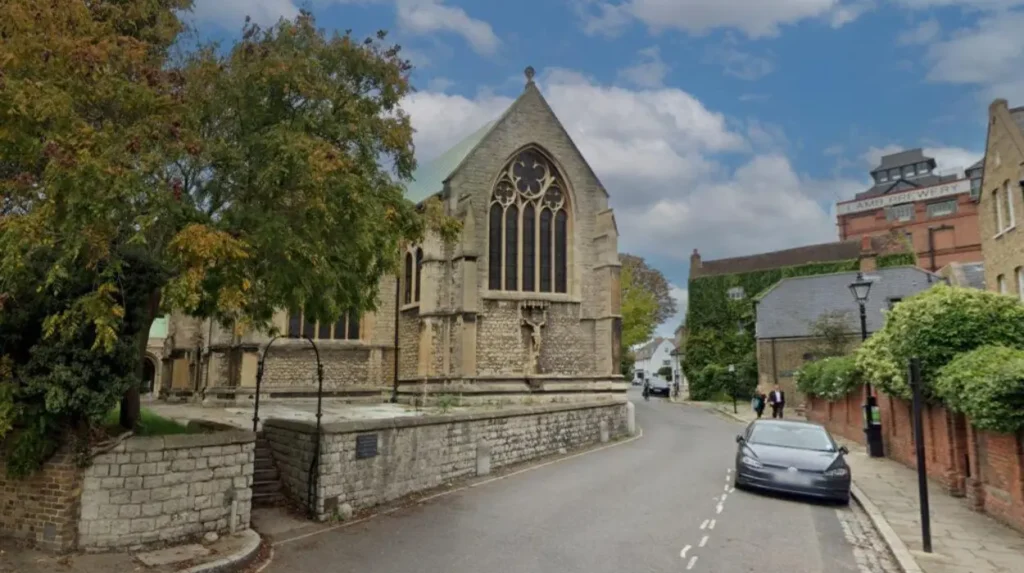
St Mary’s Ealing is a Grade II Victorian church designed by S. S. Teulon between 1866 and 1873. It incorporates an earlier church and combines Romanesque architecture, historic memorials, galleries and later restoration within Ealing’s modern urban landscape.*
St Mary’s stands on St Mary’s Road in Ealing. Historic England records the church as a robust Romanesque composition built by S. S. Teulon between 1866 and 1873.
The building is notable because the Victorian church incorporates an earlier structure. Historic England describes the nineteenth-century building as a recasing of a church dating from 1739.
The interior contains galleries on three sides. An open timber roof is supported by iron columns. Eighteenth- and nineteenth-century wall tablets remain inside the building. A brass dating from around 1490 is also recorded.
The present church therefore contains evidence from several historical periods. Its significance does not depend exclusively on the Victorian exterior.
The church itself identifies its current status as a Grade II* listed building and records restoration and remodelling completed in 2003. The church and grounds are also within a conservation area.
This combination of listing, architectural survival and continuing community use makes St Mary’s an important heritage site in Ealing.
What makes St Mary’s Church in Hanwell historically significant?
St Mary’s Hanwell is a Grade II listed Early English church built around 1841 by George Gilbert Scott and William Moffatt. Its flint construction, broach spire, historic interior and 1898 chancel demonstrate Victorian ecclesiastical architecture.*
The church stands on Church Road in Hanwell. Historic England lists it at Grade II*.
The building dates from around 1841. George Gilbert Scott and William Moffatt designed the church in the Early English style.
Its principal materials are flint with stock-brick dressings. The church has a broach spire, tall octagonal interior piers and a clerestory containing quatrefoil windows.
The church also contains a monument to Margaret Emma Orde dated 1806. The monument predates the present church and provides evidence of the earlier parish community.
A chancel was added in 1898 by W. Pywell. This addition demonstrates the continuing evolution of the building after its original construction.
St Mary’s therefore represents the nineteenth-century growth of Hanwell while retaining physical links to the earlier parish.
Why is St Mary Abbots important in Kensington?
St Mary Abbots is an important Grade II church in Kensington because Sir George Gilbert Scott rebuilt it between 1869 and 1872. The building combines Victorian Gothic architecture, a prominent spire, historic monuments and surviving elements from the previous church.*
St Mary Abbots stands on Kensington Church Street. Historic England lists the church and its churchyard railings at Grade II*.
The present church was rebuilt between 1869 and 1872. Sir George Gilbert Scott designed the building in the Geometrical Gothic style.
Its construction uses rubble stone with ashlar dressings. The plan includes an aisled nave, a lower chancel and an eastern tower with a broach spire.
A vaulted entrance cloister was added between 1889 and 1893 by J. T. Micklethwaite and Somers Clarke.
The church also retains monuments and a pulpit from the previous church. A Victorian font remains among its notable features.
The building demonstrates how Victorian architects combined new construction with historic materials and furnishings. It also shows the scale of ecclesiastical investment associated with nineteenth-century urban Kensington.
How did Victorian church building change West London?
Victorian church building transformed West London by creating larger parish churches for expanding populations. Architects such as George Gilbert Scott, S. S. Teulon and Sir George Gilbert Scott used Gothic and Romanesque styles to express religious identity and accommodate growing congregations.
West London experienced major population growth during the nineteenth century. New railways, roads, housing developments and employment centres encouraged suburban expansion.
Churches responded to this growth. Older parish churches were enlarged or replaced. New churches were built in developing residential districts.
St Mary’s Hanwell illustrates this process. Its construction around 1841 created a substantial Early English church for a growing community.
St Mary’s Ealing demonstrates another form of development. The nineteenth-century church retained elements of an earlier Georgian building while creating a substantially larger and more elaborate structure.
St Mary Abbots Kensington shows the scale of Victorian rebuilding in a rapidly developing metropolitan district. Its 1869–1872 rebuilding produced a major Gothic church designed by Sir George Gilbert Scott.
These buildings form part of the wider Gothic Revival movement. Gothic Revival architecture revived medieval architectural forms for nineteenth-century churches.
The result is a diverse West London church landscape in which medieval survivals stand alongside large Victorian buildings.
What architectural features should visitors look for in historic West London churches?
Visitors should look for medieval masonry, timber roofs, towers, spires, stained glass, memorials, churchyards and later additions. These features identify different construction periods and reveal how West London churches changed as communities, architectural styles and religious practices developed.
The architectural details vary between churches.
St Mary Perivale contains a king-post roof, medieval windows and a weatherboarded tower. These features provide evidence of medieval and early modern construction.
St Mary Ealing provides a different experience. Its Romanesque exterior, galleries, open timber roof, iron columns and historic wall tablets represent multiple phases of development.
St Mary Hanwell has a broach spire and Early English architectural details. Its tall internal piers and clerestory are important elements of the Victorian design.
St Mary Abbots has a substantial eastern tower and spire, aisled nave and Gothic detailing. The churchyard railings are also included in its listed designation.
Churchyards provide another layer of evidence. Historic gravestones, monuments, boundary walls and mature planting can reveal information about former residents and parish history.
Visitors should also distinguish original fabric from restoration. A church can contain medieval, Georgian, Victorian and twentieth-century elements within the same structure.
How are historic churches in West London protected?
Historic churches in West London are protected through listed-building legislation, conservation policies and heritage management. Listing identifies buildings of special architectural or historic interest, while conservation areas protect the wider character of historically important neighbourhoods.
The principal statutory framework is the Planning (Listed Buildings and Conservation Areas) Act 1990.
Historic England maintains the National Heritage List for England. Listed buildings are divided into Grade I, Grade II* and Grade II categories according to their level of special interest.
Listing protects significant historic fabric and controls works that affect a building’s special architectural or historic interest.
St Mary Perivale is Grade I. St Mary’s Ealing, St Mary’s Hanwell, St Mary Abbots and St Nicholas Chiswick are examples of Grade II* churches.
Conservation areas provide another level of protection. St Nicholas Chiswick sits within the Old Chiswick Conservation Area, while St Mary’s Ealing and its grounds sit within a conservation area.
Churches also remain subject to practical maintenance. Roofs, stonework, timber, drainage, stained glass and heating systems require specialist conservation work.
Protection therefore involves both statutory designation and continuing stewardship.
How can visitors explore historic churches in West London responsibly?
Visitors can explore historic churches responsibly by checking opening arrangements, respecting worship, following photography rules and treating churchyards as active heritage spaces. Churches remain places of worship, so heritage visits should not interfere with services, ceremonies or community activities.
Opening arrangements vary between churches. A listed building does not automatically operate as a museum or tourist attraction.
Visitors should check the individual church before travelling. Some churches provide regular services, heritage events or community activities. Others have restricted opening times.
The Church of England’s A Church Near You service provides information for many Anglican churches, including St Nicholas Chiswick. The service identifies it as the historic parish church of Chiswick and provides location and worship information.
Visitors should remain quiet during worship and follow instructions from church staff or volunteers.
Photography should follow local rules. Some interiors contain fragile memorials, historic glass and other sensitive features.
Churchyards should also be treated as heritage environments. Gravestones, monuments, trees and boundary structures form part of the historic setting.
A responsible visit therefore combines heritage interest with respect for the continuing religious and community function of the building.
Explore More Area Guide
Historic Houses in West London: Chiswick, Osterley & Syon
West London’s Royal Connections: Kew, Richmond and Hampton Court
Why do historic churches remain relevant to West London today?
Historic churches remain relevant because they connect modern West London with earlier settlements, preserve architectural evidence and support continuing community activity. Their buildings provide tangible records of demographic growth, architectural change, local identity and religious life across several centuries.
Modern West London contains dense residential neighbourhoods, major transport corridors, commercial centres and multicultural communities. Historic churches preserve physical evidence of the landscapes that existed before this transformation.
St Mary Perivale demonstrates the survival of a medieval village church within modern Ealing. St Nicholas Chiswick records the history of an old riverside settlement. St Mary Hanwell and St Mary Ealing demonstrate nineteenth-century suburban growth.
Historic churches also support local identity. Their towers and spires remain prominent landmarks. Their churchyards preserve historic names and monuments. Their interiors contain memorials, architectural features and objects connected to previous generations.
The buildings also remain part of contemporary community life. Churches host worship, charitable activity, cultural events, music, meetings and local initiatives.
Their relevance therefore extends beyond religious history. They provide evidence for architectural history, urban development, archaeology, genealogy and local studies.
For residents and visitors exploring West London, these churches provide a direct way to understand how villages and suburban districts developed into parts of modern London.
Which historic churches are best for understanding West London’s architectural history?
The strongest churches for understanding West London’s architectural history are St Mary Perivale, St Nicholas Chiswick, St Mary Ealing, St Mary Hanwell, St Mary Abbots Kensington and St Mary Ruislip because together they represent medieval survival, Georgian change and Victorian rebuilding.
St Mary Perivale provides the clearest medieval example. Its probable thirteenth-century fabric and later tower, porch and roof demonstrate long-term architectural evolution.
St Nicholas Chiswick demonstrates the relationship between medieval settlement and later Victorian rebuilding. Its fifteenth-century tower survives beside a largely nineteenth-century church.
St Mary Ealing represents nineteenth-century architectural transformation around an earlier church. Its Teulon design and Romanesque character provide an important example of Victorian ecclesiastical architecture.
St Mary Hanwell demonstrates the Early English Gothic Revival style associated with George Gilbert Scott and William Moffatt.
St Mary Abbots represents major Victorian Gothic rebuilding in Kensington. Sir George Gilbert Scott’s 1869–1872 church remains a prominent historic landmark.
St Mary Ruislip provides another important medieval survival. Its thirteenth-century chancel, medieval nave arcade, fifteenth-century tower and sixteenth-century porch document several phases of church development.
Together, these churches demonstrate that West London heritage is not represented by one architectural period. Its churches form a layered record extending from the medieval period through the Georgian and Victorian eras into the modern conservation period.
What are the most historic churches in West London?
Important historic churches include St Mary the Virgin Perivale, St Nicholas Chiswick, St Mary’s Ealing, St Mary’s Hanwell, St Mary Abbots Kensington and St Mary’s Ruislip. They represent medieval, Georgian and Victorian architectural history.