

West London contains a wide range of cemeteries, historic burial grounds, churchyards and memorial landscapes. These sites record centuries of local history, religious practice, migration, military service, public health policy and changing attitudes toward burial.
- What are cemeteries and burial grounds in West London?
- Why were so many large cemeteries created in West London during the 19th century?
- Which are the most important historic cemeteries in West London?
- How are West London cemeteries organised and managed?
- What types of burial and memorial spaces are available in West London?
- How does a burial take place in a West London cemetery?
- How can you find a grave or burial record in West London?
- What makes West London cemeteries important for history and heritage?
- How do cemeteries contribute to biodiversity and green space in West London?
- Why is burial space an important issue for West London?
- What laws and regulations govern burial grounds in West London?
- How are West London cemeteries likely to change in the future?
- What should visitors and researchers know before visiting a West London cemetery?
The area includes major Victorian cemeteries such as Kensal Green Cemetery and Brompton Cemetery, municipal cemeteries operated by councils, smaller historic burial grounds and churchyards connected with older settlements. Each type has different ownership, burial rights, historical significance and visitor arrangements.
West London’s burial landscape also reflects London’s rapid population growth during the 19th century. Overcrowded churchyards created pressure for larger burial grounds outside the most densely populated parts of the capital. New garden cemeteries introduced landscaped avenues, monumental architecture and formal burial plots.
Today, these places remain important for burials and memorials. They also function as heritage sites, green spaces, wildlife habitats and sources for family-history research.
What are cemeteries and burial grounds in West London?
Cemeteries and burial grounds in West London are designated places where human remains are buried or cremated remains are interred. They include municipal cemeteries, private cemeteries, churchyards and historic burial grounds managed under different legal arrangements.
A cemetery is a burial site established specifically for the interment of human remains. Cemeteries can be owned by local authorities, private companies, religious organisations or other organisations.
A burial ground is a broader term covering land used for burial. A churchyard is a burial ground associated with a church. Some churchyards are still active, while others are closed to new burials.
West London has several different management models. uk/local/ealing/">Ealing Council operates cemeteries including Acton Cemetery, Greenford Park Cemetery, Havelock Cemetery, Hortus Cemetery and South Ealing Cemetery. Hounslow Council manages nine cemetery sites, including Chiswick New Cemetery, Chiswick Old Cemetery, Hounslow Cemetery and Isleworth Cemetery.
Other important sites are managed outside the council responsible for their immediate neighbourhood. Gunnersbury Cemetery in the Ealing area is managed by the Royal Borough of Kensington and Chelsea. Hanwell also contains cemetery sites managed by Kensington and Chelsea and the City of Westminster.
This distinction matters when people need information about burial plots, grave searches, memorial permissions, opening hours or funeral arrangements.
Why were so many large cemeteries created in West London during the 19th century?
Large Victorian cemeteries were created because London’s population expanded rapidly while older churchyards became overcrowded. New landscaped cemeteries provided additional burial capacity outside congested urban churchyards and introduced organised, commercially operated burial systems.
London’s population stood at approximately one million in 1800 and more than doubled during the following half-century. Existing churchyards struggled to accommodate the growing number of deaths. The Royal Parks identifies overcrowding and public-health concerns as major reasons behind the creation of the large Victorian garden cemeteries.
The development of Kensal Green was particularly important. The General Cemetery Company was established in 1830, and an Act of Parliament was obtained in 1832 to establish the Cemetery of All Souls at Kensal Green. The cemetery opened in 1833 on what was then open land west of London.
Kensal Green became the first of the major privately operated public cemeteries established on London’s outskirts during the Victorian period. Historic England records the original site as approximately 22 hectares, with separate consecrated and unconsecrated areas.
Brompton Cemetery followed in 1840. It became one of the group now known as London’s Magnificent Seven. The other members are Kensal Green, West Norwood, Highgate, Nunhead, Abney Park and Tower Hamlets cemeteries.
These cemeteries combined burial capacity with formal architecture and landscaping. Their design helped establish the Victorian garden cemetery as an important feature of London’s urban landscape.
Which are the most important historic cemeteries in West London?
The principal historic cemeteries in West London include Kensal Green Cemetery and Brompton Cemetery, supported by important sites such as Chiswick Old Cemetery, Gunnersbury Cemetery, Hanwell Cemetery and other historic municipal burial grounds.
Kensal Green Cemetery
Kensal Green Cemetery, also known as the Cemetery of All Souls, opened in 1833. Historic England lists it as a Grade I registered park and garden. The cemetery extends across parts of the London Boroughs of Kensington and Chelsea, fulham/hammersmith/">hammersmith-and-fulham/">Hammersmith and Fulham, and Brent.
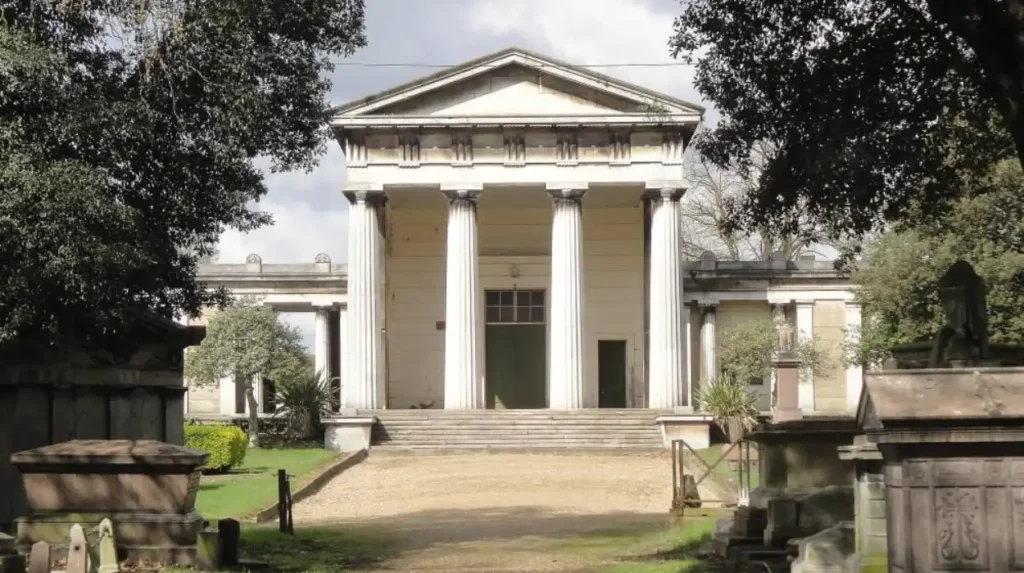
The cemetery was designed by Richard Forrest and developed with a formal architectural and landscape scheme. Its buildings included Greek Revival chapels, an entrance arch and catacombs. Historic England describes the cemetery as a working cemetery that remains in private ownership.
The site contains numerous listed monuments and historic structures. Its location beside the Grand Union Canal and Harrow Road also reflects the original relationship between Victorian cemeteries and the expanding western edge of London.
Brompton Cemetery
Brompton Cemetery opened in 1840 and was designed by architect Benjamin Baud. It occupies more than 39 acres and contains more than 205,000 burials and approximately 35,000 memorials.
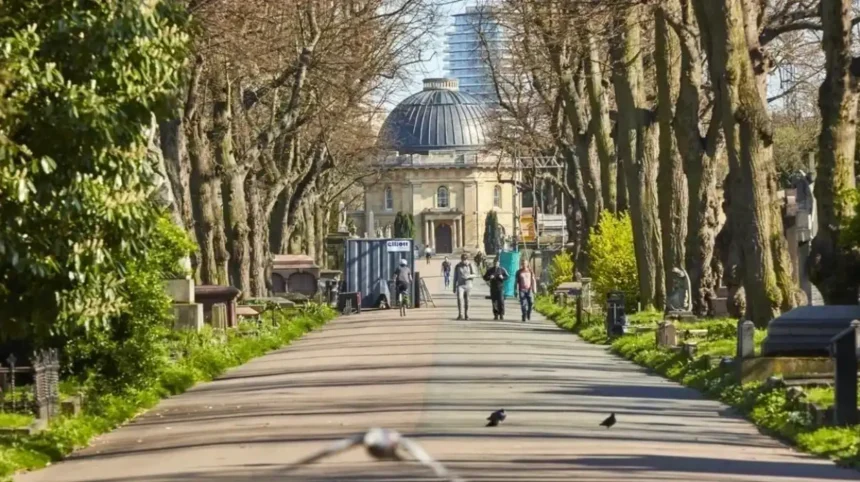
The cemetery is managed by The Royal Parks and remains a working cemetery. Its architecture includes the Central Avenue, Great Circle, colonnades, chapel and catacombs.
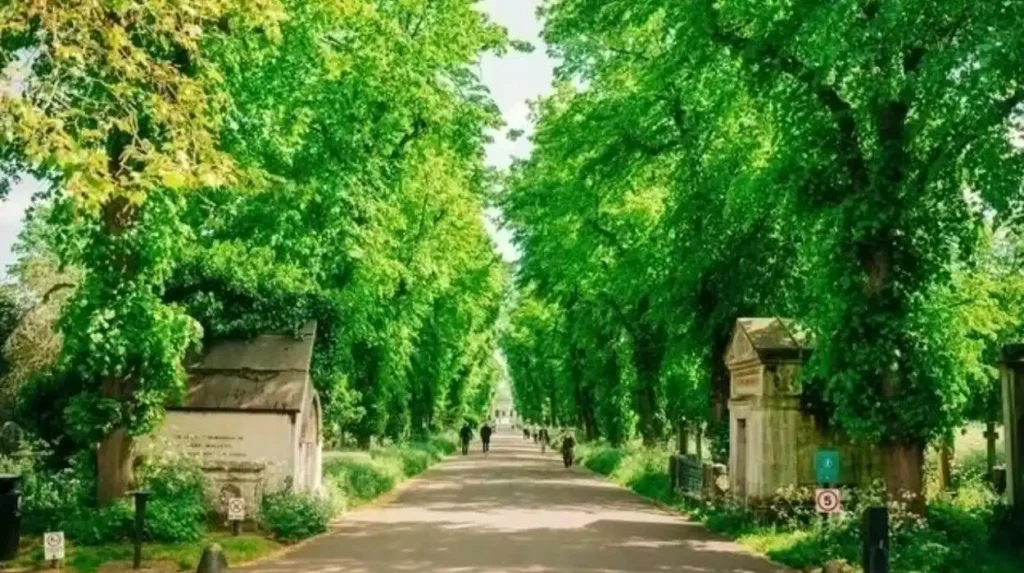
The Central Avenue measures approximately 600 metres and forms the principal axis of the cemetery. The avenue is lined with lime trees and leads toward the cemetery chapel.
Brompton also contains the graves of significant historical figures. Emmeline Pankhurst, the prominent suffragette leader, and physician John Snow are among the notable people associated with the cemetery.
Chiswick Old Cemetery
Chiswick Old Cemetery stands on Corney Road in Chiswick. Hounslow Council identifies it as a burial ground and churchyard within a conservation area. The 2026 management plan records historic tombs and graves, a First World War memorial and a network of paths.
The cemetery covers roughly 2.3 hectares according to the management plan. Its position between the A4 and River Thames places it within the historic landscape of Old Chiswick.
Gunnersbury and Hanwell cemeteries
Gunnersbury Cemetery and Hanwell Cemetery are important burial sites serving communities around Ealing and the surrounding western districts. Ealing Council identifies Gunnersbury Cemetery as being managed by the Royal Borough of Kensington and Chelsea. Hanwell contains cemetery sites under different administrative arrangements, including one managed by Kensington and Chelsea and another managed by Westminster.
How are West London cemeteries organised and managed?
West London cemeteries are managed by local authorities, private operators, religious organisations and other institutions. Management determines burial availability, grave rights, memorial rules, opening hours, record access, maintenance standards and arrangements for new interments.
Municipal cemeteries form a significant part of the burial infrastructure. Local authorities manage cemetery land, administer burial rights, maintain grounds and process applications for interments and memorials.
Ealing Council operates five council cemeteries: Acton Cemetery, Greenford Park Cemetery, Havelock Cemetery, Hortus Cemetery and South Ealing Cemetery. It also lists Gunnersbury Cemetery and Hanwell Cemetery as sites managed by other authorities.
Hounslow Council operates nine cemeteries. They include Bedfont Cemetery, Borough Cemetery, Chiswick New Cemetery, Chiswick Old Cemetery, Feltham Cemetery, Hatton Cemetery, Hounslow Cemetery, Isleworth Cemetery and New Brentford Cemetery.
The availability of new burial plots differs between sites. Hounslow currently identifies Hatton, Borough, Hounslow, Bedfont and Chiswick New cemeteries as sites where new burial spaces can be purchased. Feltham, Isleworth, New Brentford and Chiswick Old cemeteries are closed to new burials, although existing graves can be reopened for additional family burials under the relevant arrangements.
Brent Council manages cemeteries including Alperton Cemetery, Paddington Old Cemetery and Willesden New Cemetery. Its cemetery service also provides information about burial rights, interments, memorial permits and grave ownership.
Private historic cemeteries operate under different arrangements. Kensal Green is an important example. It remains privately owned and continues to operate as a working cemetery.
What types of burial and memorial spaces are available in West London?
West London burial sites contain traditional graves, lawn graves, cremated-remains plots, family graves, child burial areas, religious sections, memorial plots and historic mausoleums. Availability depends on the cemetery, available land, burial rights and local regulations.
A traditional grave normally allows a memorial structure or kerbed grave treatment. Hounslow Council provides traditional sections at sites including Bedfont Cemetery, Chiswick Old Cemetery, Feltham Cemetery, Hounslow Cemetery, Isleworth Cemetery and New Brentford Cemetery.
A lawn grave has a predominantly grass-covered surface and normally allows a headstone rather than a full kerbed enclosure. Hounslow identifies lawn sections at Borough Cemetery, Chiswick New Cemetery, Hatton Cemetery and New Brentford Cemetery.
Hounslow states that lawn graves can accommodate up to four full coffin burials, subject to ground conditions. Where further coffin burials are not required, up to eight sets of cremated remains can be interred in the grave under its stated arrangements.
Cremated-remains plots provide a separate form of interment. Ealing Council currently identifies new cremated-remains plots at Greenford Park, South Ealing, Acton and Hortus cemeteries.
Religious and cultural burial provision is also part of the West London cemetery system. Ealing Council identifies traditional Islamic burial provision, while Hounslow provides Muslim burial sections and same-day burial arrangements.
Memorials range from simple headstones to elaborate Victorian monuments, mausoleums, military memorials and cemetery chapels. Brompton alone has approximately 35,000 memorials.
How does a burial take place in a West London cemetery?
A West London burial normally involves arranging the funeral, confirming the cemetery and grave rights, completing required documentation, scheduling the interment, preparing the grave and recording the burial in the cemetery register. Specific procedures differ between operators.
The first step is identifying an appropriate cemetery and confirming that burial space is available. Existing family graves can have different rights from new graves.
A funeral director frequently manages the administrative process. Hounslow Council advises families using a funeral director to allow the funeral director to arrange the interment on their behalf.
Burial times are controlled by cemetery operating procedures. Hounslow, for example, specifies weekday interment periods that change between summer and winter, with separate arrangements for weekends and bank holidays.
Grave type also affects the memorial process. A newly buried grave requires time for the ground to settle before a permanent memorial is installed. Hounslow recommends a minimum period of 10 months after a full coffin interment before arranging a traditional memorial.
Burial rights are distinct from ownership of the physical cemetery land. A person holding exclusive rights to a grave has specific rights concerning interment and memorial arrangements, subject to the cemetery’s rules.
Brent Council states that burial rights are issued on a 50-year lease for its listed cemetery arrangements. Its charges distinguish between the right of burial and the actual interment fee.
How can you find a grave or burial record in West London?
Grave searches depend on the cemetery operator and the age of the record. Some West London burial registers are searchable online, while others require a formal request to a council or cemetery office using names, dates and other identifying information.
Brompton Cemetery provides an important example of accessible historical records. The Royal Parks has digitised burial information and provides a search facility using names and dates of death. Its historic burial books date from 1840.
Brompton’s burial registers up to 1997 are also held by The National Archives at Kew. Researchers can consult the records through the archive’s facilities.
Hounslow uses a different system. Its burial records are not available as a complete online public database. People searching for a burial must submit a genealogical burial search request. The cemetery team searches partly digitised records and older registers where necessary.
Richmond’s Old Mortlake Burial Ground provides another example. The council states that people who identify a person through its burial register search can contact the cemetery office for assistance in locating the grave.
Family-history researchers should record the full name, approximate date of death, residential address, religious affiliation and possible cemetery before starting a search. These details reduce the number of possible records and help cemetery staff locate older entries.
Historical maps, parish registers, civil registration records, cemetery registers and monument inscriptions provide complementary evidence. A single record often does not provide the complete history of an individual.
What makes West London cemeteries important for history and heritage?
West London cemeteries preserve evidence of Victorian urban growth, religious diversity, military history, migration, public health, architecture and social change. Their graves and monuments provide primary historical evidence about people and communities across several generations.
Kensal Green demonstrates how Victorian London responded to overcrowded churchyards. Its creation followed pressure for new burial capacity and the development of private cemetery companies. Historic England records the cemetery as an early large-scale commercial public cemetery.
Brompton demonstrates the architectural ambitions of the Victorian garden cemetery. Its formal Central Avenue, Great Circle, colonnades and chapel were designed as an integrated landscape. The site was deliberately constructed as both a burial ground and a landscaped environment.
Military history is another important theme. Brompton contains a Chelsea Pensioners memorial and military burial features. The cemetery also contains Commonwealth war graves.
Social history is visible through inscriptions, occupations, family relationships and memorial designs. Graves identify doctors, engineers, artists, soldiers, businesspeople, political activists, religious figures and other residents.
Brompton’s burial population also demonstrates London’s international connections. The Royal Parks records people from 40 different nationalities among the more than 205,000 people buried there.
Chiswick Old Cemetery provides a smaller-scale example of local heritage. Its historic tombs, graves, First World War memorial and relationship with Old Chiswick connect burial history with the development of the surrounding neighbourhood.
Cemetery architecture is also significant. Listed chapels, mausoleums, catacombs, gates, columns and memorial sculptures contribute to London’s architectural heritage.
How do cemeteries contribute to biodiversity and green space in West London?
West London cemeteries provide substantial green infrastructure through mature trees, grassland, flowering plants, hedges and undisturbed ground. These habitats support birds, insects, bats and other urban wildlife while preserving historic landscapes.
Brompton Cemetery demonstrates the ecological value of historic burial grounds. The Royal Parks identifies birds, butterflies, bats and beetles among the wildlife found there. Its mature lime trees provide nesting, roosting and feeding habitat.
The combination of trees, grassland, monuments and low-intensity land management creates habitat within a densely developed urban environment.
Chiswick Old Cemetery also incorporates wildlife management into its landscape. Hounslow’s 2026 management plan describes a mixture of amenity and rough grassland and records native fruit trees planted by volunteers.
Green space management must balance conservation with burial functions. Paths require maintenance, memorials require protection, grass requires cutting and graves must remain accessible to families.
Cemetery landscapes also contribute to urban cooling, rainwater infiltration and visual greenery. These functions become increasingly relevant as West London continues to experience residential development and higher land-use pressure.
The historical landscape itself requires protection. Mature trees and traditional planting patterns form part of the character of many Victorian cemeteries.
Why is burial space an important issue for West London?
Burial space is an important West London planning issue because available land is limited while demand for interment continues. Councils therefore manage existing graves, introduce different burial formats and consider long-term cemetery capacity.
Ealing’s infrastructure planning identifies cemetery capacity as a significant issue. Its 2024 infrastructure baseline recorded seven cemetery or churchyard sites covering 20.74 hectares and stated that the borough faced challenges meeting future burial demand.
Hounslow’s cemetery service also demonstrates how availability differs between sites. Some cemeteries remain open for new burial spaces, while others are closed to new graves but continue to support additional burials in existing family graves.
London’s land constraints make efficient cemetery management important. Cemeteries occupy land that also provides heritage, ecological and community value.
Grave reuse is one response to burial-space pressure. The Law Commission’s 2026 review states that grave reuse is already permitted in London local-authority cemeteries and certain other burial grounds under specific legal powers.
The Law Commission has recommended wider powers to reuse graves more than a century old, subject to government approval, consultation and stronger safeguards. These recommendations are not automatically law. Government consideration is required before the proposed reforms take effect.
The issue involves both land management and bereavement rights. Cemetery authorities must maintain accurate records and respect existing burial rights while planning for future generations.
What laws and regulations govern burial grounds in West London?
Burial grounds in West London operate under a mixture of national legislation, local authority rules, cemetery-specific legislation, religious law and contractual burial rights. The applicable framework depends on ownership, consecration, cemetery status and the type of proposed activity.
England’s burial framework contains legislation dating from different historical periods. The Law Commission’s 2026 review describes the system as fragmented, with different rules applying to local-authority cemeteries, Church of England burial grounds and private operators.
Local authorities also have statutory responsibilities. Section 46 of the Public Health (Control of Disease) Act 1984 requires a local authority to arrange burial or cremation where no suitable arrangements have been made for a person who died or was found dead in its area, subject to the legislation’s conditions.
Exhumation is separately regulated. The Law Commission’s final report states that exhuming a body generally requires a licence from the Ministry of Justice, while Church of England consecrated ground involves the ecclesiastical faculty system.
Cemetery operators also impose local rules covering memorials, grave maintenance, access, flowers, planting, vehicles and other activities.
For example, Brent Council regulates the dimensions and placement of memorials at Alperton, Paddington Old and Willesden New cemeteries.
Families should therefore consult the relevant cemetery authority before arranging a burial, memorial alteration, exhumation or transfer of burial rights.
Explore More Area Guide
Historic Churches in West London: St Mary, St Nicholas & More
Historic Houses in West London: Chiswick, Osterley & Syon
How are West London cemeteries likely to change in the future?
West London cemeteries will remain burial sites while increasingly serving heritage, biodiversity and community functions. Future management will focus on limited land, grave capacity, record keeping, conservation, religious provision and possible reforms to burial and cremation law.
The Law Commission published its final report on burial and cremation in March 2026. Its recommendations address burial-space shortages, grave reuse, consistent safeguards, written burial rights, record keeping and maintenance standards.
The Commission also published recommendations concerning new funerary methods. In England and Wales, burial, cremation and burial at sea remain the established regulated funerary methods, while newer methods such as alkaline hydrolysis and human composting require a future legal framework.
For West London, the immediate practical issues remain cemetery capacity and the management of existing sites.
Historic cemeteries also require conservation. Kensal Green’s Grade I registered status and extensive collection of listed monuments demonstrate the scale of heritage responsibility attached to Victorian burial grounds.
Brompton demonstrates how conservation can operate alongside active burial services. It remains a working cemetery while preserving its historic architecture, monuments, landscape and burial records.
The future of West London’s cemeteries therefore involves several connected functions. They must provide dignified burial services, preserve records, protect historic monuments, support biodiversity and manage scarce urban land.
What should visitors and researchers know before visiting a West London cemetery?
Visitors should check the cemetery operator, opening hours, access rules and burial status before travelling. Researchers should identify the correct cemetery authority and bring accurate names and dates when requesting grave locations or historical burial records.
Opening arrangements differ between sites. Brompton Cemetery currently lists pedestrian access from 7am to 6pm.
Hounslow states that its cemetery grounds are open every day and cemetery gates are kept open 24 hours a day, although individual administrative and burial services operate during specified hours.
Brent cemeteries use seasonal opening times. Alperton Cemetery, for example, has different closing times during winter and summer months.
Visitors should respect funerals, graves, memorials and religious practices. Historic monuments should not be climbed or touched unnecessarily. Photography should be conducted sensitively, particularly during funeral services.
Researchers should distinguish between a cemetery’s physical location and the organisation responsible for its records. A cemetery located in one West London borough can be managed by another authority.
The most reliable sources are the relevant council cemetery service, The Royal Parks for Brompton Cemetery, Historic England for designated heritage sites and The National Archives for historical records held in its collections.
West London’s cemeteries are therefore more than collections of graves. They are long-term records of the capital’s population, architecture, religion, public health, military history and urban development. Their continued management protects both burial services and a significant part of West London’s historical landscape.
What are the main cemeteries in West London?
The main cemeteries include Kensal Green Cemetery, Brompton Cemetery, Chiswick Old Cemetery, Chiswick New Cemetery, Gunnersbury Cemetery, Hanwell Cemetery, Acton Cemetery, Greenford Park Cemetery, Hounslow Cemetery and South Ealing Cemetery. These sites differ in age, ownership, burial availability and historical importance.