

West London contains a dense record of buildings that have disappeared through demolition, redevelopment, changing transport patterns and changing public demand. Former theatres, cinemas, sporting venues, industrial sites and entertainment buildings once shaped districts such as uk/local/ealing/">Ealing, Acton, hounslow/chiswick/">Chiswick, fulham/hammersmith/">Hammersmith and Shepherd’s Bush.
- What are the lost buildings of West London?
- Why did so many historic buildings disappear from West London?
- Which lost West London building was connected to the 1908 Olympics?
- What happened to the Hammersmith Palais?
- Why was the Chiswick Empire demolished?
- Which Ealing buildings have disappeared?
- What happened to lost cinemas in Acton?
- Which industrial sites have disappeared from West London?
- How can people research lost buildings in West London?
- Why do lost buildings still matter to West London’s heritage?
- What can the lost buildings of West London tell us about the future?
The surviving street pattern often gives only partial clues about these places. Some lost buildings have left a façade, a road name or a replacement development. Others survive only in photographs, planning records, architectural drawings, newspaper reports and local history archives.
The history of lost buildings is therefore also a history of how West London changed from Victorian and Edwardian suburbs into a modern part of Greater London.
What are the lost buildings of West London?
Lost buildings of West London are historic structures that have been demolished, substantially removed or replaced, including theatres, cinemas, stadiums, industrial buildings and entertainment venues that once shaped local communities and urban development.
A lost building does not always mean that every physical trace has disappeared. Ealing’s former Empire Cinema is an important example. The main cinema building was demolished in 2008–09, while its frontage was retained as part of the redevelopment site. Ealing Council records the cinema as having opened in 1934 and identifies the retained frontage as part of the site’s historic character.
Other buildings disappeared completely. The Chiswick Empire, a major variety theatre on Chiswick High Road, closed in 1959 and was demolished during the same year. The former theatre site subsequently received shops, offices and other commercial development.
West London’s lost architecture covers different periods and functions. Large entertainment venues are particularly well documented because they attracted substantial audiences and generated programmes, photographs, advertisements and licensing records. Smaller workshops, houses and commercial premises often have a weaker surviving documentary record.
The distinction between a demolished building and a surviving building with a changed use is important. A building such as the former Granada Cinema in Greenford survives physically but no longer operates as a cinema. Ealing Council records that the Granada opened in 1937 with 2,000 seats and later became a Tesco supermarket.
Lost-building research therefore considers both complete demolition and substantial architectural loss.
Why did so many historic buildings disappear from West London?
Historic buildings disappeared because West London experienced rapid population growth, redevelopment, changing entertainment habits, transport expansion, industrial restructuring, post-war planning and commercial pressure that made replacement buildings more attractive than older structures.
West London expanded dramatically during the Victorian period. Ealing Council records the construction of new roads, drainage infrastructure, schools and public buildings during this period. Charles Jones served as Ealing’s borough surveyor from 1863 to 1913 and designed important public buildings, including Ealing Town Hall.
The twentieth century introduced different pressures. Cinema changed theatre economics. Television changed cinema attendance. Private car ownership changed shopping patterns. Industrial employment moved away from established sites. Large-scale redevelopment replaced buildings that no longer fitted new commercial or planning requirements.
The Chiswick Empire demonstrates the entertainment transition particularly clearly. The theatre opened in 1912 as a variety and music-hall venue. It presented live entertainment, theatre, pantomime, opera and moving pictures. In 1932 it operated as a full-time cinema for one year before returning to variety entertainment. It closed permanently on 29 June 1959 and was demolished later that year.
Ealing’s former cinemas show a similar pattern. The council’s historic cinema records explain how television contributed to the decline of traditional cinemas during the 1950s and 1960s. The Granada Cinema in Greenford screened its final film on 15 September 1966.
Planning policy also affected the survival of older structures. Historic buildings without statutory protection were particularly vulnerable when their sites were considered suitable for new commercial, residential or infrastructure projects.
The modern conservation framework is stronger. Ealing Council states that demolishing, extending or altering a listed building requires the appropriate consent. Listed buildings are protected for architectural or historic interest, with Grade II representing the largest category of listed buildings nationally.
Which lost West London building was connected to the 1908 Olympics?
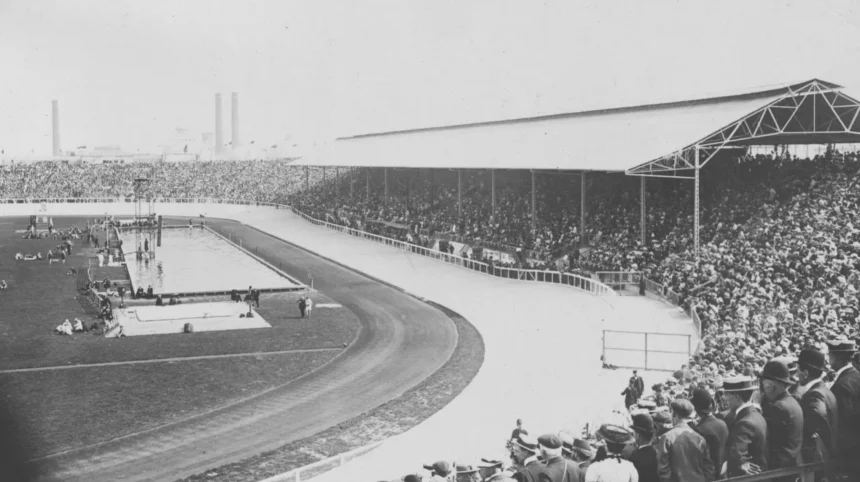
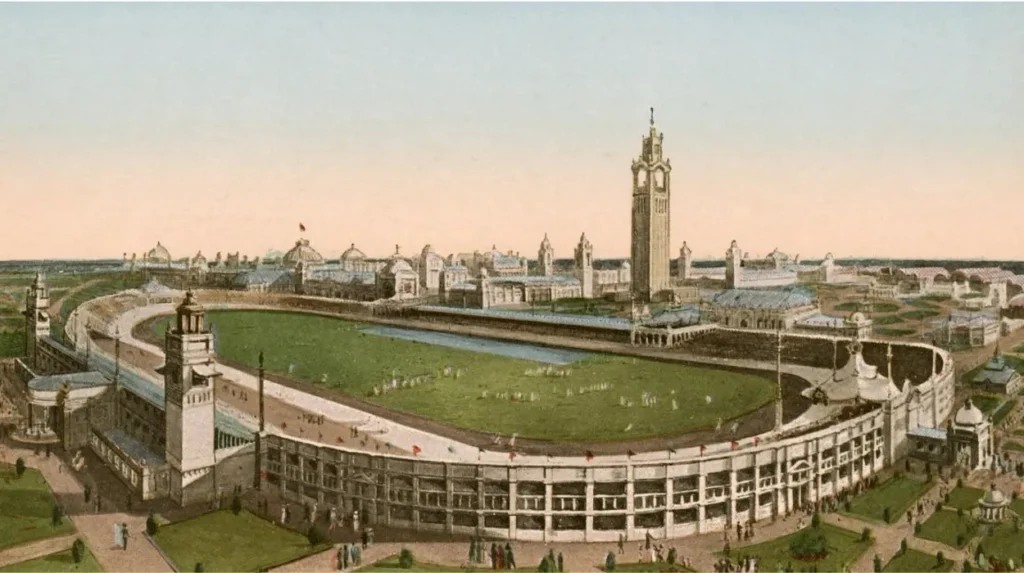
White City Stadium was West London’s most internationally significant lost sporting building. Built at Shepherd’s Bush for the 1908 London Olympics, it opened on 27 April 1908 and was demolished in 1985 after decades of sporting and entertainment use.
White City Stadium stood at Wood Lane in Shepherd’s Bush. The Olympic Studies Centre identifies it as the first purpose-built Olympic Stadium and records its construction for the 1908 Games. The stadium was completed in approximately ten months.
The 1908 Olympics created an important legacy for sport. The stadium contained an athletics track, swimming pool and cycling facilities, with additional areas for events such as wrestling and gymnastics. The Olympic programme involved 22 nations and 2,008 athletes.
The stadium also became associated with one of the defining moments in marathon history. The 1908 Olympic marathon distance was established at 42.195 kilometres, the distance now used as the standard marathon length. The race finished inside the White City Stadium.
White City Stadium remained useful after the Olympics. Its later history included athletics, speedway, boxing, concerts, football and greyhound racing. Historic England records its use for greyhound racing and its appearance during a 1966 World Cup tournament.
Queen’s Park Rangers also used White City Stadium for periods when the club played away from Loftus Road. Historic England records QPR’s spells at White City in 1931–33 and 1962–63 before the club returned to Loftus Road in 1963.
White City Stadium closed in 1984 and was demolished in 1985. The former stadium site forms part of the modern White City commercial district.
The loss demonstrates how a single West London building can have several historical identities. White City Stadium was an Olympic venue, football ground, greyhound stadium, athletics facility and entertainment venue.
What happened to the Hammersmith Palais?
Hammersmith Palais was a major dance and music venue on Shepherd’s Bush Road that operated from 1919 until 2007. The building was demolished in 2012 after its closure, ending an 87-year history of dance, popular music and entertainment.
Hammersmith Palais opened in 1919 as the Hammersmith Palais de Danse. Its location was 242 Shepherd’s Bush Road, close to the boundary between Hammersmith and Fulham and the wider Shepherd’s Bush area. The venue became one of London’s best-known dance halls.
The building’s cultural role changed over time. It functioned as a dance venue and later accommodated other forms of entertainment. During the 1930s it was also used as an ice rink. Its later decades were strongly associated with live music and nightclub culture.
The venue operated for 87 years. Its final period included concerts by artists and groups associated with the British live-music scene. The building finally closed in April 2007.
Demolition followed several years later. The Palais was demolished in May 2012 and replaced by a student accommodation development. A legacy wall incorporating historic visual material from the Palais remained associated with the replacement development.
The building is also significant in popular music history. Joe Strummer’s visit to the venue in 1977 influenced The Clash song “White Man in Hammersmith Palais”. The venue therefore survives in cultural memory even though its physical structure has disappeared.
Historic England’s Hammersmith and Fulham archive provides another important resource for researching this period. Its collection includes historic aerial photographs of Hammersmith, Shepherd’s Bush and White City, allowing researchers to compare earlier landscapes with present-day development.
The Hammersmith Palais illustrates the vulnerability of entertainment buildings when their original commercial function disappears. It also demonstrates why photographic archives matter when a building is demolished.
Why was the Chiswick Empire demolished?
The Chiswick Empire was demolished in 1959 after the decline of traditional variety entertainment. The Frank Matcham-designed theatre had opened in 1912 and hosted variety, music hall, theatre, cinema and other performances before its final closure.
The Chiswick Empire stood at 414 Chiswick High Road facing Turnham Green. Theatre architect Frank Matcham designed the building for theatre proprietor Oswald Stoll. It opened on 2 September 1912.
Frank Matcham was one of Britain’s major theatre architects. His work included theatres designed around large auditoriums, stage facilities, audience circulation and decorative interiors. The Chiswick Empire formed part of this early twentieth-century theatre-building tradition.
The venue had a large auditorium and presented a wide programme. Its entertainment included variety and music hall acts, plays, pantomimes, opera and moving pictures. In 1932 it became a full-time cinema for one year, but the experiment did not succeed and the building returned to variety entertainment.
The final performance took place in June 1959. Liberace was associated with the theatre’s closing programme. The theatre was then demolished in July 1959. An office block, shops and a supermarket were subsequently developed on the site.
The Chiswick Empire demonstrates a wider national change in entertainment. Purpose-built cinemas altered the economics of popular entertainment, while television later reduced the need for audiences to visit cinemas and theatres.
Theatres Trust records and specialist theatre archives are particularly valuable for researching demolished theatres. The University of Sheffield’s archive catalogue preserves Chiswick Empire material, including a 1914 programme.
The theatre’s physical disappearance did not eliminate its historical significance. Local history research continues to identify the building’s location, architecture, performers and relationship with Chiswick High Road.
Which Ealing buildings have disappeared?
Ealing has lost several important entertainment buildings, including the Broadway Palladium and most of the former Empire Cinema. These losses reflect the borough’s transformation from an early twentieth-century entertainment centre into a modern commercial and residential district.
Ealing’s history contains an unusually strong cinema and theatre tradition. The borough became known internationally through Ealing Studios and the films associated with Ealing’s post-war film industry. The town centre also contained several major entertainment buildings.
The Broadway Palladium
The site of today’s WH Smith on Ealing Broadway has a longer entertainment history. Ealing Council’s historical walking guide records that the Lyric Theatre occupied the site during the nineteenth century. It was followed by the Hippodrome cinema and later the Broadway Palladium.
The Broadway Palladium retained the appearance of a theatre until it was demolished in 1958. The present WH Smith building replaced it.
This example demonstrates how the same central site can move through several commercial identities while remaining part of the town’s principal shopping area.
The former Empire Cinema
The Empire Cinema opened in Ealing in 1934. Ealing Council identifies it as the fifth of six cinemas built in the town and records its distinctive frontage. The cinema closed before redevelopment, and the majority of the building was demolished in 2009.
Only the frontage was retained. The surviving façade is therefore an architectural fragment rather than a surviving cinema building.
The Empire site also illustrates the complexity of urban redevelopment. Planning applications proposed new cinema facilities and mixed-use redevelopment. The council’s planning documentation connected the site with broader plans for a film-focused cultural quarter and improved links around Ealing’s town centre.
The changing Ealing cinema landscape
Ealing’s cinema history also includes buildings that survived through conversion. The former Granada Cinema in Greenford opened in 1937 with 2,000 seats. Its last film was shown in 1966. The building subsequently became a Tesco supermarket.
The contrast between the Broadway Palladium, the former Empire and the Granada shows three different outcomes: complete demolition, façade retention and adaptive reuse.
What happened to lost cinemas in Acton?
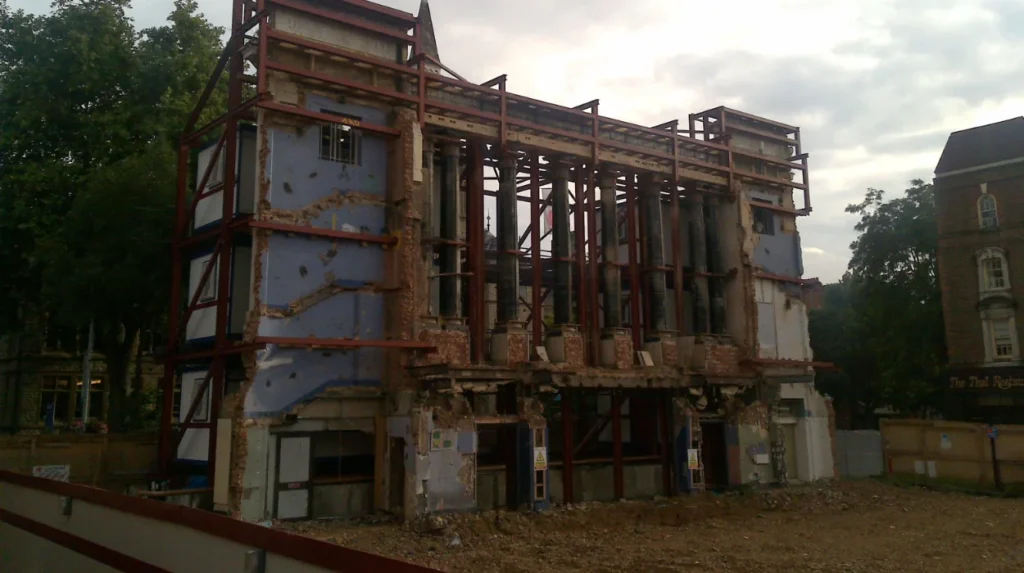
Acton lost several cinemas as local cinema-going declined and older buildings were converted, altered or demolished. The former Rex Cinema on Horn Lane is one documented example, opening in 1909 before later closure, conversion to offices and demolition in 2007.
The former Rex Cinema began as the Acton Cinematograph Theatre on 26 December 1909. It later operated under names including Acton Kinema, Carlton Cinema and Rex Cinema. The building originally contained a single auditorium with approximately 580 seats.
The building’s function changed before its final loss. It ceased operating as a cinema around the 1940s. Its frontage was altered, and the premises later served as offices.
The former cinema was demolished in 2007. Housing subsequently occupied the site.
Acton’s wider cinema history demonstrates how widespread the change was. Historical research records five local cinemas operating in Acton during the 1940s. Other buildings survived through conversion rather than demolition.
The Dominion Cinema is a different example. The building survives but no longer operates as its original cinema function. It demonstrates the importance of distinguishing between a lost building and a lost use.
Ealing Council’s wider historic-building resources show that local cinema history is an important part of the borough’s architectural record.
For researchers, cinema buildings are often easier to reconstruct than ordinary commercial premises because cinema operators produced advertisements, opening programmes, photographs and newspaper publicity.
Which industrial sites have disappeared from West London?
West London’s industrial landscape also contains major losses, particularly around Chiswick and the Great West Road. Shipbuilding, bus engineering and factory production once occupied sites that later became offices, housing, commercial premises or transport infrastructure.
Chiswick’s industrial history extended beyond entertainment. The Thornycroft shipyard operated beside Chiswick Mall and produced torpedo boats and destroyers. The site formed part of the district’s relationship with the River Thames and its industrial economy.
The Chiswick Bus Works became another major industrial site. From 1921, the works were associated with the overhaul of London’s bus fleet. Local historical research describes it as the largest employer in the district before its eventual replacement by modern development.
The Great West Road created another major industrial landscape. Factories developed along the road from the 1920s, including Art Deco industrial buildings associated with manufacturing and consumer industries. Many of these structures were later demolished or substantially altered.
Industrial buildings were particularly vulnerable because their original production requirements changed. Large floorplates, loading areas, industrial access arrangements and manufacturing equipment often became unsuitable for later commercial uses.
The loss of industrial architecture also removed evidence of employment history. A demolished factory does not only represent a missing building. It represents a missing workplace, production process and employment centre.
This makes industrial archaeology important for understanding West London’s development.
How can people research lost buildings in West London?
Researchers can reconstruct lost West London buildings through council archives, Historic England records, local history societies, historic maps, planning documents, newspapers, theatre collections, photographs and surviving architectural fragments at the original sites.
Historic England provides one of the most important national resources. Its Hammersmith and Fulham Local Heritage Hub includes historic aerial photography covering places such as Hammersmith, Shepherd’s Bush and White City. These photographs allow researchers to compare historic building footprints with present-day urban form.
Council archives are equally important. Ealing Council maintains local history material covering historic buildings, cinemas and the development of Ealing. Its historical walking guide identifies former buildings and explains how specific sites changed over time.
Planning records are especially useful for twentieth- and twenty-first-century losses. Ealing’s former Empire Cinema documentation records the cinema’s opening date, closure, demolition and façade retention.
Theatre archives provide another specialist source. The University of Sheffield’s archive catalogue holds a Chiswick Empire programme dating from 1914. Such material confirms the building’s operational history and the type of entertainment presented there.
Local history societies can provide detailed research unavailable in general architectural databases. The Brentford and Chiswick Local History Society has published historical research about the Chiswick Empire, including its demolition and subsequent redevelopment.
Historic photographs are also valuable. They reveal façades, shopfronts, street layouts, signs, entrances and surrounding buildings. Historic England’s archive provides extensive photographic material for West London.
Historic maps provide another layer of evidence. Comparing different editions can establish when a building appeared, changed function or disappeared.
Explore More Area Guide
West London Heritage Sites: Chiswick, Kew, Syon and Osterley
Cemeteries and Burial Grounds in West London
Why do lost buildings still matter to West London’s heritage?
Lost buildings matter because they explain how West London developed, reveal changing patterns of work and entertainment, preserve community memory and provide evidence for understanding architectural, social, economic and planning history.
A demolished building can remain historically significant even when no physical structure survives.
White City Stadium connects West London with the 1908 Olympics and the development of modern marathon standards. Hammersmith Palais connects Shepherd’s Bush Road with Britain’s dance and live-music history. Chiswick Empire records the rise and decline of large-scale variety entertainment. Ealing’s lost cinemas document changes in twentieth-century leisure.
Lost buildings also explain the present urban landscape. A modern office block can occupy the footprint of a theatre. A supermarket can replace a cinema. Housing can occupy a former entertainment or industrial site.
The absence of the original structure therefore becomes part of the area’s history.
West London’s heritage policy increasingly recognises that historic character involves more than individually listed buildings. Kensington and Chelsea’s conservation policy, for example, states that partial or full demolition of structures with architectural merit can cause irreversible damage to townscape character. It also identifies archaeological remains as a finite and fragile resource.
Ealing’s heritage guidance similarly distinguishes designated heritage assets from other historic buildings while emphasising the importance of appropriate conservation controls.
The study of lost buildings also supports better interpretation. Plaques, archive images, digital maps, heritage walks and local history publications can identify former sites without reconstructing buildings physically.
What can the lost buildings of West London tell us about the future?
West London’s lost buildings show that heritage protection, adaptive reuse, archival recording and sensitive redevelopment are essential for retaining historic character while accommodating new housing, employment, transport infrastructure and commercial development.
The history of West London’s lost buildings demonstrates that architectural survival depends on more than age. Function, ownership, planning policy, economic conditions and public recognition all influence whether a structure remains.
Some buildings survive because they receive statutory protection. Others survive because their original function can be replaced with a viable new use. The former Granada Cinema demonstrates adaptive reuse, while the former Ealing Empire illustrates façade retention after substantial demolition.
The strongest lesson comes from comparison. White City Stadium disappeared completely, but its Olympic significance remains extensively documented. Chiswick Empire disappeared physically, yet theatre archives preserve its programmes and history. Hammersmith Palais disappeared as a building, while photographs, recordings and cultural references continue to document its role.
Future redevelopment will continue to change West London. Housing demand, commercial redevelopment, transport investment and regeneration will place historic structures under continuing pressure.
Early documentation provides an important safeguard. Recording a building’s architecture, construction date, use, occupants and relationship with its surroundings creates a permanent historical record even when physical survival is impossible.
The lost buildings of West London are therefore not simply a catalogue of demolished structures. They form a record of urban change. From the Olympic stadium at White City to the Chiswick Empire, Hammersmith Palais, Ealing’s cinemas and Acton’s former picture houses, each site reveals a different stage in the development of West London.
What are the lost buildings of West London?
Lost buildings of West London are historic structures that have been demolished, substantially altered or replaced. They include theatres, cinemas, stadiums, industrial buildings and entertainment venues.