

Key Points
- Hundreds of pets and their owners came together at St John the Baptist, Holland Park in West London during the weekend of October 3 and 4, 2026.
- This yearly event is organized in honor of the Feast of St Francis and there have been dogs and cats of all types and sizes together with other pets.
- The event has gained exponential popularity, with the number of participants increasing from approximately 50 in earlier years to almost 400 people per day in 2026.
- As a result of the large crowds, four church officers have been needed for blessing, whereas there was only one in the earlier years.
- There have also been pet blessing ceremonies in other churches and cathedrals in the United Kingdom during the weekend, involving dogs, cats, rabbits, goats, and tortoises.
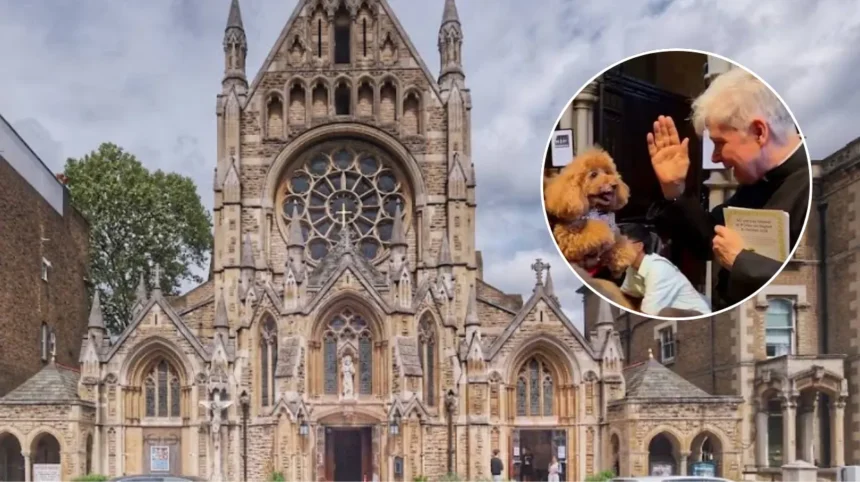
Holland Park (West London Times) October 6, 2026 — Hundreds of dogs, cats, and their devoted owners converged on a historic West London place of worship over the weekend, queueing both inside and outside the building for a special annual tradition. As reported by Véronique Hawksworth, AI Content Editor, and Lottie Vonhenning of My London and SWNS, crowds gathered at St John the Baptist in Holland Park on October 3 and 4, 2026, to celebrate the Feast of St Francis through a dedicated pet blessing service.
Why Did Hundreds of Pets and Owners Gather at St John the Baptist in Holland Park?
The annual celebration has evolved into a major community fixture, drawing substantial numbers of animal lovers from across the capital. Footage captured by dog lifestyle blog The Dogvine illustrated long queues of four-legged guests and their human companions waiting patiently both inside and outside the church sanctuary to receive their official blessing. While the service predominantly attracts dogs and cats of every conceivable breed and age, church representatives confirmed that an inclusive policy applies, stating that “all pets were welcome” to participate in the solemn yet joyful occasion.
The dramatic surge in attendance has caught the attention of organizers and local media alike. According to data shared with The Dogvine founder Teresa Keohane by the church, attendance figures have skyrocketed. As reported by Véronique Hawksworth and Lottie Vonhenning of My London, nearly 400 people attended the service on each day of the weekend—representing a massive increase from the roughly 50 visitors the event historically attracted in earlier years.
Explore more uk/local/hammersmith-and-fulham/hammersmith/">Hammersmith News:
Lebanese Taverna Express Licence Suspended After Enforcement Inspection West London 2026
Civic Campus Granted Late-Night Licence in Hammersmith 2026
How Has the Annual Pet Blessing Event Grown Over Recent Years?
The exponential rise in popularity has necessitated operational changes within the parish. In previous years when attendance hovered around 50 participants, a single church official was sufficient to conduct the blessings. However, as noted by My London, the scale of the 2026 gathering meant that four separate church officials were required to manage the crowds and ensure every animal received their individual blessing.
Reflecting on the remarkable expansion of the tradition, Teresa Keohane of The Dogvine stated to My London, “It’s grown over the years since I started sharing and promoting that the church does the pet blessings, and it really took off in 2024.”
Explaining her personal motivation for attending the annual gathering despite not being particularly religious, Teresa Keohane added,
“Before that, they used to only get about 50 people, so then they only needed one official to do the blessings, but as it’s grown considerably now, they have multiple. We’re not especially religious, but we come every year because it’s a chance to give thanks for the animals who give us so much, and simply because they deserve it.”
The phenomenon at St John the Baptist is part of a broader nationwide trend observed over the same weekend. Similar blessing services took place at churches and cathedrals across the United Kingdom, welcoming a diverse array of creatures including rabbits, goats, and tortoises, thereby highlighting the deep-rooted cultural and emotional bond between humans and their animal companions.
Background of the Particular Development
The tradition of blessing animals is deeply rooted in Christian history, closely associated with St Francis of Assisi, the patron saint of animals, ecology, and the environment, whose feast day falls on October 4. Historically, churches have opened their doors around this date to offer blessings to livestock, working animals, and household pets, acknowledging their vital role in human life and creation. Over recent decades, urban churches—particularly in cities like London—have revived and modernized this custom to reflect the changing nature of pet ownership, where companion animals are increasingly viewed as core members of the family. Events like the one at St John the Baptist in Holland Park have leveraged digital media platforms, lifestyle blogs, and community networks to transform localized religious customs into high-visibility public gatherings that draw hundreds of urban residents seeking communal spaces to celebrate their pets.
This ongoing trend toward community-centric, pet-inclusive religious and civic events is likely to have a noticeable impact on pet owners, local parishes, and urban animal welfare advocates. For pet owners and local communities in West London, the surging popularity of services at venues like St John the Baptist fosters stronger neighborhood ties and provides a unique outlet for animal appreciation outside of traditional commercial settings. For local parishes and religious institutions, embracing pet blessings offers a practical avenue for community engagement, drawing higher footfall and younger or non-traditional demographics through their doors. However, the rapid expansion also presents logistical challenges; parishes will likely need to implement advanced ticketing, timed entry slots, or crowd-management protocols in future years to safely accommodate hundreds of animals and owners within historic architectural spaces without causing undue stress to the participating pets.