


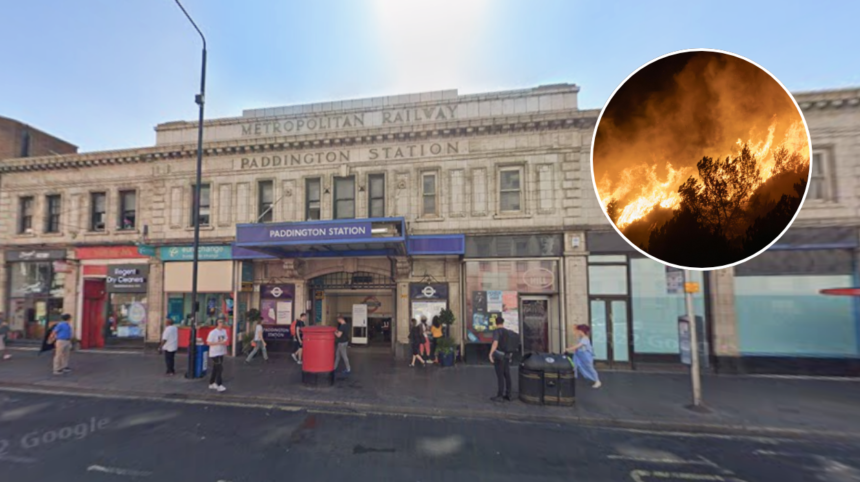
Key Points
- An electricity supply failure caused by a fire in the grass near the tracks in the Paddington London area resulted in the blocking of all the lines from Paddington to Heathrow Airport and Reading.
- According to the London Fire Brigade, six fire engines and about 40 firefighters were called to put out the fire near Scrubs Lane in North Kensington.
- National Rail stated that the electricity supply failure has blocked all lines, causing numerous cancellations and delays.
- Heathrow Express and Great Western Railway (GWR) services were badly affected, with GWR services to Reading cancelled or terminated early.
- The Elizabeth line between Paddington and Heathrow Terminals 4 and 5 and between Paddington and Reading was partially suspended by Transport for London (TfL).
- The emergency services managed to evacuate 380 passengers trapped on one of the trains of the Elizabeth line.
- Heathrow Airport advised passengers to give themselves additional time when traveling as there were some serious delays on the Piccadilly line as well.
London (West London Times) September 09, 2026 — A massive trackside grass fire near London Paddington caused severe disruption across critical rail links, halting services heading towards Heathrow Airport and western destinations. The blaze, which broke out on a Saturday afternoon, resulted in an overhead electricity supply failure that instantly paralyzed travel infrastructure, stranding hundreds of passengers and forcing multiple train operators to suspend operations.
What Caused the Major Disruptions Across London Paddington Train Lines?
As reported by GB News and the London Fire Brigade, the incident began shortly after 4:00 PM when a grass fire ignited near Scrubs Lane in North Kensington. The London Fire Brigade stated that six fire engines and approximately 40 firefighters were dispatched to tackle the escalating flames.
The fire caused severe damage to local infrastructure, leading to a critical loss of power to overhead power cables. National Rail stated that the resulting electricity supply failure left all lines between London Paddington, Heathrow Airport, and Reading completely blocked. According to updates provided by Great Western Railway (GWR), the fire brigade actively dealt with the hazard between London Paddington and uk/local/ealing/west-ealing/">West Ealing, forcing services to be halted, delayed, or terminated early at Reading.
Explore more West London Fire News:
Hounslow House Fire Murder Investigation: Woman Dies in West London 2026
Hounslow House Fire Murder Investigation Launched in West London 2026
How Were Heathrow Airport and Elizabeth Line Services Affected?
As reported by various outlets, the transport network serving west London suffered immediate gridlock. Heathrow Express confirmed that no trains were operating in either direction between Paddington and the airport terminals.
Transport for London (TfL) announced that the Elizabeth line experienced substantial suspensions, specifically between Paddington and Heathrow Terminals 4 and 5, as well as between Paddington and Reading. Additionally, the branch line running towards Abbey Wood suffered severe delays.
Adding to the commuter chaos, approximately 380 passengers were stranded on an Elizabeth line train caught near the danger zone. Fire crews were specifically called upon to assist in safely evacuating these passengers from the stalled carriages.
Heathrow Airport issued advisory statements urging passengers to allow extra time for their journeys. Travelers attempting to use alternative routes faced compounding misery, as the Piccadilly line—which also runs services to the airport—experienced severe delays following a separate trespasser incident at fulham/hammersmith/">Hammersmith.
In an update shared by GWR, services remained heavily disrupted for the remainder of the day, with network operators working closely with emergency response teams to extinguish the fire and restore power cables safely. Though services progressively resumed following the containment of the blaze, rail operators warned that lingering delays and repositioning issues could impact morning schedules.
Background of the Development
Trackside fires and infrastructure vulnerabilities during warm or dry periods have historically posed significant challenges to the United Kingdom’s railway network. The lines connecting London Paddington to Heathrow Airport and the Thames Valley represent one of the country’s busiest commuter and aviation corridors, carrying tens of thousands of passengers daily via the Heathrow Express, Great Western Railway, and the Elizabeth line.
Because modern high-speed and commuter trains rely entirely on continuous overhead electrical power systems or complex signaling tracks, localized environmental incidents—such as grass fires near embankments—can instantly cut power supplies. This latest event mirrors previous instances where minor brush or rubbish fires near urban rail corridors have escalated into major logistical crises, drawing immediate deployment from the London Fire Brigade and prompting calls for enhanced trackside vegetation management.
This unexpected transport shutdown directly impacts daily commuters, international travellers heading to Heathrow Airport, and leisure passengers travelling west toward Reading. In the immediate aftermath, thousands of travellers faced severe schedule backlogs, missed flights, and long queues, prompting airport authorities to reinforce advice for passengers to build substantial buffers into their travel plans.
Furthermore, the incident highlights ongoing operational resilience concerns for transport authorities like Network Rail and Transport for London (TfL). If infrastructure vulnerability to trackside environmental hazards is not comprehensively addressed, similar disruptions will continue to risk recurring economic friction, passenger safety hazards, and reputational strain on Britain’s primary rail corridors.