


Key Points
- Reduction in Total Numbers: According to the Metropolitan Police, the number of drug offences recorded in the capital decreased by 10.6 percent in the year before September 2026. London Now
- Total Monthly Numbers: The Metropolitan Police reported that there were a total of 4,324 drug offences recorded in London for the month of September 2026. London Now
- Borough Offences: Westminster was ranked highest on the list, having 445 drug offences recorded against the 247 recorded in Kensington and Chelsea. London Now
- Other High Offences: Croydon recorded 234 offences, followed by Newham (214), Tower Hamlets (207), Brent (205), Hackney (165), Enfield (163), and Lambeth (158). London Now
- Rate Disparities: Westminster also held the highest offence rate with 1.7 per 1,000 population, while Kensington and Chelsea followed closely with 1.6 per 1,000. London Now
- The Lowest Rate: Bexley, Ealing, Kingston upon Thames, Richmond upon Thames, and Sutton had the lowest rate in the city at 0.2 per 1,000 population, meaning Westminster was 8.5 times higher. London Now
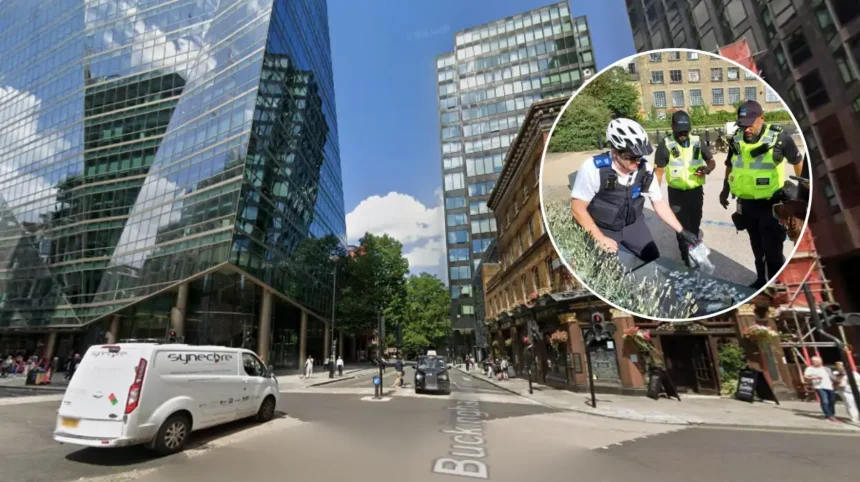
- Recent Operations: Among the Metropolitan Police operations in the last month were the discovery of hidden Class B drugs behind benches in Tower Hamlets on September 30, conviction of cocaine importers on September 26, and a drug raid resulting in the closure of a Kilburn snooker club and 10 arrests on October 9. London Now
London (West London Times) October 19, 2026 — Westminster recorded a drug offence rate more than eight times higher than five other London boroughs, even as wider figures across the capital showed an annual downward trend.
How Did London Boroughs Rank in Monthly Drug Offences?
As reported by Emily Elliott of The London Now, Metropolitan Police data shows that a total of 4,324 drug offences were recorded across London during September 2026. Leading the table, Westminster recorded the highest number of offences in the capital, with 445 incidents logged in total.
As detailed by Emily Elliott of The London Now, that figure was almost twice the 247 offences recorded in Kensington and Chelsea, which held the second-highest absolute volume across the capital. Further down the scale, Croydon recorded 234 offences, followed closely by Newham with 214, Tower Hamlets with 207, and uk/local/brent/">Brent with 205. Meanwhile, Hackney logged 165 offences, Enfield registered 163, and Lambeth recorded 158.
Why Does Westminster Stand Out on Drug Offence Rates?
Beyond raw volume, the disparity becomes sharper when evaluating population proportions. As highlighted by Emily Elliott of The London Now, Westminster stood out by recording the highest offence rate in the city, sitting at 1.7 offences per 1,000 people. Kensington and Chelsea closely followed at a rate of 1.6 per 1,000 residents.
By stark comparison, outer and suburban boroughs presented much lower proportions. As reported by Emily Elliott of The London Now, Bexley, Ealing, Kingston upon Thames, Richmond upon Thames, and Sutton each recorded a rate of just 0.2 offences per 1,000 people. This statistical gap puts Westminster’s recorded rate at an astounding 8.5 times the rate seen in those five combined boroughs.
Further contextualizing the geographical spread, Barking and Dagenham alongside Tower Hamlets each recorded 0.7 offences per 1,000 people, while Brent, Croydon, Hackney, Islington, and Newham each leveled at 0.6 per 1,000. These metrics underscore a marked difference in recorded drug offences across different municipal boundaries in London.
Explore more West London Crime News:
Trial Date Set for Man Accused of Murdering Mother in Hayes, West London 2026
Architect Simone de Gale Convicted Over Heathrow Flight Attack West London 2026
What Do Overall Capital Trends and Recent Police Operations Show?
Despite high concentrations in central tourist and residential hubs like Westminster and Kensington and Chelsea, the broader picture indicates progress in crime reduction. As noted by Emily Elliott of The London Now, the overall number of recorded drug offences fell by 10.6% across London over the 12-month period ending in September 2026 compared to the previous year. The dataset captures various classifications of drug infractions, prominently featuring drug possession offences as categorized in the official Metropolitan Police data dashboard.
Alongside statistical tracking, operational enforcement has remained active across the city’s neighborhoods. As documented by Emily Elliott of The London Now, police actions included an incident on September 30 where officers discovered a concealed stash containing a significant quantity of Class B drugs hidden behind benches in Tower Hamlets. Earlier in the month, on September 26, four members of an organized criminal network who plotted to import cocaine hidden inside frozen fish deliveries bound for a London market were handed prison sentences. Additionally, on October 9, a snooker club in Kilburn was legally ordered to remain shut following a targeted drug raid that resulted in 10 arrests.
Background of the Particular Development
The release of these Metropolitan Police figures forms part of routine monthly and annual crime reporting cycles used to evaluate public safety strategies across Greater London. Westminster and Kensington and Chelsea have historically experienced high volumes of recorded drug offences due to factors unique to central London districts, including high population churn, massive daily influxes of commuters and international tourists, nocturnal entertainment economies, and heavy proactive policing patrols. Conversely, outer boroughs like Bexley and Kingston routinely report lower volume and rate metrics due to differing demographic profiles and residential layouts. The 10.6% annual decrease aligns with ongoing localized Metropolitan Police initiatives aimed at cracking down on open-air drug dealing, county lines networks, and supply chains operating within the capital.
This development highlights persistent localized policing challenges that directly affect London residents, local business owners, and local authorities. For communities living in high-rate areas such as Westminster and Kensington, the concentration of drug offences can fuel secondary issues such as public antisocial behavior, street-level acquisitive crime, and safety concerns around public spaces. Conversely, the 10.6% city-wide fall indicates that targeted interventions and proactive drug raids—such as those recently executed in Kilburn and Tower Hamlets—are actively disrupting supply networks. Over the coming months, these figures will likely pressure local councils and borough commanders to reallocate resources toward hotspot zones, potentially shifting patrol strategies to protect vulnerable residential areas while managing the unique night-time economy pressures of central London.