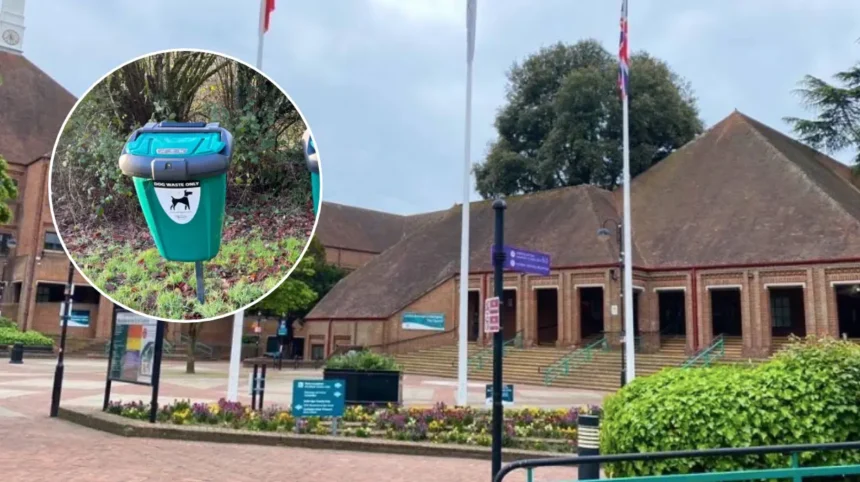
Key Points:
- Bin Removal: Removal of all 700 dog bins from the western London Borough of Hillingdon is scheduled as part of a cost-saving measure for the local authority.
- Savings: This policy is expected to save the local authority £160,000 per year, out of which £60,000 will be used for increased street cleaning.
- Shift in Disposal: The dog waste, which constitutes 14.5 tonnes per month, will now be disposed off through normal waste bins marked with “I can take dog waste too.”
- Lack of Public Consultation: No public consultation was held prior to implementing this decision, which was signed by the council officers.
- Residents’ Concerns: Ruislip Residents’ Association is worried about possible problems related to overflowing bins, as well as the lack of a map listing other disposal points.
- Mitigation Approach: Hillingdon Council has admitted the possible problems of increased dog fouling; however, it claimed that it will tackle this problem using appropriate signage and enforcement.
uk/local/hillingdon/">Hillingdon (West London Times) October 29, 2026 – Hillingdon Council has announced a controversial borough-wide cost-cutting measure that will see the complete removal of all 700 specialized dog waste bins across west London. The policy, designed to eliminate the need for a separate dog waste collection service, is expected to generate an annual saving of £160,000 for the local authority. While officials maintain that existing general waste infrastructure can adequately handle the additional 14.5 tonnes of canine waste produced monthly, community organizations have sharply criticized the lack of public consultation and warned of potential sanitation risks in local parks and walking paths.
Why Is Hillingdon Council Removing All 700 Dog Waste Bins?
The decision to decommission the borough’s entire network of specialized dog waste receptacles stems from an administrative review aimed at streamlining municipal expenditures. As reported by Philip James Lynch of the Local Democracy Reporting Service, Hillingdon Council stated that maintaining a separate, dedicated dog waste collection service is “no longer necessary” given that existing general waste bins can handle the volume.
The structural change is calculated to yield a total annual saving of £160,000. Out of this total, the local authority plans to channel £60,000 directly into bolstering general street cleaning operations across the borough. Council officers evaluated alternative approaches, including retaining all bins or selectively removing only those situated immediately adjacent to standard litter bins. However, these alternatives were ultimately rejected because maintaining any portion of the dedicated infrastructure would still necessitate funding a separate collection service.
To facilitate the transition, municipal workers will affix stickers reading “I can take dog waste too” onto standard litter bins located within local parks and popular dog-walking spots. These modifications are scheduled to take place prior to the phased physical removal of the specialized bins. According to an official council report, the policy was formally categorized as “the most effective and efficient option available to the council.”
How Has the Local Community Responded to the Bin Removal Plan?
The move has sparked immediate pushback from community stakeholders, particularly regarding the transparency and execution of the plan. As reported by Philip James Lynch of the Local Democracy Reporting Service, the Ruislip Residents’ Association highlighted on its website that “some of Hillingdon’s dog bins already overflowed under the current collection service.” Furthermore, the association noted that the council had failed to publish an accessible list or map detailing alternative bin locations for residents.
Critics have also voiced strong objections to the procedural path taken by local government officials. The cost-cutting plan was officially signed off without holding a formal public consultation, a shortcut that the Ruislip Residents’ Association openly criticized.
In response to concerns raised about public health and environmental maintenance, the council report acknowledged a tangible risk of an increase in dog fouling across the borough. Nevertheless, municipal authorities insisted that this risk can be successfully managed through targeted warning signs, public communication campaigns, and increased local enforcement measures.
Explore more Hillingdon News:
Hillingdon Council Removes All Dog Poo Bins To Save Money In 2026
Hillingdon Council Approves 70% Resident Parking Charge Hike in West London 2026
Background of the Development
The decision to eliminate dedicated dog waste infrastructure in Hillingdon reflects broader financial pressures facing local authorities across the United Kingdom amid tightening municipal budgets. Local councils are increasingly forced to re-evaluate specialized waste management services that operate independently of mainstream refuse collection. Historically, dedicated dog waste bins required distinct handling protocols and separate vehicle runs to satisfy strict sanitary and regulatory frameworks. By integrating canine waste into the general municipal waste stream—a practice already adopted by various other UK local authorities—councils aim to reduce duplicate logistical overheads. However, this administrative shift frequently intersects with long-standing community sensitivities regarding urban cleanliness, public hygiene standards, and the equitable allocation of council tax revenues toward neighborhood upkeep.
How This Development Can Affect Dog Owners and Local Residents
For dog owners and residents living across Hillingdon, the removal of all 700 specialized bins introduces immediate logistical challenges and cleanliness concerns during daily walks. Dog owners will now need to carry waste over longer distances to reach standard litter bins or transport it back to their private residential waste containers, which could inadvertently increase the incidence of discarded waste bags in public spaces if general bins become full. While Hillingdon Council intends to mitigate rising fouling rates through signage and enforcement, residents living near popular walking trails and parks may experience localized sanitation issues if the 14.5 monthly tonnes of waste strain existing general refuse capacity. Ultimately, the success of the transition will depend heavily on the effectiveness of the council’s proposed communication campaign and whether the reallocated £60,000 for street cleaning is sufficient to prevent environmental degradation in high-traffic neighborhoods.