Key Points
- Trial of New Measures: In response to the nationwide Fight Fly-Tipping Fortnight initiative, Wandsworth Council will trial the introduction of temporary warning signs in fly-tipping black spots, following clearing of the litter.
- Statements by Leaders: Speaking about the trial measures, Councillor Ethan Brooks, cabinet member for environment, stressed that the council would do everything possible in order to fight the offenders in the interests of law-abiding citizens.
- Steps Taken: The council plans to recruit more enforcement officers and draw up a borough-wide strategy.
- Cost to the Financial Bottom Line: According to Wandsworth Council, its primary street cleaning contract costs about £4 million each year, which is inclusive of cleaning up small fly-tipping sites.
- Context for Government Action: The Prime Minister Andy Burnham outlined plans by the government that include the National Crime Agency and Proceeds of Crime Act to force offenders to foot clean-up expenses.
- Scale of the Problem: Defra statistics indicate 1.26 million recorded cases of fly-tipping in England during 2024/25 (an increase of 9%), where the highest density is registered at 53 incidents per 1,000 people in London. Of interest is that Wandsworth was the area in London with the highest fly-tipping incidence in 2024.
- Illegal Waste Carriers: Keep Britain Tidy states that 38% of fly-tipping is associated with illegal carriers and rogue social media advertisements for waste removal services.
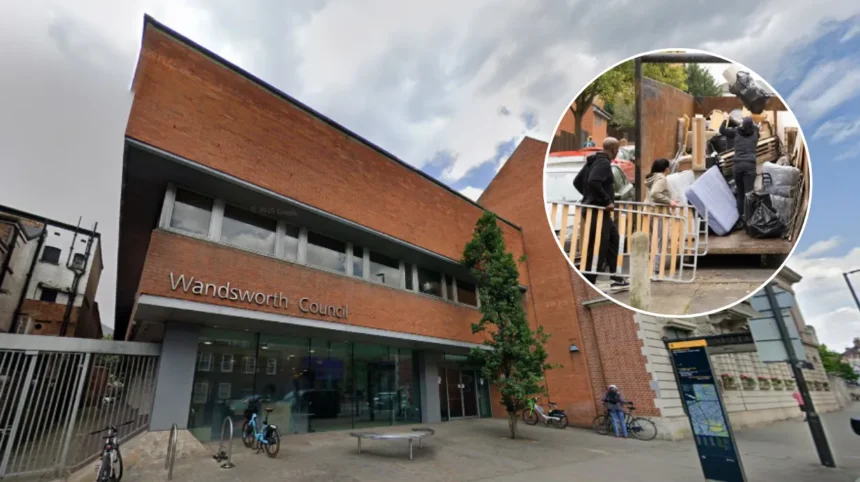
Wandsworth (West London Times) October 19, 2026 – Wandsworth Council has launched an aggressive series of localized trials and enforcement expansions to combat illegal waste dumping, coinciding with the nationwide Fight Fly-Tipping Fortnight initiative.
- Key Points
- How Is Wandsworth Council Responding To The Rising Threat Of Fly-Tipping?
- What Specific Enforcement Measures Are Being Implemented Locally?
- How Does Local Action Align With National Government Crackdowns?
- Background of the Particular Development
- How This Development Affects Residents and Local Businesses
How Is Wandsworth Council Responding To The Rising Threat Of Fly-Tipping?
As reported by Oliver Sandell of the South West Londoner, Wandsworth Council is stepping up its fight against illegal waste through a series of trial measures, including painting temporary warning stencils at chronic fly-tipping hotspots immediately after rubbish clearance.
The initiative forms part of Fight Fly-Tipping Fortnight, a two-week national campaign managed by the environmental charity Keep Britain Tidy to encourage active community and municipal involvement against illegal waste disposal.
Addressing the local impact of the crisis, Councillor Ethan Brooks, cabinet member for the environment, stated as reported by Oliver Sandell of the South West Londoner:
“Most residents take pride in keeping their neighbourhoods clean, and it is unfair that a small minority continue to blight our streets through fly-tipping. We are determined to use every tool available to prevent it.”
What Specific Enforcement Measures Are Being Implemented Locally?
To maintain pressure on offenders throughout the two-week campaign, Wandsworth Council confirmed it will actively share digital examples across social media channels highlighting individuals caught and fined for illegal dumping.
Furthermore, the local authority intends to expand its frontline presence by increasing the total number of enforcement officers. This expansion supports the development of a wider borough-wide strategy prioritizing targeted prevention, rapid clearance turnarounds, and measurable reductions in overall fly-tipping volumes.
Operating these street-cleaning services places a heavy financial weight on local taxpayers. According to council figures highlighted by Oliver Sandell of the South West Londoner, the primary street-cleaning contract totals roughly £4 million every year, a figure inclusive of removing small-scale fly-tips.
How Does Local Action Align With National Government Crackdowns?
The local measures in South West London run parallel to wider national efforts targeting waste crime. In August, Prime Minister Andy Burnham outlined plans to involve the National Crime Agency in tracking down organized waste criminal networks, alongside utilizing the Proceeds of Crime Act to compel offenders to fund clean-up operations.
Keep Britain Tidy data indicates that roughly 38% of fly-tipping incidents connect directly to unlicensed operators. These rogue operators frequently use social media platforms to advertise cheap rubbish removal services before illegally abandoning the waste.
Statistical insights from the Department for Environment, Food and Rural Affairs (Defra) show that England recorded 1.26 million fly-tipping incidents during 2024/25, marking a 9% increase compared to the previous year. Urban centers experience significantly higher concentrations; London registered an average rate of 53 incidents per 1,000 residents, contrasting sharply with the broader English average of 21 per 1,000. Within the capital, Wandsworth recorded the highest absolute number of fly-tipping incidents of any London borough in 2024.
Despite the scale of the challenge, Wandsworth Council has maintained that it will pursue persistent offenders relentlessly.
Explore more uk/local/west-london-council/">West London Council News:
Council Faces Mounting Costs Over Closed Depot in West London 2026
Council Staff Used Credit Card for Personal Purchases, West London 2026
Background of the Particular Development
The escalation of anti-fly-tipping measures in Wandsworth reflects mounting pressure on local authorities across England to address soaring municipal waste crime. Over recent years, illegal dumping has transformed from a low-level nuisance into a sophisticated, multi-million-pound illicit enterprise often driven by unlicensed operators avoiding commercial disposal fees. With London consistently reporting higher incident rates per capita than the rest of the country—and boroughs like Wandsworth handling peak volumes of discarded rubbish—traditional cleanup models relying solely on reactive removal have proved financially unsustainable. The integration of local council deterrence campaigns like Fight Fly-Tipping Fortnight with national legislative frameworks, such as asset seizure and National Crime Agency involvement, represents a coordinated shift toward intercepting waste criminals at both the grassroots and organized network levels.
How This Development Affects Residents and Local Businesses
For the residents and legitimate business owners of Wandsworth, this intensified crackdown promises cleaner neighborhoods, reduced environmental blight, and a fairer distribution of civic maintenance costs over the long term. By deploying visible deterrents like warning stencils, increasing enforcement officer patrols, and publicising fines, the council aims to create a strong psychological and legal barrier against casual dumpers and rogue traders. While households seeking cheap waste disposal must exercise increased caution to verify that their chosen contractors are fully licensed—thereby avoiding indirect complicity and potential fines—the ultimate outcome should relieve local communities of the persistent eyesores and public health hazards associated with high-density urban waste dumping.