


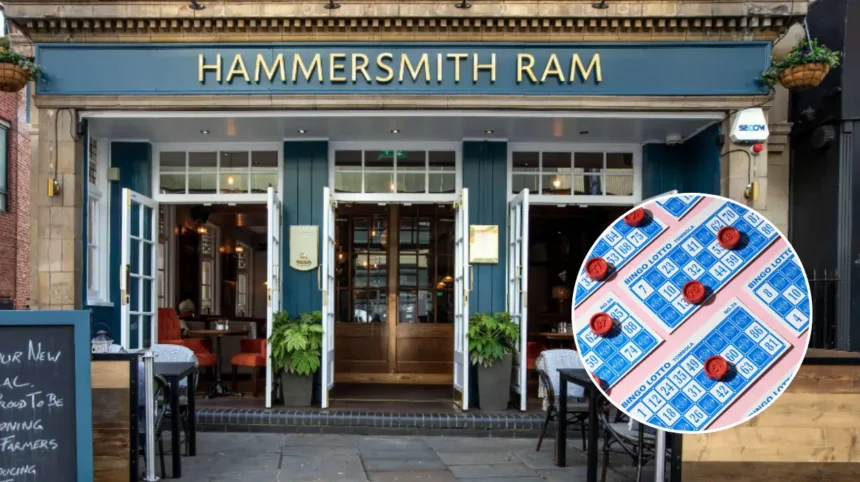
Key Points
- The famous pub Hammersmith Ram on King Street, West London, was closed in July after its owner Young & Co’s Brewery Company sold it to Hammersmith Realty Ltd, owned by Arora Family.
- However, just weeks later, the place opened up without permission as a discount store and this raised concern amongst the locals, councillors and the Hammersmith and Fulham Council.
- A real estate firm LCE Property has put forward a proposal to the council, filed on September 14, to convert the venue into a Bingo hall stating that it would be a “social hub.”
- “LCE’s Mohan Sidhu informed Local Democracy Reporting Service (LDRS) that this venue is not going to be converted into an Adult Gaming Centre (AGC) and that they would like to seek an alcohol license.”
- “According to Arora Family, the occupant of the discount store had been put there temporarily due to the squatter’s issue and they might have exceeded the terms of their contract by opening a discount store.”
- “The deadline given to Arora Family by Hammersmith and Fulham Council is September 22 to sort out the unauthorized use of the premises or face possible enforcement.”
- “Hammersmith Broadway councillors Callum Nimmo and Molly Mantle have organized a petition in order to save the local pub, wondering how this unauthorized store operation can happen without consultation of locals.”
- “Similar conversions have been planned elsewhere by LCE Property; according to Southwark News, a plan to convert a closed Peckham Wetherspoon’s into a bingo hall was recently made.”
uk/local/hammersmith-and-fulham/hammersmith/">Hammersmith (West London Times) September 21, 2026 — As reported by Ben Lynch of My London, the historic Hammersmith Ram pub on King Street faced an unexpected fate after being sold in July by its previous owner, Young & Co.’s Brewery, to Hammersmith Realty Ltd, a subsidiary of the Ealing-based property firm Arora Family. Within weeks of its closure as a centuries-old watering hole, the building reopened under the banner of a ‘Discount Store’ entirely without the necessary planning permission.
This swift transformation sparked immediate consternation and pushback among local residents and community representatives. Consequently, Hammersmith and Fulham Council intervened, writing directly to the Arora Family regarding the breach and setting a strict response deadline of September 22, warning that failure to comply could result in formal enforcement action.
Addressing the unauthorized shop setup, a spokesperson for Arora Family stated to the LDRS that the current occupier had been introduced on a temporary basis only after squatters had moved into the vacant property. The spokesperson added that it appeared the temporary occupant had “acted outside the terms of the agreement by running the premises as a shop.”
What are the details of LCE Property’s proposal to turn the site into a bingo hall?
As first reported by local publication Hammersmith Today, a fresh twist emerged when the real estate company LCE Property filed an official application with the council—registered on September 14—to reimagine the King Street premises as a bingo hall. A public consultation regarding this proposal is scheduled to run until October 14.
According to the official submission documents, the project claims it will “attract patrons of all ages and should be seen as a community orientated venue.” The application further states:
“Beyond the gambling aspect, these venues act as vital social hubs that encourage local interaction, build relationships, and help reduce loneliness for participants. It reuses commercial floor space, causes no unacceptable amenity impacts and enhances vitality and viability in our ever declining high streets.”
Mohan Sidhu, a Director at LCE Property, told the LDRS that the design aims to preserve the character of the building, stating: “We still want to keep that same look, same everything…[but] it’s more of a leisure thing.” Furthermore, Mr Sidhu confirmed that there are intentions to apply for an alcohol licence if the bingo hall proposal gains approval. Addressing concerns about loopholes where venues operate as Adult Gaming Centres (AGCs) instead of traditional bingo halls—as seen in areas like Brent—Mr Sidhu assured that this practice will not happen at the King Street location.
How does this development align with the property owner’s stated intentions?
The submission of the bingo hall application appeared to run counter to earlier statements issued by the Arora Family. Previously, the company indicated to the LDRS that its core intention was to retain the historic building as a pub over the long term and find a suitable operator.
When questioned by the LDRS regarding how LCE’s proposal aligns with those previous comments, a spokesperson for Arora Family clarified their current position:
“Due to the ongoing issues with the current tenant, we are now actively considering operators who may take over the ground-floor premises.”
The spokesperson emphasized:
“Our position is that any future occupier will be required, under their agreement with Hammersmith Realty Limited, to operate strictly within the planning permissions and permitted uses authorised by Hammersmith and Fulham Council. We will not authorise any occupier to operate outside the lawful planning use of the premises.”
They reiterated openness to discussions with suitable operators, adding:
“As previously stated, our objective is to secure a suitable and sustainable long-term operator for the premises, with any future agreement making it expressly clear that the property may only be used in accordance with the permissions granted by the council.”
Explore more Hammersmith News:
Hammersmith Office Block Replaced With Student Flats, Hammersmith 2026
Historic Smuggled Pipe Organ Restored in Hammersmith 2026
What is the community response and broader context surrounding these venue conversions?
In response to the rapid sequence of events, Hammersmith Broadway councillors Callum Nimmo and Molly Mantle took swift action by launching a community petition aimed at officially reopening the Hammersmith Ram as a traditional pub.
Highlighting the community’s frustration, Cllr Molly Mantle stated:
“Pubs are a cornerstone of our community, and their status is protected. So as soon as we saw what happened, we asked, ‘was there planning permission?'”
Adding to this critique, Cllr Callum Nimmo remarked:
“The answer: no planning application had been made. So we’re asking, how did this happen, and why weren’t local people given a say?”
This local controversy forms part of a wider commercial trend across the capital. Highlighting parallel developments, Southwark News reported last week that a Peckham Wetherspoon’s had closed permanently, with LCE Property plans to convert that particular venue into a bingo hall also actively under consideration.
Background of the particular development
The transformation of the Hammersmith Ram reflects broader structural pressures facing traditional British public houses and high street retail spaces across urban centers like London. Over recent years, shifting consumer habits, rising operational and energy costs, and corporate restructuring by major brewing groups—such as Young & Co.’s Brewery—have led to the sale and closure of numerous historic community pubs.
When properties change hands rapidly between corporate landlords, interim periods of vacancy often invite informal or unauthorized commercial uses, ranging from short-term retail pop-ups to squatting issues. Concurrently, alternative leisure operators, including commercial bingo and gaming ventures represented by firms like LCE Property, increasingly target vacant high street assets to capitalize on changing municipal zoning trends and commercial demand for experiential leisure venues over traditional retail or hospitality.
This planning application and the wider controversy surrounding the Hammersmith Ram are likely to intensify scrutiny from local authorities over temporary commercial tenancies and unauthorized changes of use in West London. If Hammersmith and Fulham Council enforces strict adherence to local planning frameworks by the September 22 deadline, it could force property holders like the Arora Family to accelerate formal, transparent consultations with licensed hospitality operators rather than interim retail tenants.
For the local community and patrons who signed the councillors’ petition, this development underscores a protective pushback against the erosion of traditional community spaces. However, if the bingo hall proposal successfully navigates the public consultation running until October 14, it could set a prominent precedent for how shuttered historic pubs across London are repurposed into modern leisure hubs, permanently altering the hospitality landscape of high streets like King Street.