


Key Points
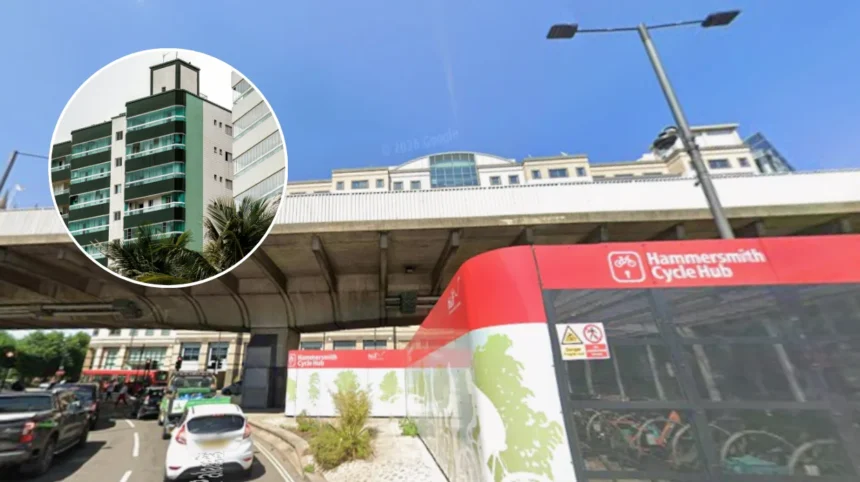
- Location of Project: The project will take place in the area situated at 1-3 Sussex Place, next to the Hammersmith Flyover and across St Paul’s Church in West London.
- Core Proposal: A redundant 1980s, eight storey office block will be demolished and rebuilt into a new 14 storey PBSA building.
- Yield of Housing: There will be 291 bed spaces in the new tower, consisting of 147 cluster bedrooms, 115 studio bedrooms and 29 accessible bedrooms (with 10% accessible units).
- Affordable Housing and Nominations: 35% of the entire unit will be designated as affordable housing. Imperial College London has signed a deal for taking 51 per cent of the total bed spaces, which include all affordable units.
- Planning Approval: The scheme has been granted unanimously by the Planning and Development Control Committee of Hammersmith and Fulham Council after a recommendation for approval by council officers.
uk/local/hammersmith-and-fulham/hammersmith/">Hammersmith (West London Times) September 17, 2026 — A 1980s office block situated by the Hammersmith Flyover is scheduled for total demolition to make way for a 291-bed student housing scheme housed within a new 14-storey building. Local planning chiefs officially cleared the project during a committee meeting, ensuring that 35 per cent of the incoming accommodation units will be classified as affordable housing.
The existing structure, positioned opposite St Paul’s Church, has been labeled as “outdated” within formal planning documentation. As reported by Ben Lynch of MyLondon, the eight-storey building is currently part-occupied by Notting Hill Genesis but is soon to be completely vacated. Elaborating on the deficiencies of the site, planning consultants at Boyer, acting on behalf of applicant McLaren Property, wrote in submitted documents that “the existing building has a dated, poor quality and unattractive interior and exterior and is not fit for modern office needs”. They further noted via statements reported by Ben Lynch of MyLondon that the structure “is currently partly occupied by Notting Hill Genesis but is in need of comprehensive refurbishment, as outlined within the submitted letter from Hanover Green” and “does not relate successfully to the surrounding grain and townscape”.
Ahead of the local authority’s Planning and Development Control Committee meeting, Hammersmith and Fulham Council officers formally recommended the application for approval. As highlighted by Ben Lynch of MyLondon, council officers stated that the scheme provides a vital opportunity to regenerate the brownfield site and deliver necessary student housing provisions, which have grown increasingly critical due to the continued expansion of Imperial College. Statistical data referenced during the planning process indicates that approximately 64 per cent of students residing within the borough currently depend on private houses of multiple occupation (HMOs) for their term-time accommodation.
Explore more Hammersmith News:
Historic Smuggled Pipe Organ Restored in Hammersmith 2026
Council Probes Unauthorised Discount Store at Hammersmith Ram in 2026
How did local planners and university representatives respond to the proposal?
During the public consultation phase preceding the committee’s final determination, only three formal representations were submitted, consisting of two objections. As detailed by Ben Lynch of MyLondon, the primary concerns raised by local respondents centered on the overall scale of the proposed 14-storey development and potential noise impacts on the immediate vicinity.
Addressing the committee directly, Grant Leggett, Executive Director at Boyer, confirmed that the applicant engaged extensively with major higher education institutions, noting that Imperial College “fully supports” the introduction of student accommodation at the Sussex Place location. As reported by Ben Lynch of MyLondon, Grant Leggett emphasized that a formal nomination agreement has already been executed with the university, ensuring that
“Imperial will take 51 per cent of the bed spaces including all of the affordable provision”.
During committee discussions, local representatives raised specific operational questions regarding the scheme. Cllr Callum Nimmo, serving as the Hammersmith Broadway ward representative, questioned potential issues involving anti-social behaviour (HTA/ASB) and mounting pressures on local parking infrastructure. While acknowledging that the building will operate under a strict car-free policy, Cllr Nimmo noted that temporary congestion could still arise during peak student move-in and move-out windows. In response, council planning officers assured committee members that targeted mitigation strategies are planned to manage potential anti-social behavior, while parking restrictions will be rigorously enforced locally due to the development’s car-free design. Following these evaluations, the planning application was unanimously approved by the committee.
Background of the Particular Development
The approval of the 14-storey student accommodation block at 1-3 Sussex Place arrives against a backdrop of intensifying pressure on the private rental market across outer London boroughs. For years, higher education institutions such as Imperial College London have experienced steady growth in student enrollment, outstripping the supply of university-managed halls. Consequently, a vast majority of students have been forced to compete for private housing via Houses of Multiple Occupation (HMOs), driving up rental costs and creating supply bottlenecks.
Local authorities, including the London Borough of Hammersmith and Fulham, have increasingly sought to allocate underutilized or functionally obsolete 1980s commercial office spaces near major transport interchanges—such as the Hammersmith Flyover corridor—for high-density, sustainable Purpose-Built Student Accommodation (PBSA). This policy shift aims to funnel student populations into managed, purpose-built environments while simultaneously easing the strain on family-sized private rental housing stock within the local community.
The replacement of the obsolete office block with 291 modern student flats is poised to generate notable shifts for multiple groups within the local ecosystem. For prospective and current students attending institutions like Imperial College London, the development introduces a secure, highly accessible housing option equipped with contemporary amenities, with over a third of the rooms ring-fenced as affordable units. This directly mitigates severe cost-of-living and accommodation-finding pressures for lower-income students.
Conversely, for local Hammersmith residents and neighborhood associations, the physical transformation of the site into a 14-storey tower will permanently alter the immediate townscape silhouette near St Paul’s Church and the flyover. While the car-free status of the building aims to prevent permanent vehicular congestion, local residents may experience temporary disruption during the multi-year construction phase, alongside localized footfall changes once the building reaches full occupancy ahead of the academic cycle.