

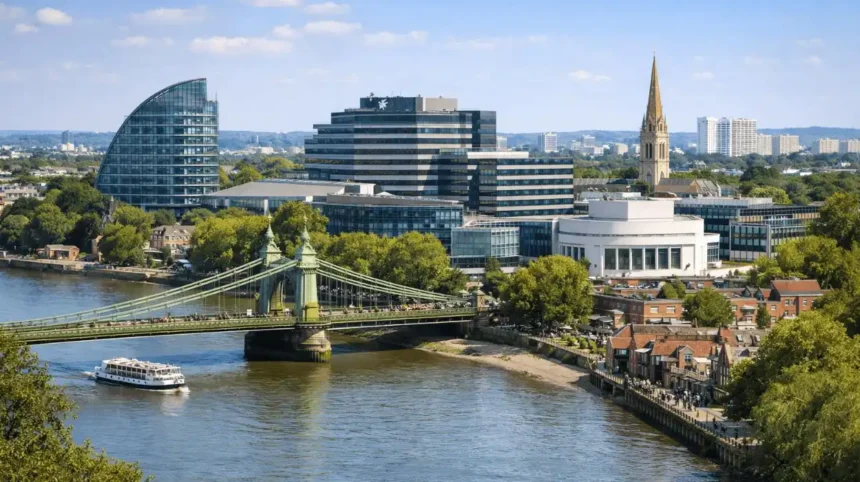
West London is a major commercial zone containing established town-centre offices, innovation clusters, industrial estates, airport-related businesses and regeneration areas. Key districts include uk/local/hammersmith-and-fulham/hammersmith/">Hammersmith, White City, hounslow/chiswick/">Chiswick, Brentford, Park Royal, brent/wembley/">Wembley, Uxbridge, Hayes, Heathrow and Old Oak. London planning policy identifies several of these locations as strategic economic clusters or Opportunity Areas.
- What are the main business districts in West London?
- Why is West London important for business?
- What makes Hammersmith a major business district?
- Why is White City an important business and innovation district?
- What is the role of Chiswick Business Park?
- How important is the Great West Road and Brentford business corridor?
- What role does Park Royal play in West London’s economy?
- Why is Old Oak becoming a major West London business district?
- What business role does Wembley play in West London?
- What business activities are concentrated around Uxbridge?
- Why is Hayes important for business and industry?
- How does Heathrow influence West London business districts?
- How are West London business districts connected?
- Which industries are strongest across West London?
- How is West London’s business landscape changing?
- What is the future outlook for West London business districts?
What are the main business districts in West London?
West London’s main business districts include Hammersmith, White City, Chiswick, Brentford, Park Royal, Wembley, Uxbridge, Hayes, Heathrow and Old Oak. These districts support office employment, technology, life sciences, media, logistics, aviation, manufacturing and professional services across the sub-region.
West London does not operate as one single central business district. Its commercial economy is distributed across interconnected locations with different economic roles.
The London Plan identifies the Heathrow Economic Area, White City, Great West Road and Chiswick Business Park among important economic clusters. Heathrow covers parts of Hillingdon and Hounslow and specialises in aviation, logistics, industrial activity and technology. White City has strengths in health, life sciences, media and technology. Great West Road has media, industrial and creative-industry activity.
This decentralised structure gives West London a broad employment base. Office districts sit alongside industrial estates, research campuses, retail centres, transport hubs and airport-related commercial areas.
The result is a business geography that extends from the western edge of central London towards Heathrow, Uxbridge and the wider Thames Valley.
Why is West London important for business?
West London is important because it combines central-London connectivity with Heathrow Airport, major transport corridors, universities, research institutions, industrial land and established commercial centres, creating a diverse economic base that serves London, the UK and international markets.
Transport is a defining feature of West London’s commercial geography. The area is served by the Underground, Elizabeth line, National Rail, major roads and Heathrow Airport.
The Elizabeth line provides direct connections between western locations and central London. Heathrow provides international aviation connectivity, while major road corridors support freight, distribution and business travel.
West London also contains substantial strategic employment land. London planning documents group many industrial locations under the Park Royal/Heathrow industrial market area. These include Park Royal, Great West Road, Hayes Industrial Area, North Uxbridge Industrial Estate, Uxbridge Industrial Estate, ealing/northolt/">Northolt, Greenford and Perivale.
The economic structure therefore extends beyond conventional office districts. Warehousing, advanced manufacturing, logistics, research, technology and airport services form an important part of the regional economy.
What makes Hammersmith a major business district?
Hammersmith is a major West London business district with offices, professional services, media, technology, retail and transport infrastructure. Hammersmith town centre also functions as a strategic commercial location within the wider Heathrow and Elizabeth line west growth corridor.
Hammersmith is one of the most established commercial centres in West London. Its location between central London and Heathrow gives it strong strategic connectivity.
Hammersmith Broadway and Hammersmith station form an important transport interchange. London Underground services connect the district with central and western London, while nearby roads provide access to wider West London employment areas.
The borough also supports specialist commercial activity. Hammersmith & Fulham identifies business development, entrepreneurship, skills and employment as important elements of its economic strategy. The borough also identifies White City Innovation District as a strategic business area.
Hammersmith’s business environment includes offices, restaurants, shops, hotels and services that support workers and visitors.
Its position between established central-London markets and West London growth areas gives the district an important intermediary role.
Why is White City an important business and innovation district?
White City is a major West London innovation district specialising in life sciences, healthcare, technology, media and research. London identifies White City as a strategic economic cluster and an Opportunity Area with significant planned employment and housing growth.
White City has developed from an industrial and media location into a major research and innovation district.
Imperial College London is a major institutional anchor. The surrounding area contains research, education, life-sciences and technology activity alongside commercial development.
London City Hall identifies White City as a strategic economic cluster specialising in health, life sciences, media and technology innovation. Current London planning information indicates 16,800 indicative jobs and 6,500 indicative homes for the White City Opportunity Area.
The district also forms part of a wider West London innovation geography connecting White City with Old Oak, Imperial College and other emerging commercial locations.
Its economic importance therefore extends beyond conventional office employment. Research, biotechnology, healthcare innovation, technology and higher education form a central part of its business identity.

What is the role of Chiswick Business Park?
Chiswick Business Park is a mixed commercial district in Hounslow that provides office and employment space within the Great West London business corridor. It forms part of a wider commercial area connecting Chiswick, Brentford, Hammersmith, Heathrow and central London.
Chiswick Business Park is located within the London Borough of Hounslow and forms part of West London’s established office and commercial economy.
The district provides a professional business environment close to Chiswick, Gunnersbury and major transport routes. Its location also places it near the Great West Road corridor.
London City Hall classifies Chiswick Business Park as a strategic economic cluster with a mixed commercial focus.
The wider Chiswick area combines business premises with residential neighbourhoods, hospitality, restaurants and local services. This creates a mixed-use environment rather than an isolated office zone.
The district also benefits from proximity to the Great West Corridor, which contains a concentration of commercial and industrial activity.
How important is the Great West Road and Brentford business corridor?
The Great West Road and Brentford corridor is one of West London’s established commercial zones, supporting offices, industrial businesses, creative companies, technology firms and other employers between Hammersmith, Chiswick, Brentford and Heathrow.
The Great West Road has a long industrial and commercial history. It became an important manufacturing corridor during the twentieth century and continues to contain significant employment land.
London’s current planning framework identifies Great West Road/Golden Mile as a strategic economic cluster. Its specialisms include media, industrial activity and creative industries.
Brentford also sits within the wider Great West Corridor. Its location provides connections towards Hammersmith, Chiswick, Heathrow and central London.
The area demonstrates the mixed character of West London’s economy. Modern offices sit alongside industrial premises and employment estates.
This combination protects a broader range of business types than a district based exclusively on high-rise offices.
What role does Park Royal play in West London’s economy?
Park Royal is one of London’s largest industrial and employment areas, supporting manufacturing, food production, logistics, distribution, creative businesses, workshops and commercial services across Brent, Ealing and Hammersmith & Fulham.
Park Royal is a major employment location in West London and one of the capital’s most important industrial areas.
Its strategic importance comes from its scale, location and transport connections. It sits close to central London while providing industrial and commercial space that is difficult to accommodate in dense central districts.
London planning documents place Park Royal within the Park Royal/Heathrow industrial market area. The designated industrial locations include Park Royal itself alongside several other West London employment areas.
Park Royal supports businesses that require larger premises, vehicle access, storage, production space and distribution facilities.
Its economic role differs from Hammersmith and White City. Instead of being dominated by office and research employment, Park Royal provides an important industrial foundation for the wider London economy.
Why is Old Oak becoming a major West London business district?
Old Oak is becoming a major West London regeneration and business district centred on Old Oak Common, innovation, commercial development, transport infrastructure and new employment space. The area connects Brent, Ealing and Hammersmith & Fulham.
Old Oak is undergoing one of the largest regeneration programmes in West London.
The Old Oak and Park Royal Development Corporation is responsible for the area’s regeneration strategy. The wider Old Oak and Park Royal Opportunity Area covers parts of Brent, Ealing and Hammersmith & Fulham.
The 2026 masterplanning programme includes 8,000 new homes, 20 acres of public realm, six acres of green space and up to 200,000 square metres of commercial and community space. The development is centred on Old Oak Common station.
The planned transport interchange is especially significant. Old Oak Common is designed to connect HS2 with the Elizabeth line, Great Western Main Line and Heathrow Express services.
The district is also developing an innovation economy. Imperial College London and OPDC announced a strategic partnership in 2026 focused on entrepreneurship, advanced manufacturing, science and technology.
This gives Old Oak a role that extends beyond regeneration. It is being positioned as a future commercial and innovation centre.
What business role does Wembley play in West London?
Wembley is a major commercial and employment centre in Brent, combining offices, retail, hospitality, entertainment, residential development and large-scale event infrastructure. London planning policy identifies Wembley as a high-density growth location with strong public transport connections.
Wembley has developed into a major mixed-use commercial centre.
Wembley Stadium is an important visitor and event institution, while Wembley Park contains offices, retail, restaurants, housing and public spaces.
The area’s business economy therefore combines everyday employment with visitor-related activity. Hospitality, retail, events, professional services and property development all contribute to its commercial profile.
London planning guidance identifies Wembley as a location for increased height and density. It also emphasises public transport and active travel infrastructure as important components of future development.
Wembley also benefits from Underground and National Rail connections, making it accessible from different parts of London.
Its position demonstrates how entertainment and commercial development can operate together within a West London business district.
What business activities are concentrated around Uxbridge?
Uxbridge is a major commercial centre in Hillingdon, supporting corporate offices, professional services, retail, education, technology and surrounding industrial activity. Its location near major road routes and Heathrow strengthens its role within the wider West London economy.
Uxbridge functions as an important employment and administrative centre for north-west London.
Uxbridge town centre contains offices, retail businesses, restaurants and public services. The surrounding employment areas provide additional commercial and industrial premises.
London’s planning framework identifies North Uxbridge Industrial Estate and Uxbridge Industrial Estate within the Park Royal/Heathrow industrial market area.
The district also benefits from its proximity to Heathrow and the wider M4, M25 and A40 transport network.
Uxbridge therefore serves both local and regional business markets. Companies based there can access West London communities while maintaining connections to Heathrow, central London and the wider Thames Valley.
Why is Hayes important for business and industry?
Hayes is an important West London employment location with industrial estates, logistics, manufacturing, offices and transport connections. Its position between Heathrow, Hillingdon and the Great West Corridor makes it an important part of the region’s industrial and commercial network.
Hayes has a long industrial history and remains an important employment location.
The Hayes Industrial Area is listed within London’s Park Royal/Heathrow industrial market area.
The area provides space for industrial, distribution and commercial businesses. Its proximity to Heathrow strengthens demand for logistics and supply-chain activity.
Hayes also benefits from the Elizabeth line, which improves passenger connectivity between the area and central London.
This combination of industrial land and improved public transport makes Hayes an important example of how traditional employment areas are adapting to modern business requirements.
How does Heathrow influence West London business districts?
Heathrow is a major economic engine for West London, supporting aviation, logistics, tourism, trade, supply chains and related employment. In 2023, Heathrow-related organisations employed more than 80,000 people directly and supported an estimated 105,000 jobs across nine neighbouring local authorities.
Heathrow Airport is central to West London’s international business economy.
Heathrow’s 2024 sustainability reporting, based on 2023 economic data, states that organisations operating across the airport employed more than 80,000 people. The airport directly generated an estimated £6.36 billion in UK gross value added, while wider direct, indirect and induced activity supported 105,000 jobs across nine neighbouring local authorities.
Heathrow also supports extensive supply-chain activity. Its 2025 regional figures identify 452 London supply-chain partners, with 67% classified as small and medium-sized enterprises, alongside £1.23 billion in supply-chain spending.
The airport therefore influences businesses well beyond the airport boundary.
Its economic geography includes Hillingdon, Hounslow and neighbouring areas where logistics, hospitality, construction, transport, technology and professional services support aviation activity.
How are West London business districts connected?
West London business districts are connected through the Underground, Elizabeth line, National Rail, major roads and Heathrow Airport. These transport systems link Hammersmith, White City, Chiswick, Brentford, Hayes, Uxbridge, Heathrow, Wembley and Old Oak with central London and wider regional markets.
Transport is essential to the functioning of West London’s business geography.
The Elizabeth line strengthens connections between western London, Heathrow and central London. Underground services connect major commercial centres including Hammersmith, White City and Uxbridge.
Road infrastructure also has a major economic function. The M4 corridor provides access between West London, Heathrow and the Thames Valley. The M25 provides connections to national road networks.
Old Oak represents a further change in West London’s transport structure. The planned Old Oak Common interchange will connect several major rail services and strengthen links with national markets.
These connections allow different business districts to operate as parts of a wider economic network.
Which industries are strongest across West London?
West London has a diversified economy covering professional services, technology, life sciences, media, creative industries, aviation, logistics, manufacturing, retail, hospitality and research. Different districts specialise in different activities, creating a broad regional employment structure.
The distribution of industries is geographically varied.
White City is associated with life sciences, healthcare, media and technology.
Park Royal and Hayes provide important industrial and logistics functions. Heathrow supports aviation, freight, tourism and international business.
Hammersmith contains office-based commercial and professional activity. Chiswick and the Great West Road combine offices, creative industries and industrial employment.
Old Oak is increasingly associated with innovation, advanced manufacturing, science and technology. The 2026 OPDC-Imperial partnership specifically targets frontier innovation, entrepreneurship and advanced manufacturing.
This specialisation creates economic diversity across West London rather than concentrating all employment within one district.
Explore More Area Guide
Working in West London: Jobs, Careers and Skills
West London Weekend Itineraries: Kew, Richmond & Kensington
How is West London’s business landscape changing?
West London’s business landscape is shifting towards innovation, life sciences, technology, mixed-use development and improved transport while retaining established industrial and logistics functions. White City, Old Oak, Heathrow and the Great West Corridor are central to this continuing economic transformation.
Regeneration is reshaping several established employment locations.
White City is developing as a life-sciences and innovation centre. London planning documents describe it as one of the UK’s leading life-sciences hubs.
Old Oak is being transformed through major infrastructure investment and planned commercial development. Its regeneration strategy covers a 25-year period and focuses on economic growth, new communities and improved public realm.
At the same time, industrial locations remain strategically important. London’s planning framework continues to identify employment areas across the Park Royal/Heathrow corridor.
This balance between innovation and industrial capacity is a defining characteristic of West London’s future business geography.
What is the future outlook for West London business districts?
The future of West London business districts is centred on better transport connectivity, regeneration, innovation, life sciences, industrial capacity and international trade. Old Oak, White City, Heathrow, Wembley and the Great West Corridor are particularly important locations for future employment growth.
West London’s commercial future is closely linked to major infrastructure and planning programmes.
Old Oak has the potential to become a significant new employment and innovation district because of Old Oak Common and its national rail connections. The current masterplan includes up to 200,000 square metres of commercial and community space.
White City continues to develop around research, healthcare, life sciences and technology.
Heathrow remains a major international employment and logistics hub. Its current economic footprint extends across multiple neighbouring authorities.
The wider Great West Corridor and Park Royal/Heathrow industrial geography will continue to provide employment space for manufacturing, logistics and other businesses.
Together, these districts create a diversified commercial network. West London’s business economy is therefore defined by several complementary centres rather than one dominant financial district.
What are the main business districts in West London?
The main business districts include Hammersmith, White City, Chiswick, Brentford, Park Royal, Wembley, Uxbridge, Hayes, Heathrow and Old Oak. Each area has a different commercial focus, including offices, technology, logistics, manufacturing, aviation, retail and research.