

Key Points
- Staff at RTÉ’s television and radio headquarters in Donnybrook, Dublin, were evacuated on Friday morning following a serious bomb threat.
- Other prominent Irish media organisations, including Virgin Media, Newstalk, and the Irish Independent, were also targeted with similar threats.
- RTÉ Radio One went off air briefly before resuming transmission from an outside mobile broadcast vehicle stationed near the campus.
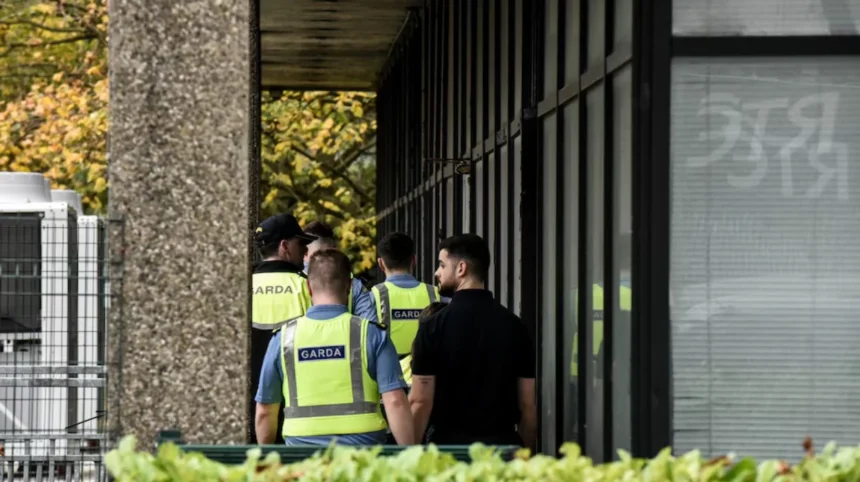
- An Garda Síochána deployed armed response units and sniffer dogs to search the Montrose campus buildings.
- Irish political leaders, including Taoiseach Micheál Martin and Minister for Justice Jim O’Callaghan, linked the incident to wider Europe-wide hybrid security disruptions.
Dublin, RTÉ Headquarters (West London Times) November 7, 2026 – Staff at Ireland’s national broadcaster have successfully returned to their offices after a major security alert triggered sweeping evacuations across the Montrose campus in Donnybrook. The emergency response unfolded on Friday morning after station officials received an email threat warning that an explosive device had been planted on site and would detonate within 45 minutes. The incident prompted an immediate multi-agency security operation involving An Garda Síochána, armed support units, and specialist search teams.
- Key Points
- Why Were RTÉ Staff and Children Evacuated From the Montrose Campus?
- Which Other Irish Media Organisations Were Targeted in the Security Alert?
- How Did An Garda Síochána and the Irish Government Respond to the Threats?
- Is This Incident Part of a Broader European Hybrid Security Campaign?
- Background of the Particular Development
- Prediction
Why Were RTÉ Staff and Children Evacuated From the Montrose Campus?
As reported by Cate McCurry of the PA News Agency and published in the uk/local/hillingdon/">Hillingdon Times, staff members—including prominent radio and television presenters—along with children being looked after in an on-site crèche, were swiftly ordered to leave the studio buildings following the receipt of the threatening email at 8:40 am.
As reported by Cate McCurry of the PA News Agency, RTÉ director-general Kevin Bakhurst explained the decision to evacuate, stating:
“On the basis of the information we had, we decided that we wanted to put the safety of the staff first and evacuate the buildings.”
Bakhurst further described the disruption, stating:
“It’s a disgraceful attack on the media, on free media, and unfortunately, probably where it comes from, they don’t really appreciate the importance of free media.”
He added:
“It’s more concern about how do we prevent stuff like this happening again because it’s been so disruptive. We’re doing our best to stay on air. I think the teams everywhere are doing a really good job, but we are so dependent on technology. It looks that it was a hoax, and it’ll all be fine. But how do we make ourselves proofed for this in the future?”
During the security lockdown, RTÉ Radio One transmission was temporarily interrupted around 9am, replacing the scheduled programme Today With David McCullagh with pre-recorded music. Broadcasting operations resumed shortly afterwards from an RTÉ mobile broadcast vehicle stationed outside the main gates, where presenters continued coverage while searches were underway.
Which Other Irish Media Organisations Were Targeted in the Security Alert?
As reported by Cate McCurry of the PA News Agency, the security threat was not isolated to RTÉ. It is understood that several other media organisations across Ireland, including Virgin Media, Newstalk, and the Irish Independent, also received very serious threats on Friday morning. Mediahaus and Independent News Media also evacuated their premises on Talbot Street as a precautionary measure.
As reported by Cate McCurry of the PA News Agency, RTÉ presenter David McCullagh told listeners that the warning received at the broadcaster specified an explosion would occur within 45 minutes. Furthermore, as reported by Cate McCurry of the PA News Agency, RTÉ presenter Sarah McInerney noted that the sender of the threatening email claimed affiliation with a group responsible for recent security threats directed at European airlines, asserting that an operative had successfully smuggled an explosive device onto the premises.
How Did An Garda Síochána and the Irish Government Respond to the Threats?
As reported by Cate McCurry of the PA News Agency, An Garda Síochána deployed resources including an Armed Support Unit and canine search units to thoroughly inspect the RTÉ campus. A Garda spokesperson stated:
“An Garda Síochána is aware of a threat made against media organisations here and in Europe. An Garda Síochána has been liaising with the Irish media organisations and the threats will be investigated.”
Addressing the wider implications of the security breach, Ireland’s Minister for Justice Jim O’Callaghan emphasised that authorities were treating the communications with utmost gravity. As reported by Cate McCurry of the PA News Agency, Minister O’Callaghan stated:
“Europe has increasingly become the target of different forms of hybrid attacks, which are evolving in complexity and sophistication. To counter these threats, it is important to strengthen our co-operation and co-ordination. Threats of this nature are completely unacceptable and every effort will be made to identify those responsible.”
Is This Incident Part of a Broader European Hybrid Security Campaign?
As reported by Cate McCurry of the PA News Agency, Taoiseach Micheál Martin confirmed that after speaking with the Garda Commissioner and security officials, he believes the coordinated emails dispatched to media houses in Ireland, the UK, and across wider Europe form part of a synchronized multi-jurisdictional hybrid operation.
As reported by Cate McCurry of the PA News Agency, Taoiseach Micheál Martin stated:
“Yesterday, we had significant threats to airlines and to air travel, and clearly there are elements out there who are anxious to sow as much disruption and create fear and anxiety among people, not just here but across Europe.”
He added:
“Gardaí’s first duty is to rigorously investigate, which they will. They are working with international security partners in terms of co-ordinating the investigation, and they are also sharing intelligence and learning from others. There are efforts afoot globally, certainly within Europe, to create disruption, sow the seeds of anxiety and fear among populations.”
Despite the widespread nature of the threats and recent aviation disruptions, government officials have expressed confidence that national security protocols remain robust ahead of high-profile international political summits scheduled to take place in Dublin.
Background of the Particular Development
The security alert affecting RTÉ and multiple independent media organisations occurs against a backdrop of escalating hybrid warfare tactics, cyber disruptions, and coordinated hoax campaigns targeting critical infrastructure across Europe throughout late 2026. In the days immediately preceding the media threats, European transport networks—specifically commercial aviation—experienced a wave of hoax bomb threats that forced emergency landings and diversions across cities including Dublin, Madrid, Milan, Copenhagen, Helsinki, and Warsaw.
Security agencies and European Union transport officials have increasingly warned that media institutions represent high-visibility targets for malicious actors seeking to test emergency readiness, leverage public press platforms to amplify disruption, and strain law enforcement resources. Ireland’s national broadcaster has previously updated its physical security, but the simultaneous targeting of multiple domestic media outlets marks an unprecedented escalation in coordinated intimidation tactics directed against press institutions in Ireland.
Prediction
This coordinated wave of hybrid security threats is likely to accelerate institutional overhauls of physical and digital security protocols across media organisations in Ireland and the wider European Union. For media personnel, newsrooms, and public service broadcasters, the incident underscores an urgent need for standardized emergency response frameworks, enhanced email security filters, and resilient decentralized broadcasting redundancies to ensure continuous transmission during unexpected evacuations.
Furthermore, as law enforcement agencies and international intelligence partners trace the origin of these digital campaigns, public authorities will face heightened pressure to fortify critical national infrastructure against sophisticated hybrid warfare, ensuring that upcoming diplomatic events and national assemblies remain protected from targeted disruption.