Key Points
- Home Secretary Shabana Mahmood told police to “leave the politics to the politicians”.
- A new impartiality standard will be developed by the College of Policing and consulted on early next year.
- About 200 local police commands are planned across England and Wales.
- Up to 200 recruits a year will enter a fast-track programme to become superintendents within five to 10 years.
- Police leaders supported impartiality but stressed the need for discretion when officers respond to complex incidents.
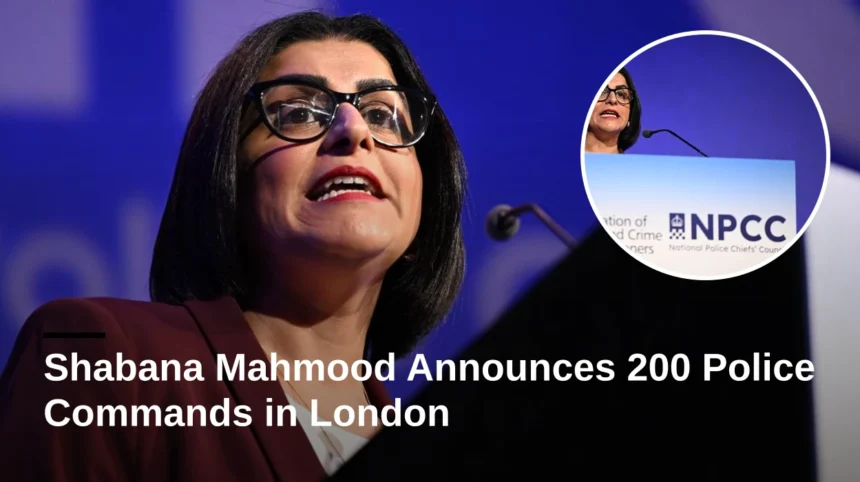
London (West London Times) November 18, 2026 – Home Secretary Shabana Mahmood has told police officers to “leave the politics to the politicians” while announcing plans for a new impartiality standard. Speaking to police chiefs and commissioners, Ms Mahmood said the standard would aim to ensure people were treated fairly regardless of race, faith or other characteristics.
- Key Points
- What did Shabana Mahmood say about political activity?
- What will the new impartiality standard include?
- What wider policing reforms were announced?
- Who criticised or supported the announcement?
- What is the background to the impartiality reforms?
- How could the changes affect police and the public?
The College of Policing will develop the guidance, which is expected to go to consultation early next year. It will cover policing events, community engagement, political symbols on badges and lanyards, and the treatment of victims and offenders.
What did Shabana Mahmood say about political activity?
As reported by KentOnline, Ms Mahmood said community engagement should involve residents’ association meetings and discussions about local concerns, rather than engagement with activist groups pursuing political agendas. She told officers: “When it comes to political groups, leave the politics to the politicians, and we will leave the policing to you.”
Ms Mahmood said most officers police impartially, but argued that examples of differential treatment had damaged confidence and allowed claims of two-tier policing to gain ground. She rejected the suggestion that police forces routinely operate a two-tier system.
What will the new impartiality standard include?
The Independent reported that the standard will bring key impartiality principles together in one document. The Home Office said it is intended to give officers clearer guidance and reassure the public that police powers will be used fairly.
The guidance is also expected to address officers’ conduct at community-led events and the use of symbols that could have political connotations. The former anti-racism commitment was criticised by Ms Mahmood, who said some wording had undermined confidence in impartial policing.
What wider policing reforms were announced?
According to the Government, around 200 Local Police Commands will be created across England and Wales, with each broadly equivalent in size to a unitary authority and led by a named commander.
The Government also plans a fast-stream leadership programme for up to 200 recruits each year. The programme will be open to people inside and outside policing and place participants on a five-to-10-year route to superintendent, according to the Home Secretary’s speech.
National Police Chiefs’ Council Chairman Gavin Stephens said impartial use of police powers was essential, but officers needed tolerance because emergency calls often involve limited information and complex circumstances. He said discretion meant that apparently similar situations could be handled differently because of details not visible to the public.
Who criticised or supported the announcement?
Shadow Home Secretary Chris Philp said it was wrong for police to treat people differently because of skin colour. Reform United Kingdom leader Nigel Farage said the Government’s acknowledgement of differential treatment supported his party’s previous claims about two-tier policing.
Ms Mahmood said concerns about unequal treatment had become more prominent, while also warning against claims that every officer routinely applies a two-tier system. A More in Common poll cited in reporting found that one-third of Britons believed police treated ethnic-minority people more favourably than white people.
What is the background to the impartiality reforms?
The reforms follow political and public debate about whether policing is applied consistently across different groups and causes. Ms Mahmood linked the debate to concerns that earlier equality guidance used unclear or divisive language. The issue was also discussed in the context of the murder of Henry Nowak and subsequent accusations of two-tier policing and far-right protests. The College of Policing is expected to consult on the proposed standard early next year before any final guidance is issued.
How could the changes affect police and the public?
The proposed standard could give officers a single framework for handling politically sensitive events, community engagement and cases involving different protected characteristics. For the public, its effect will depend on how the guidance is consulted on, implemented and monitored by individual forces.
The planned local commands could make responsibility for everyday policing clearer by placing named commanders closer to communities. The leadership programme could also broaden recruitment into senior policing, while the emphasis on discretion means officers will continue to make operational judgments based on the circumstances of individual incidents.