


Key Points
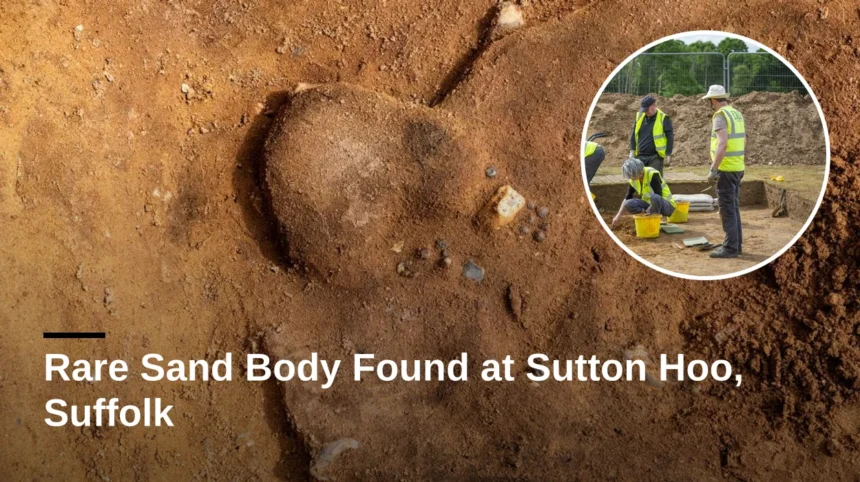
- Time Team archaeologists uncovered a rare Anglo-Saxon “sand body” in Sutton Hoo’s Garden Field.
- Beads, tweezers, a knife and a brooch were found with the grave.
- Archaeologists identified evidence suggesting a second burial may lie beneath it.
- The excavation formed part of a month-long investigation for a four-part documentary series hosted by Sir Tony Robinson.
- National Trust archaeologist Angus Wainwright said the dig broadened attention beyond Sutton Hoo’s royal burials.
Sutton Hoo (West London Times) November 19, 2026 – Time Team archaeologists have discovered a rare Anglo-Saxon grave containing a “sand body” at Sutton Hoo in Suffolk. The find was made in Garden Field, a cemetery separate from the site’s famous royal burial mounds and seventh-century ship burials. Beads, tweezers, a knife and a brooch were recovered, while evidence indicated that another burial could be located beneath the grave. The discovery was made during a month-long excavation conducted for a new four-part documentary series hosted by actor and television presenter Sir Tony Robinson.[1][2][3]
- Key Points
- What did archaeologists discover at Sutton Hoo?
- Where was the Anglo-Saxon grave found?
- What did the National Trust say about the discovery?
- What is the background to Sutton Hoo’s Garden Field excavation?
- How could the discovery affect the audience of ‘Mysterious’ Anglo-Saxon grave discovered at Sutton Hoo?
What did archaeologists discover at Sutton Hoo?
As reported by the Harrow Times, Time Team’s excavation uncovered a “sand body” alongside several grave goods, including beads, tweezers, a knife and a brooch.[1] The National Trust said such remains form when a body and its bones decompose in acidic soil, leaving a hardened impression in the surrounding sand.[1][2]
The BBC reported that archaeologists also found evidence suggesting a second burial could lie beneath the grave.[2] The available reports do not confirm that a second body has been excavated.
Where was the Anglo-Saxon grave found?
The excavation took place in Garden Field, described by the Independent as a cemetery distinct from Sutton Hoo’s royal burial grounds and seventh-century ship-burial area.[3] The work followed a wider two-year research project involving Time Team and the National Trust, with the Garden Field excavations carried out in 2025.[10]
What did the National Trust say about the discovery?
National Trust archaeologist Angus Wainwright said earlier archaeological work at Sutton Hoo had concentrated on the royal burial mounds. He said the new excavation placed greater emphasis on the people who lived in the surrounding landscape, as well as their ancestors and descendants.[1][2]
“This excavation moves the focus to these people and their ancestors and descendants,” Angus Wainwright said, according to the Harrow Times and the BBC.[1][2]
Wainwright also described the discovery of another sand body in the Garden Field cemetery as a high point of the latest excavation. He compared the phenomenon with earlier sand bodies found at Sutton Hoo during excavations in the 1980s.[1][3]
What is the background to Sutton Hoo’s Garden Field excavation?
Sutton Hoo is known for its Anglo-Saxon royal burial mounds and seventh-century ship burial, which have shaped understanding of early medieval England. Garden Field is a separate cemetery within the wider Sutton Hoo landscape. The National Trust and Time Team have been investigating the area through a two-year research project. Earlier work connected with the project also examined missing pieces of the sixth-century Bromeswell Bucket, whose intact base contained a cremation burial and grave goods.[10]
How could the discovery affect the audience of ‘Mysterious’ Anglo-Saxon grave discovered at Sutton Hoo?
The discovery is likely to give viewers of the four-part Time Team documentary a clearer view of burial practices beyond Sutton Hoo’s royal monuments. The sand body and associated objects may help audiences understand how ordinary East Anglian communities used the landscape alongside elite groups. Evidence of a possible second burial could provide an additional line of investigation when the programme presents the excavation. Any interpretation of the grave’s identity, status or relationship to the possible lower burial remains subject to further archaeological assessment.