


Key Points
- Council Opposition: As said by a West London mother named Georgina Estrella, the Ealing Council is unwilling to perform the EHC assessment for her son Ryan, despite multiple needs of him being documented.
- Complicated Conditions: The child named Ryan who had completed his Year 11 in the summertime and at present, is not enrolled in any form of schooling, is suffering from Autism Spectrum Disorder, Burnside Butler Syndrome, Hypermobility, Anxiety, and Sensory Sensitivities.
- Communication Barriers: Ryan spends long spells being non-verbal, owing to selective mutism and his dependence on using either an iPad or writing to communicate and needs a means to learn anything.
- Financial & Emotional Impact: As a result of no educational placements being provided for Ryan, Georgina must limit herself to very little agency work to look after him at home, which causes a great financial loss.
- Tribunal Allegations: Georgina says that the local authority is trying to push the case through the court system to delay the funding of the case since a tribunal hearing is not scheduled until July 2027.
- Council’s Response: A spokesperson from Ealing Council said that individual assessments take place under the Children and Families Act 2014 and are not influenced by financial issues.
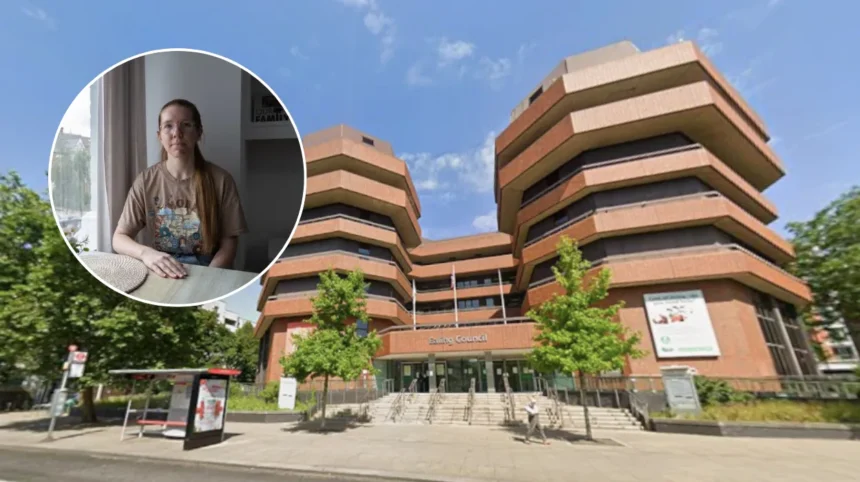
West London (West London Times) September 30, 2026 — Georgina Estrella has asserted that uk/local/ealing/">Ealing Council is intentionally dragging her family through the legal system to avoid funding support for her teenage son. Ryan, who completed Year 11 in the summer, is currently not receiving any formal education after failing to progress to sixth form because no colleges could provide the necessary adjustments without an Education, Health and Care Plan (EHCP).
According to Philip James Lynch of MyLondon, Georgina Estrella stated that “the only reason that I can get out of them is pretty much that they don’t feel like it. They have all the evidence from the school to say that he has additional needs, but on the court forms they just put: ‘We don’t think he has additional needs’.”
What additional needs does Ryan live with?
As detailed by Philip James Lynch of MyLondon, Ryan lives with a complex array of conditions, including Autism Spectrum Disorder, Burnside Butler Syndrome, and hypermobility. He is mostly non-verbal due to selective mutism and relies heavily on alternative communication methods, such as an iPad or written responses.
Furthermore, Philip James Lynch of MyLondon noted that Ryan experiences frequent and prolonged non-verbal episodes, high levels of anxiety, sensory sensitivities to noise, and emotional dysregulation resulting in shutdowns and meltdowns. He also contends with physical complications linked to hypermobility, such as chronic pain, fatigue, and an occasional need for a wheelchair. Despite possessing strengths in mathematics and logical thinking, these compounding factors severely impede his ability to attend and engage in a traditional school environment.
How has the lack of an EHCP affected the family?
As highlighted by Philip James Lynch of MyLondon, the absence of an EHCP has left Ryan and his mother in educational limbo. While Georgina described Ryan’s former school as going “above and beyond” for him, mainstream settings without an EHCP have proven unable to accommodate his profile, leaving him out of school entirely.
As reported by Philip James Lynch of MyLondon, Georgina Estrella explained the personal toll, stating that “it’s really distressing. Educationally he is able, but he isn’t being given the opportunity. For me, I do agency work, but I have to be at home quite a lot. Working full-time is impossible, which causes a considerable loss of earnings. It’s distressing for Ryan as well.”
Why does the mother believe the council is using the tribunal system as a tactic?
As covered by Philip James Lynch of MyLondon, Georgina believes that Ealing Council knows the legal bar for an EHCP assessment is low—requiring only evidence that a student may have additional needs—and that a tribunal will ultimately rule in the family’s favour. She alleges that by forcing the case to a tribunal scheduled for July 2027, the local authority is deliberately stalling to avoid funding any support in the interim.
As quoted by Philip James Lynch of MyLondon, Georgina Estrella appealed directly to the local authority: “[To the council] you don’t have to wait for the tribunal, you can do something now. Please take us seriously and do the right thing.”
Explore more Ealing News:
Ealing Council Wrongfully Removes Homeless Man From Housing Register Ealing 2026
Ealing Council Breaches Homelessness Law for Family in Ealing 2026
What is Ealing Council’s position on the matter?
As documented by Philip James Lynch of MyLondon, Ealing Council maintains that its decisions are made strictly in accordance with statutory guidelines. An Ealing Council spokesperson stated that “requests for an Education, Health and Care (EHC) needs assessment are considered individually and in accordance with the statutory test set out in the Children and Families Act 2014.”
The spokesperson added, as reported by Philip James Lynch of MyLondon, that
“decisions are based on the circumstances of the individual child or young person and the information and evidence available to the council. They are not made on the basis of financial considerations.”
Additionally, the council noted that because the family has exercised its right of appeal to the Special Educational Needs and Disability (SEND) Tribunal, it would be inappropriate to comment publicly on the evidence while proceedings are ongoing. Nevertheless, the council emphasised that it “remains committed to working with the family and relevant partners to support Ryan’s education and needs while that process is ongoing.”
Background of the Development
Special Educational Needs and Disability (SEND) provision across local authorities in England has faced severe systemic strain, marked by rising demand for Education, Health and Care Plans (EHCPs) and significant budgetary constraints within local government sectors. Under the Children and Families Act 2014, local authorities are legally required to conduct an EHC needs assessment if it is established that a child or young person may have special educational needs that require an EHCP.
However, disputes over whether a child’s needs can be met within existing mainstream resources without a formal plan frequently result in disagreements between parents and councils. When local authorities refuse to assess or issue a plan, families can appeal to the SEND Tribunal—an independent judicial body. Due to high volumes of casework nationwide, these tribunals often experience extended waiting lists, leaving children out of school and placing immense caregiving and financial pressure on families while legal processes slowly unfold.
This development highlights the ongoing legal and administrative bottlenecks within local authority SEND departments, which can directly affect families, local government budgets, and vulnerable young people across the United Kingdom. For families of children with special educational needs, such prolonged tribunal pathways can cause extended educational exclusion, developmental stagnation, and acute financial hardship for parents who must reduce working hours to provide full-time care.
For local councils, the increasing reliance on tribunal appeals risks escalating legal expenses and administrative friction, while potentially eroding community trust. If tribunals consistently rule in favour of families in cases where assessments were initially rejected, local authorities may face heightened scrutiny regarding how initial threshold decisions are evaluated, potentially prompting calls for earlier collaborative mediation rather than prolonged legal escalation.