


Key Points
- A North London local authority generated over £1 million in less than two years through penalty charge notices issued to motorists on a trial School Street scheme.
- The enforcement scheme operates outside Manor School in Kensal Rise, within the London Borough of Brent.
- Local representatives and councillors highlighted that motorist compliance remains persistently low, driving up the cumulative total of financial penalties issued to drivers.
- Concerns were raised regarding whether the high volume of fines indicates an effective traffic-calming measure or highlights issues with signage, driver awareness, and council strategy.
London (West London Times) November 6, 2026 – A North London local authority has generated more than £1 million in less than two years through penalty fines issued to motorists navigating a trial School Street scheme in the borough. The financial milestone has drawn scrutiny from local representatives who argue that high penalty figures point to underlying compliance challenges rather than successful traffic management.
How Much Money Has Brent Council Raised From the Kensal Rise School Street Scheme?
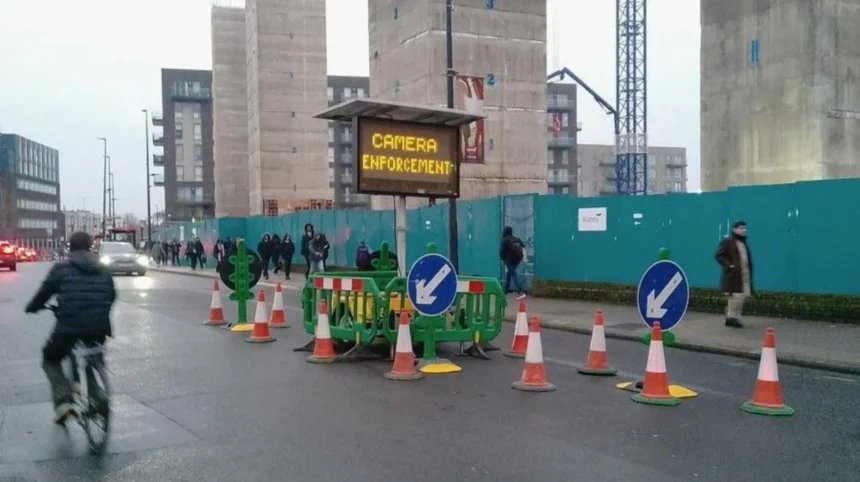
As reported by Louis Dargavel Corbett of MyLondon, uk/local/brent/">Brent Council has raked in more than £1m in less than two years from fines issued to drivers on one of the borough’s trial School Streets. The traffic restriction scheme, situated outside Manor School in Kensal Rise, was established to improve pedestrian safety and reduce vehicle congestion during school run hours. However, the volume of penalty charge notices (PCNs) issued to motorists has accumulated rapidly, crossing the seven-figure threshold within a short timeframe.
What Are Local Councillors Saying About the High Compliance Failures?
As reported by Louis Dargavel Corbett of MyLondon, the local authority has admitted that “compliance is too low” following repeated challenges raised by elected officials. Cllr Barbara Want, a Liberal Democrat councillor for Kensal Rise photographed outside Manor School where the School Street scheme is currently implemented, has repeatedly raised concerns at the rate of fines. Councillor Want and other community figures have questioned why motorists continue to breach the restrictions in such high numbers, querying whether clearer warning signage, advanced driver notification, or alternative engineering solutions are required to prevent motorists from inadvertently entering the restricted zone and incurring heavy fines.
Why Are Motorists Struggling With School Street Restrictions?
As detailed in coverage by MyLondon, trial School Streets are designed to restrict motor vehicle access outside educational institutions during peak drop-off and pick-up times to safeguard children and encourage active travel. Critics and local motorists, however, frequently argue that signage regarding operational hours can be ambiguous or difficult to spot for drivers unfamiliar with local side streets. The continuous accumulation of fines at the Kensal Rise location has reignited debates across Greater London regarding the balance between enforcing road safety and penalising motorists who may struggle to navigate complex, localized traffic experimental schemes.
Background of the Particular Development
School Streets have become an increasingly prominent fixture across London boroughs as local authorities strive to improve air quality, lower carbon emissions, and protect children from traffic dangers outside school gates. Introduced under experimental traffic orders, these schemes temporarily pedestrianize roads directly outside schools during specific morning and afternoon windows. Over recent years, local councils have increasingly turned to Automatic Number Plate Recognition (ANPR) cameras to enforce these restrictions remotely. While proponents argue that camera enforcement is essential to deter illegal driving behavior and protect vulnerable pedestrians, critics often scrutinize local authorities over whether such schemes function primarily as traffic management tools or lucrative revenue streams, particularly when driver non-compliance remains consistently high over multi-year trial periods.
Prediction
This financial milestone and the ongoing debate surrounding compliance rates in Kensal Rise are likely to exert mounting pressure on Brent Council and other London local authorities to review how experimental traffic schemes are communicated to the public. For local residents, motorists, and parents, the continued friction over high fine yields could accelerate demands for improved physical signage, flashing warning indicators, or grace periods for first-time offenders. If compliance fails to improve organically, the council may face intensified political scrutiny over whether reliance on penalty notices undermines public trust in active travel initiatives, potentially forcing modifications to how restrictions are monitored and enforced across the borough.