


Key Points
- Bitcoin briefly fell below $60,000 after reversing a more than 5% rally.
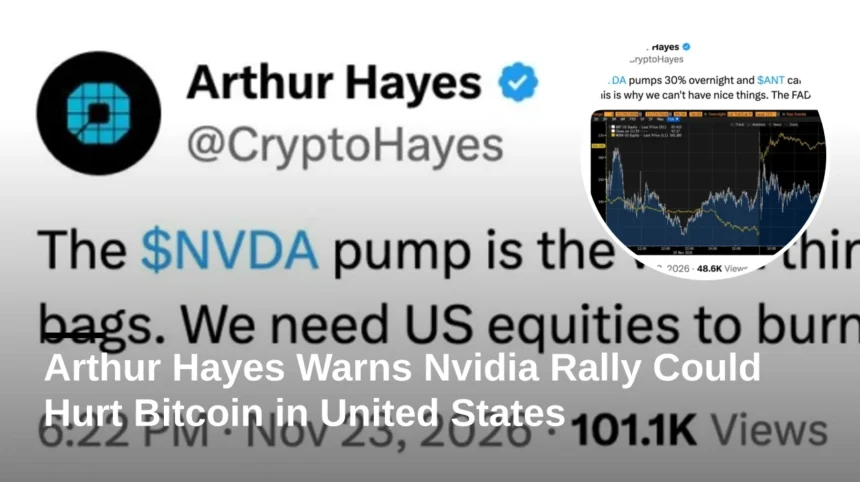
- Arthur Hayes called Nvidia’s surge the “worst thing” for crypto holdings.
- Hayes said stronger United States equities could reduce pressure on the Federal Reserve to expand liquidity.
- Nvidia shares reportedly rose as much as 36% intraday and closed 31% higher.
- Hayes previously warned that Bitcoin could test $50,000 if the Nasdaq continued to fall.
Bitcoin And Stocks Are Moving In Different Directions: Arthur Hayes Says Nvidia’s Rally Is The ‘Worst Thing’ For Crypto | TradingView News
United States (Edinburgh Daily News) November 24, 2026 – Bitcoin reversed an earlier rally and briefly traded below $60,000 after Nvidia shares led a broad rebound in United States technology stocks. Arthur Hayes, BitMEX co-founder, said the equity surge could be damaging for cryptocurrency holders because a sustained stock-market recovery might reduce the Federal Reserve’s incentive to provide additional liquidity. Bitcoin had climbed more than 5% to about $64,440 before giving back its gains.
Why does Arthur Hayes oppose Nvidia’s rally?
As reported by TradingView News, Hayes wrote on X that the Nvidia rally was “the worst thing” for crypto portfolios because he wanted United States equities to weaken enough to encourage Federal Reserve money creation. His view links cryptocurrency performance to expectations for monetary easing and increased market liquidity.
“The $NVDA pump is the worst thing that could happen for our crypto bags. We need US equities to burn so the Fed prints,” Hayes wrote.
Hayes also compared Nvidia’s move with Anthropic’s public-market performance, arguing that investors were selling or fading other recent technology-market enthusiasm while concentrating on Nvidia.
How did Nvidia’s gains affect Bitcoin and other markets?
According to TradingView News, Nvidia shares rose as much as 36% during the session and closed 31% higher after Jensen Huang was reinstated as chief executive. The move lifted sentiment across semiconductor and technology stocks and encouraged purchases of other risk assets, including cryptocurrency.
Bitcoin’s gains did not hold. The cryptocurrency was down more than 1% in the report’s latest reading after falling back from its intraday high. Retail sentiment on Stocktwits remained bullish, while discussion volume stayed high.
Shorter-dated United States Treasury yields and the dollar also fell during Monday’s session. The two-year Treasury yield, which often reflects expectations for Federal Reserve policy, declined from 4.70%, while the dollar index slipped 0.04%.
What has Hayes said about Bitcoin’s next support level?
Hayes previously said Bitcoin could test $50,000 if the Nasdaq continued to decline. A separate TradingView News report said he made that warning after Bitcoin broke below a previous local low. Other market coverage reported a possible $55,000 retest after a sharp fall in South Korea’s KOSPI index.
Bitcoin had fallen almost 20% during November in the supplied report, placing the cryptocurrency on course for its weakest November since 2018. Barron’s separately reported that Bitcoin was down about 19.6% for the month and that CME Group’s FedWatch tool showed a 100% implied probability of a Federal Reserve rate increase at the meeting ending December 9, including a 94% chance of a quarter-point increase and a 6% chance of a half-point increase.
What is the background to the market development?
The latest market split follows a period in which Bitcoin and technology shares had often moved with wider investor risk appetite. Nvidia’s sharp rise strengthened confidence in artificial-intelligence and semiconductor stocks, while Bitcoin subsequently failed to maintain its advance. Hayes has argued that debt-funded artificial-intelligence infrastructure could eventually require government support, which he believes could later benefit Bitcoin. He has also warned of a possible crash comparable with 1929, while saying authorities are unlikely to choose austerity.
How could this affect Bitcoin investors and stock-market participants?
If United States equities continue rising, Hayes’s argument suggests that investors could expect less immediate monetary support and that Bitcoin may remain under pressure despite strength in technology stocks. A continued Nasdaq decline, by contrast, could reinforce market expectations of policy intervention but would also increase broader risk aversion. For Bitcoin investors, the $60,000 level and Hayes’s $55,000 and $50,000 scenarios are key thresholds discussed in the cited reports. Stock-market participants may therefore see Nvidia’s performance as a sign of technology-sector strength, while cryptocurrency traders focus on liquidity expectations and Bitcoin’s ability to recover.