Key Points
- Severe Pollution Surge: Air pollution across urban areas in England reached “very high” levels on Monday, November 9, 2026, driven by calm, foggy weather that trapped emissions close to the ground following a weekend of fireworks and bonfires.
- Alarming Concentration Levels: Government monitoring data showed that 11 locations—primarily across London and Greater Manchester—hit the top category on the 10-point particulate matter scale.
- Extreme PM2.5 Readings: As reported by Matthew Pearce of The Guardian, the worst reading was registered in Hillingdon, west London, where the 24-hour average concentration of fine particulate matter (PM2.5) peaked at 129 micrograms per cubic metre—more than eight times the World Health Organization’s (WHO) daily guideline.
- Widespread Impact Across Regions: Another 27 monitoring sites recorded “high” pollution levels across the capital, the north-west, the Midlands, Yorkshire, and eastern England. Affected urban centres included Manchester Piccadilly, Wigan, Blackburn, Preston, and Rochdale.
- Official Alerts and Directives: London City Hall, acting on forecasts from Imperial College London, issued a high air pollution alert for Tuesday, November 10, 2026. Mayor of London Sadiq Khan and environmental campaigners urged citizens to avoid non-essential burning, switch off idling vehicle engines, and utilize public transport.
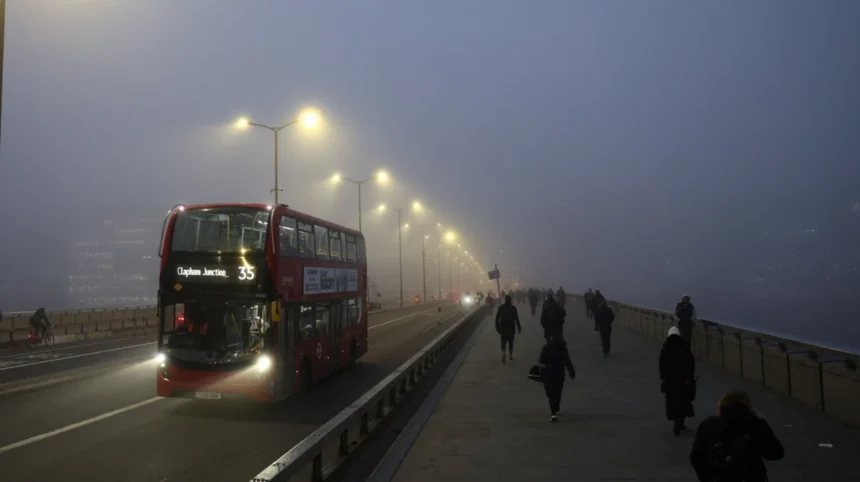
London (West London Times) November 10, 2026 — Air pollution soared to hazardous levels across major urban centers in England on Monday as stagnant, foggy meteorological conditions locked emissions near the ground in the wake of weekend bonfire and fireworks festivities.
What Caused the Dangerous Spike in Air Pollution Across England?
As reported by Matthew Pearce of The Guardian, government air quality monitoring data confirmed that 11 distinct locations—predominantly spread across London and Greater Manchester—hit the top category of the official 10-point particulate matter pollution index during the 24-hour period leading up to 10 am on Monday. The hazardous conditions were compounded by a heavy blanket of fog and absolute calm winds that prevented local emissions, domestic wood burning, and lingering smoke from weekend fireworks displays from dispersing into the upper atmosphere.
According to figures cited by Matthew Pearce of The Guardian, particulate pollution reached unprecedented peaks in western London. In uk/local/hillingdon/">Hillingdon, west London, the 24-hour average concentration of fine particulate matter (PM2.5) soared to an alarming 129 micrograms per cubic metre. This staggering measurement is more than eight times higher than the strict daily guideline threshold established by the World Health Organization (WHO). Beyond the capital, similar “very high” pollution classifications were documented across multiple northern urban hubs, including Manchester Piccadilly, Wigan, Blackburn, Preston, and Rochdale. Furthermore, an additional 27 monitoring stations registered “high” air pollution levels spanning the Midlands, Yorkshire, the north-west, and eastern England.
How Are Authorities and Officials Responding to the Crisis?
In response to the deteriorating atmospheric conditions, regional authorities mobilized emergency advisories. A spokesperson for the mayor of London stated:
“On the advice of forecasters at Imperial College London, we’ve issued a high air pollution alert for Tuesday 10 November”.
As detailed by Holly Evans of The Independent, London Mayor Sadiq Khan urged commuters and residents to exercise extreme caution, consider switching to public transport, and avoid unnecessary driving. The Mayor explicitly advised the public to follow health guidelines, refrain from burning garden waste, and switch off vehicle engines when idling to prevent exacerbating local particulate concentrations.
Environmental groups also voiced grave concerns over the recurring nature of weather-trapped pollution events. Andrea Lee, campaigns manager at Clean Air Fund, emphasized the severity of domestic emissions during stagnant atmospheric states. As covered by Matthew Pearce of The Guardian, Lee stated that
“We need to phase out non-essential burning in our towns and cities so that we don’t experience these unhealthy air pollution levels”.
When Will Air Quality Conditions Improve Across the UK?
Meteorological forecasters have indicated that relief is dependent on shifting weather patterns. Government agencies and municipal monitoring teams noted that they are continuing to closely monitor the situation on the ground. Officials anticipate that air quality levels will gradually improve later in the week as increasing cloud cover and stronger winds pick up, breaking the stagnant inversion layer that currently traps harmful particulates over England’s urban landscapes.
Background of the Particular Development
This severe pollution episode follows a recurring seasonal vulnerability in the United Kingdom where calm autumn weather converges with mass cultural celebrations. Early November consistently brings traditional Bonfire Night and Diwali festivities involving widespread fireworks and domestic bonfires, which release massive quantities of fine particulate matter (PM2.5 and PM10) into the atmosphere. When these celebrations coincide with meteorological phenomena such as radiation fog and thermal inversions—where a layer of warm air traps cooler, polluted air near the surface—urban emissions from vehicular traffic, domestic wood burning, and heating systems cannot disperse. Similar atmospheric trapping events have historically led to severe public health warnings across English cities, prompting ongoing debates regarding the regulation of domestic wood burners, non-essential bonfires, and urban traffic management.
Prediction: How This Development Can Affect the Particular Audience
For urban residents, commuters, and vulnerable health groups across England—particularly children, the elderly, and individuals with pre-existing respiratory or cardiovascular conditions—this meteorological event poses immediate health risks. Prolonged exposure to PM2.5 concentrations exceeding eight times WHO guidelines can trigger acute asthma attacks, aggravate chronic bronchitis, increase hospital admissions for heart conditions, and cause widespread throat and eye irritation.
From a policy and behavioral standpoint, this crisis is likely to intensify public scrutiny on urban clean-air policies. It will likely increase pressure on local authorities and municipal leaders in London, Greater Manchester, and other metropolitan areas to implement stricter temporary traffic restrictions, enforce tighter controls on domestic wood and garden burning during stagnant weather warnings, and accelerate public awareness campaigns regarding clean air protection.