


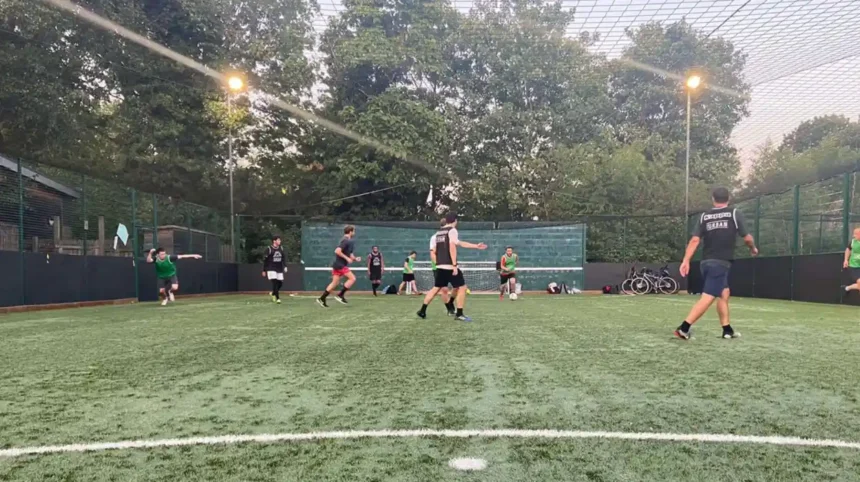
Five-a-side football is one of the most accessible forms of organised sport in West London. The small-sided format brings together local residents, workers, students and visitors through structured matches, leagues, casual games and training sessions. West London contains a broad network of sports centres, community facilities, commercial football venues and outdoor pitches that support regular participation.
- What is five-a-side football?
- Why is five-a-side football popular in West London?
- Where can people play five-a-side football in West London?
- How do five-a-side football pitches differ from full-sized pitches?
- What rules are used in five-a-side football?
- How does a typical five-a-side match work?
- What skills are most important in five-a-side football?
- What formations are used in five-a-side football?
- How can beginners start playing five-a-side football in West London?
- What equipment is needed for five-a-side football?
- What health and fitness benefits are associated with playing football?
- How much does five-a-side football cost in West London?
- How do organised five-a-side leagues operate?
- What should players consider when choosing a West London venue?
- How does five-a-side football support communities in West London?
- What is the future of five-a-side football in West London?
- How can players get the most from five-a-side football in West London?
The game uses fewer players, a smaller playing area and shorter matches than the traditional 11-a-side format. These features create a fast-paced activity that fits into evenings, weekends and shorter periods of free time. Five-a-side football also supports different levels of participation, from informal social games to competitive league football.
West London covers several London boroughs, including uk/local/fulham/hammersmith/">hammersmith-and-fulham/">Hammersmith and Fulham, Ealing, Hounslow, Hillingdon, Kensington and Chelsea, Richmond upon Thames and parts of Brent. Each area has a different mix of indoor and outdoor sporting facilities. Understanding how five-a-side football works helps players select suitable venues, organise teams and participate safely.
What is five-a-side football?
Five-a-side football is a small-sided version of association football played by two teams of five players, usually including one goalkeeper, on a reduced-size pitch with modified rules designed for fast, continuous and accessible play.
Association football is the sport governed internationally by FIFA, the Fédération Internationale de Football Association. Five-a-side football adapts the basic principles of association football to a smaller number of participants and a more compact playing environment.
A standard five-a-side team generally consists of four outfield players and one goalkeeper. Some recreational games use flexible substitutions so that larger groups can share playing time. Commercial leagues and organised competitions usually establish rules covering squad sizes, substitutions and player eligibility before a season begins.
The smaller format changes the structure of the game. Every player receives frequent involvement with the ball. Defending and attacking responsibilities change rapidly. Passing, movement and positional awareness become central to successful play.
Five-a-side football is different from futsal, although the two formats share several characteristics. Futsal is a formally regulated indoor sport played under specific FIFA laws. Recreational five-a-side football in England often follows local rules set by the venue or competition organiser.
Why is five-a-side football popular in West London?
Five-a-side football is popular in West London because its short matches, flexible team sizes and wide range of indoor and outdoor facilities fit the schedules and lifestyles of residents, workers, students and organised community groups.
West London has a large and densely connected population. Public transport, major employment centres and residential neighbourhoods bring large numbers of potential participants close to sports facilities.
The format requires fewer players than an 11-a-side match. An organiser needs ten players for a full five-a-side game, compared with 22 players for a traditional full-sided match. This lower number makes it easier for colleagues, friends and community groups to arrange games.
Match durations also suit modern schedules. Many recreational games use periods ranging from 40 to 60 minutes. League fixtures often operate on evening schedules, allowing participants to play after work or study.
West London also has strong connections with the wider football culture of the capital. Professional clubs, grassroots teams, schools and community programmes contribute to sustained interest in the sport. Five-a-side football provides a direct participation route for people who do not play in a full 11-a-side team.
The activity also supports social participation. A regular game creates a recurring meeting point for established groups and new participants. This is particularly relevant in a large urban area where people move between neighbourhoods, workplaces and educational institutions.
Where can people play five-a-side football in West London?
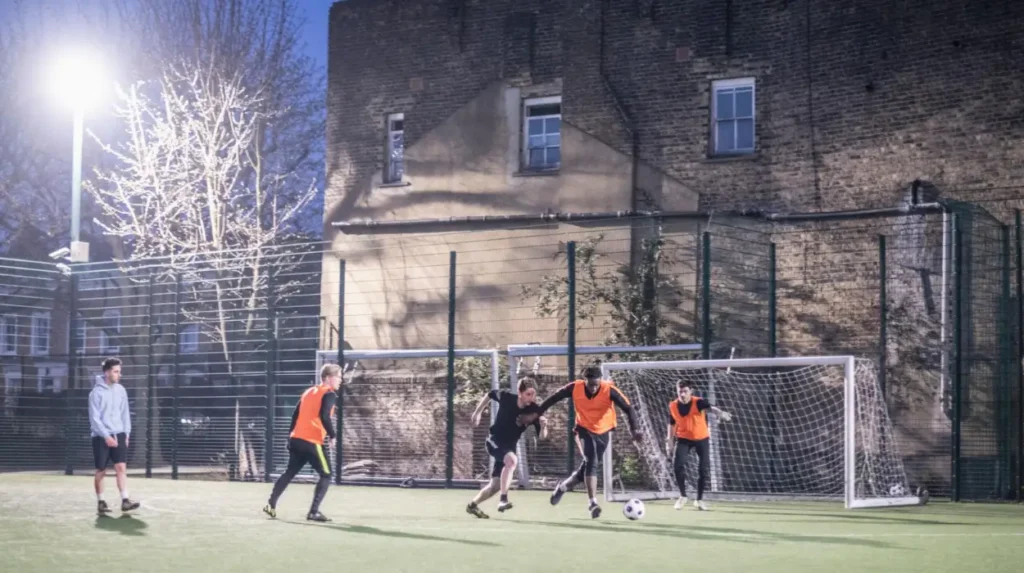
People can play five-a-side football in West London at dedicated commercial football centres, local authority leisure facilities, school and community pitches, and multi-use games areas that provide bookable or publicly accessible small-sided spaces.
Dedicated football centres provide some of the most structured opportunities. These venues generally offer artificial turf pitches, floodlighting, changing facilities and organised leagues. Artificial turf is a manufactured playing surface designed to provide a durable alternative to natural grass.
Local authority leisure facilities form another important part of the sporting network. Borough councils and their leisure partners operate sports centres containing indoor halls and outdoor facilities. Availability depends on the individual site, season and booking programme.
Examples of facility settings across West London include sports centres, school sites with community hire programmes and public recreation grounds. A player should check the specific venue’s current pitch dimensions, surface type, opening hours and booking rules before arranging a match.
Multi-use games areas, commonly known as MUGAs, also support informal football. A MUGA is an enclosed outdoor space designed for more than one sport, such as football, basketball and netball. These facilities are common in parks, housing estates and community recreation areas.
Venue choice affects the playing experience. A commercial centre usually provides organised booking systems and maintained pitches. A community pitch can provide lower-cost access. An indoor sports hall provides protection from poor weather but uses a different surface and playing environment.
How do five-a-side football pitches differ from full-sized pitches?
Five-a-side football pitches are substantially smaller than standard 11-a-side football fields, creating shorter passing distances, more frequent possession changes and greater individual involvement during every stage of the game.
A full-sized association football pitch can vary within the dimensions permitted by the Laws of the Game. Five-a-side pitches are much smaller and their exact dimensions depend on the venue and competition.
The reduced playing area changes player movement. A defender is closer to an opponent. A forward receives the ball under greater pressure. Teams must react quickly when possession changes.
Pitch surfaces also vary. Three common surface types are artificial turf, hard indoor flooring and natural grass, with artificial turf commonly used at dedicated small-sided centres.
Artificial turf provides a consistent surface and supports intensive use. Hard indoor flooring produces a faster rolling ball and often requires footwear suited to the venue. Natural grass creates a more traditional outdoor football experience but is affected by weather and seasonal maintenance.
Enclosed pitches often use perimeter boards or rebound walls. These structures reduce interruptions because the ball remains in the playing area more often. Other pitches use standard touchlines and require normal restarts when the ball leaves the field.
Goals are also smaller than those used in senior 11-a-side football. The reduced goal size reflects the smaller pitch and shorter shooting distances.
What rules are used in five-a-side football?
Five-a-side football uses simplified rules that govern player numbers, substitutions, restarts, fouls and goalkeeper actions, while exact regulations vary between commercial venues, local leagues and formally organised competitions.
The most important rule principle is that local competition rules take priority in recreational five-a-side football. Players should read the venue’s regulations before a match begins.
Team size is usually five players on the pitch. Many competitions allow rolling substitutions. A rolling substitution allows a player to leave and re-enter the game repeatedly, subject to the organiser’s rules.
Offside is generally not used in recreational five-a-side football. Removing the offside rule simplifies play and reflects the compact size of the pitch.
Restart procedures also differ between venues. Some games use kick-ins instead of throw-ins. A kick-in returns the ball to play using the foot after it has crossed a sideline. Other competitions use standard throw-ins.
Sliding tackles are frequently restricted or prohibited, especially on artificial turf. The purpose is to reduce collision and injury risks in a compact playing space.
Goalkeeper rules vary. Some leagues restrict how long a goalkeeper can control the ball or regulate whether the goalkeeper can receive a return pass from a teammate. These rules are designed to maintain the pace of play and prevent excessive possession in defensive areas.
Disciplinary systems also vary. Yellow and red cards, temporary suspensions and points deductions are examples of sanctions used by organised leagues.
How does a typical five-a-side match work?
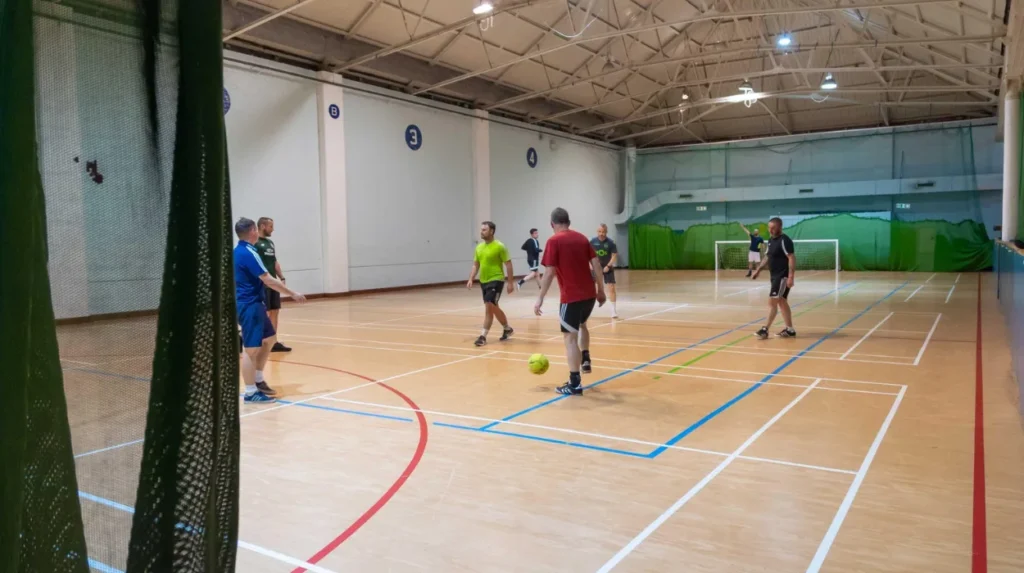
A typical five-a-side match begins with two teams of five, uses short halves or a fixed total playing time, permits rapid substitutions and requires teams to manage frequent transitions between attack and defence.
Before the game, teams normally confirm player numbers and distinguish themselves using shirts, bibs or matching kit. A bib is a lightweight garment worn over clothing to identify one team from another.
The match begins according to the organiser’s restart procedure. Because the pitch is small, teams enter attacking situations quickly.
Possession changes frequently. A blocked shot can immediately create a counterattack. A misplaced pass can place the defending team under pressure within seconds.
Substitutions are an important part of match management. Players who work at high intensity often rotate with substitutes. This helps maintain energy levels and allows larger groups to participate.
The referee or match official applies the competition rules. In informal games, players often manage decisions collectively. Organised leagues generally use appointed officials to oversee fouls, restarts and disciplinary matters.
At the end of a league fixture, the result contributes to a standings system. Common systems award points for wins and draws, although the exact scoring method depends on the competition.
What skills are most important in five-a-side football?
The most important five-a-side football skills are close ball control, accurate passing, quick decision-making, positional awareness and sustained movement because the smaller playing area creates constant pressure and frequent involvement.
Close control is essential. Players often receive the ball near an opponent and need to protect possession immediately. Short touches and controlled changes of direction help maintain possession.
Passing accuracy is equally important. The reduced pitch creates many short passing options, but opponents can close those spaces quickly. A misplaced pass often produces an immediate attacking opportunity for the other team.
Decision-making occurs at a faster pace. Players need to identify passing lanes, shooting opportunities and defensive responsibilities within a limited amount of time.
Positional awareness supports team structure. When one player attacks, another player often needs to cover the resulting space. A balanced team avoids having all players move toward the ball at the same time.
Fitness remains important, but the physical demands differ from those of 11-a-side football. Five-a-side football involves repeated accelerations, changes of direction and short recovery periods.
Goalkeepers also require specialised skills. Reactions, positioning and distribution are particularly important because shots often occur from close range.
What formations are used in five-a-side football?
Five-a-side teams use simple formations to organise attacking and defensive responsibilities, with common structures including a 2-2 shape, a 1-2-1 diamond and flexible systems based on continuous player movement.
A 2-2 formation uses two players with primarily defensive responsibilities and two players operating further forward. It is simple to understand and suits teams that are developing basic positional discipline.
The 1-2-1 diamond places one player at the back, two players in central or wide positions and one player in an advanced role. This structure creates clear passing angles between the four outfield players.
Flexible movement is a central feature of experienced five-a-side teams. Players rotate positions while maintaining defensive coverage. Rotation prevents the formation from becoming static and can create space.
The goalkeeper also contributes to the team’s structure. In some situations, the goalkeeper acts as an additional passing option. This creates a numerical advantage during possession but requires careful awareness of the goalkeeper’s position and the competition rules.
A formation provides a starting structure rather than a fixed set of positions. Effective teams communicate and adjust their shape as the ball moves.
How can beginners start playing five-a-side football in West London?
Beginners can start playing five-a-side football by joining a casual group, booking a pitch with friends, registering for an introductory league or using local sports facilities that offer structured and informal participation opportunities.
The simplest route is to organise a game with friends or colleagues. Ten players create two full teams of five, while additional players can rotate as substitutes.
Booking a pitch requires basic planning. The organiser should confirm the cost, duration, surface, changing arrangements and cancellation policy. Splitting the booking cost among participants often reduces the individual payment.
Organised leagues provide a more structured route. A league generally operates on a fixed schedule and requires teams to play a series of fixtures. This format is useful for groups seeking regular competition.
Individual players can also look for groups that need additional participants. Some organised sessions accept individual registrations and allocate players to teams.
Beginners benefit from learning the specific rules used at their chosen venue. This prevents confusion about restarts, tackling and goalkeeper restrictions.
Appropriate clothing and footwear are also important. Footwear should match the playing surface. Players should check whether the venue permits moulded studs, turf shoes or indoor trainers.
What equipment is needed for five-a-side football?
Five-a-side football requires basic sporting equipment, including suitable footwear, comfortable clothing and a ball supplied by players or the venue, while organised matches often add bibs, shin protection and goalkeeper equipment.
Footwear should be selected for the surface. Artificial turf shoes are designed for synthetic playing areas. Indoor trainers are used on suitable indoor floors. Traditional football boots are not appropriate for every small-sided surface.
Clothing should allow unrestricted movement. Players commonly wear sports shirts, shorts or tracksuit bottoms depending on the venue and weather.
Shin guards provide protection to the lower legs. Some informal games do not require them, but organised competitions and individual venues can set their own safety requirements.
A football is required unless the venue supplies one. The ball size and type depend on the format and local rules. Futsal uses a distinct ball with specific characteristics, while recreational five-a-side football often uses a standard football appropriate to the organiser’s rules.
Bibs help distinguish teams when players do not have matching shirts. Goalkeepers often wear a contrasting top so that they are clearly identifiable.
What health and fitness benefits are associated with playing football?
Regular football participation supports physical activity through repeated running, acceleration and movement, while organised team sport also creates regular social interaction and structured opportunities for continued participation.
Football is a form of moderate-to-vigorous physical activity for many participants. The World Health Organization recommends regular physical activity for adults and identifies physical activity as an important part of reducing risks associated with inactivity.
Five-a-side football involves repeated movement across short distances. Players accelerate, decelerate, turn and change direction throughout the game.
Regular participation contributes to overall weekly activity levels. The exact physical demands depend on match intensity, playing position, fitness level and match duration.
Team participation also creates a social structure around exercise. A scheduled weekly game provides a fixed time for physical activity and contact with other participants.
Injury prevention remains important. Players should warm up before high-intensity activity and use equipment appropriate to the surface. Anyone returning after an injury should follow appropriate professional guidance.
How much does five-a-side football cost in West London?
The cost of five-a-side football in West London depends on the venue, location, pitch type, booking time and competition format, with team-based pitch hire commonly shared among all participating players.
Pricing varies substantially between neighbourhoods and facilities. Central locations, peak evening periods and dedicated commercial venues often have different prices from community facilities or off-peak sessions.
A pitch booking is usually charged to the person or group making the reservation. The total can then be divided among the players. For example, if ten participants share the cost equally, each participant pays one-tenth of the total pitch fee.
League participation can involve additional charges. These can include team registration fees, match fees or seasonal entry costs.
Players should check the complete cost before committing to a regular competition. Important details include cancellation charges, late payment rules and charges for replacement equipment.
Lower-cost options can include council-supported facilities, community programmes and public recreation spaces. Availability and booking requirements differ by borough and individual site.
How do organised five-a-side leagues operate?
Organised five-a-side leagues operate through scheduled fixtures, registered teams, published rules and league standings, creating a structured competition in which results determine positions and, in some formats, promotion or knockout progression.
A league begins with a group of registered teams. The organiser creates a fixture schedule that determines when teams play each other.
The competition records match results. League standings usually rank teams using points and other criteria defined by the organiser. Goal difference, goals scored and head-to-head records are examples of additional ranking methods.
Some leagues use divisions. Divisions group teams according to competition structure and playing level. Promotion and relegation systems can move teams between divisions when the organiser uses a multi-tier format.
Cup competitions are another format. A cup usually uses knockout rounds in which a team progresses by winning a match or a two-leg contest, depending on the rules.
Team organisers carry administrative responsibilities. They confirm player availability, manage payments and communicate with league officials.
What should players consider when choosing a West London venue?
Players should choose a West London five-a-side venue by assessing location, transport access, pitch surface, changing facilities, booking costs, match availability and the level of competition offered at the site.
Location affects long-term participation. A venue close to home, work or a transport route is easier for a regular group to reach.
West London is served by several transport systems, including London Underground services, Elizabeth line services, National Rail routes and local buses. Travel times vary between boroughs and should be considered when scheduling evening matches.
The playing surface affects footwear and game style. Teams should establish whether they prefer artificial turf, indoor flooring or another available surface.
Facilities also affect the overall experience. Changing rooms, showers, lockers and spectator space are examples of features that differ between venues.
Booking availability is particularly important for regular teams. Popular evening periods can have high demand, so groups seeking a fixed weekly match time should investigate recurring booking options.
Accessibility should also be considered. Players with specific access requirements should contact the venue directly to confirm step-free access, accessible changing facilities and other relevant provisions.
How does five-a-side football support communities in West London?
Five-a-side football supports West London communities by creating regular local activity, encouraging team participation and providing sporting opportunities for people who want a flexible alternative to traditional full-sized football.
Community sport brings people together around a shared activity. Five-a-side football has a relatively simple participation structure because a full game requires only ten players.
Local sports centres and recreation facilities provide places where residents can participate without joining a traditional weekend football club. This broadens access to the sport.
Workplace teams also use five-a-side football for regular activity. West London’s employment centres create opportunities for colleagues to organise games outside working hours.
Students represent another important participant group. The format fits around academic schedules and requires fewer players than a full football squad.
Community programmes also use small-sided football as part of wider physical activity provision. These programmes can include youth sessions, adult recreation and structured coaching.
The long-term value of accessible facilities remains significant. Pitch availability, affordable participation and safe facilities determine how easily residents can maintain regular sporting habits.
Explore More Area Guide
Sports Centres in West London: Complete Guide
Outdoor Gyms in West London: Free Parks and Fitness Facilities
What is the future of five-a-side football in West London?
The future of five-a-side football in West London is linked to continued demand for accessible urban sport, effective management of sports facilities and the development of inclusive opportunities for different ages, abilities and participation levels.
Urban areas require efficient use of recreational space. Small-sided pitches accommodate football within a smaller footprint than full-sized fields.
Artificial playing surfaces also support intensive use throughout the year when properly maintained. This is important in areas where land and sporting space are under pressure.
Digital booking systems have also changed how participants arrange games. Online platforms allow groups to check availability, reserve pitches and manage payments more efficiently.
Participation remains connected to broader public health and community objectives. Regular physical activity and local social opportunities are both important parts of active communities.
Future development will also depend on accessibility. Facilities need to serve beginners, regular recreational players and competitive teams. Inclusive programmes can expand participation across different groups.
Five-a-side football will remain closely connected to West London’s broader sporting identity. The format offers a practical route into regular football for people with limited time, smaller social groups or a preference for short, high-intensity matches.
How can players get the most from five-a-side football in West London?
Players get the most from five-a-side football by selecting a suitable venue, understanding local rules, maintaining regular participation, using appropriate equipment and developing teamwork, fitness and technical skills over time.
A consistent group makes regular participation easier. Players should agree on a schedule, booking arrangements and expected commitment.
Clear communication improves the match experience. Teams should understand basic positional responsibilities and respect the rules set by the venue or organiser.
Technical development also improves enjoyment and performance. Close control, accurate passing and awareness are especially valuable in small-sided football because players interact with the ball frequently.
Fitness should develop alongside technical skills. Regular warm-ups and appropriate recovery support sustained participation.
West London provides a broad setting for this form of football. Dedicated centres, leisure facilities and community spaces offer different routes into the game. Each player or team can select an environment based on location, cost, surface and level of competition.
Five-a-side football combines the core principles of association football with a format designed for smaller groups and compact urban spaces. Its continued relevance comes from its practical structure. A group needs fewer players, matches fit into shorter periods and facilities can support repeated use.
For West London residents, workers and students, the game remains a direct way to participate in organised or informal sport. Understanding the rules, facilities, equipment and competition structures provides a clear foundation for getting involved and maintaining regular participation.
Where can I play five-a-side football in West London?
Five-a-side football is available at dedicated football centres, leisure centres, community sports facilities and multi-use games areas across West London. Availability varies by borough, venue and booking time.