Key Points
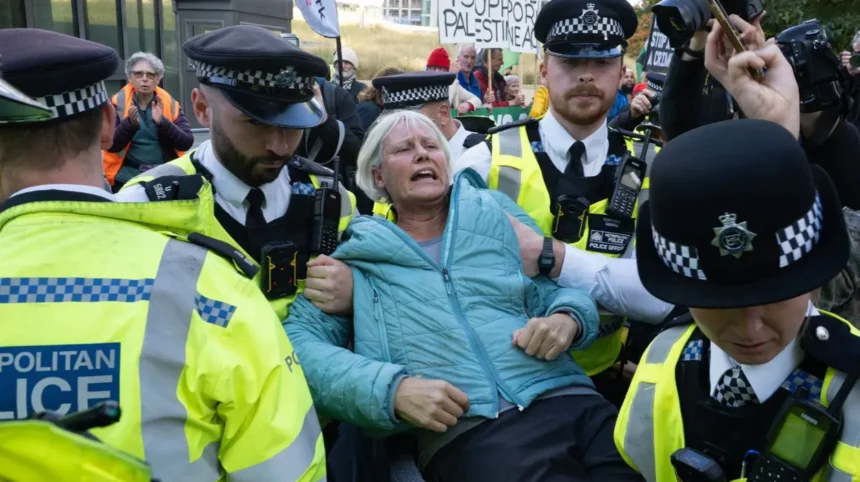
- Emphasis on Arrests: More than 300 protesters have been arrested after gathering at the US Embassy in Nine Elms, south London, in support of the banned group Palestine Action.
- Metropolitan Police Information: A post on X has shown the arrest figures to be 325 with 320 people being arrested for protesting in support of a banned organisation under the Terrorism Act.
- Demonstration Timing: The protest occurred on Saturday, October 31, 2026, ahead of a forthcoming Supreme Court hearing of challenges of the ban on the proscribed group.
- Demonstration Organisers: The protest was organized by Defend Our Juries campaign, which opposes the ban of Palestine Action.
- High-Profile Arrests: One of the people who was arrested is 94 years old Margaret Owen, a human rights lawyer, which has raised much public debate and criticism from figures such as Green Party leader Zack Polanski.
- Overall Arrest Figures: Organisers said that Saturday’s protest raised the overall number of people arrested for defiance of the ban on Palestine Action to more than 4,000 since July 2025.
- Related Demonstration: There was another protest outside the US consulate in Edinburgh near Holyrood, but Police Scotland says that no arrests were made there.
London, Nine Elms (West London Times) November 2, 2026 – More than 300 demonstrators have been arrested after gathering outside the US Embassy in London in support of the proscribed group Palestine Action, according to the Metropolitan Police. Hundreds of people took part in the demonstration in south-west London on Saturday, holding signs and chanting slogans ahead of a crucial legal challenge at the Supreme Court.
- Key Points
- Why Did Hundreds Gather Outside The US Embassy In London?
- What Did The Metropolitan Police State Regarding The Arrests?
- Who Were Some Of The Notable Individuals Detained During The Protest?
- How Does This Event Fit Into The Wider Campaign Against The Palestine Action Ban?
- Background of the Particular Development
- Prediction: How This Development Can Affect Civil Liberties and the UK Legal Landscape
Why Did Hundreds Gather Outside The US Embassy In London?
The demonstration, organised by the campaign group Defend Our Juries, drew hundreds of participants to Ponton Road, just off the US Embassy grounds in Nine Elms. As reported by Clara Margotin of Press Association (covered by The Standard and uk/local/ealing/">Ealing Times), many demonstrators applauded and chanted “free, free Palestine” as police officers moved in to carry out arrests and transfer individuals to waiting police vans.
Participants held placards bearing messages such as
“I oppose genocide, I support Palestine Action”,
“we are protesters, not terrorists”,
and “heroes, not terrorists”, while others wore keffiyehs and waved Palestinian flags. According to Clara Margotin of PA Media, one protester managed to climb a tree outside the embassy and waved a placard reading,
“God help us. Teachers who support Palestine. Palestine Action,”
prompting the crowd below to chant “tree, tree Palestine”.
What Did The Metropolitan Police State Regarding The Arrests?
Providing official figures on the operation, the Metropolitan Police announced in a statement on X that 325 people had been arrested in connection with the demonstration. As noted by Press Association journalists, the vast majority—amounting to 320 individuals—were detained on suspicion of expressing support for a proscribed organisation under the Terrorism Act.
Expressing support for Palestine Action became a criminal offence under the Terrorism Act following its proscription in June 2025. Police enforced a Section 35 dispersal order covering the embassy grounds and surrounding areas from 8 am to 11 pm on Saturday. Officers continued making arrests into the evening as crowds maintained their presence.
Who Were Some Of The Notable Individuals Detained During The Protest?
The demonstration attracted a cross-section of society, including high-profile campaigners and legal figures. As reported by PA Media, among those detained was 94-year-old human rights lawyer Margaret Owen. Footage of her arrest circulated widely online, drawing sharp condemnation from political figures.
Green Party leader Zack Polanski took to X to describe a video of Ms Owen’s arrest, stating:
“This is truly dystopian. Not in our name”.
Other participants explained their motivations to reporters at the scene. As reported by PA Media, an ex-lawyer named Charles Allison, 75, stated prior to his detention:
“I speak as an ex-lawyer, so it’s uncomfortable for me to break the law deliberately. But I felt that I could do no other”.
Mr Allison added:
“I fear for our civil liberties, which are being devalued and watered down, even by this new Labour Government”.
He was subsequently taken away by two police officers just before 1 pm after officers told him he posed a “threat”.
Additionally, attendee Lauren Wallace, 36, told PA reporter Clara Margotin that she brought her four-year-old daughter Lilah to the protest to show her
“the power of protest and how important it is to be political”.
Explore More UK News
London Man Arrested Over Fatal Group Attack in Leeds 2026
Newham Westminster And Croydon Top London Arson Figures 2026
How Does This Event Fit Into The Wider Campaign Against The Palestine Action Ban?
The protest outside the US Embassy occurred just days before an upcoming Supreme Court hearing scheduled for November 4, 2026, which will hear an appeal against the designation of Palestine Action as a terrorist group. Activists and supporters argue that the government ban is draconian and severely curtails freedom of speech.
A spokesperson for Defend Our Juries stated that the arrests made on Saturday pushed the cumulative total of people detained for defying the ban beyond 4,000 since July 2025, describing the milestone as “truly dystopian”. The spokesperson stated:
“The ban on Palestine Action was straight out of Donald Trump’s playbook so it’s fitting that this significant milestone has been reached on Halloween and outside the US embassy, laying bare the terrifying attacks on free speech that this authoritarian ban has unleashed”.
In addition to the main demonstration in London, a parallel protest took place outside the US consulate near Holyrood in Edinburgh on Saturday. However, Police Scotland confirmed that no arrests were made at the Scottish demonstration.
Background of the Particular Development
The escalation of arrests outside the US Embassy is the latest chapter in an ongoing legal and political conflict surrounding Palestine Action. In June 2025, the UK government officially proscribed Palestine Action under the Terrorism Act following high-profile direct action campaigns by activists. Expressing verbal, written, or symbolic support for the group subsequently became a criminal offence carrying potential custodial sentences.
This legislative move triggered fierce opposition from civil liberties organisations, legal professionals, and human rights campaigners who argue that the terrorism label is a disproportionate restriction on peaceful assembly and free expression. Campaign groups such as Defend Our Juries were subsequently formed to orchestrate coordinated acts of civil disobedience, resulting in thousands of voluntary and targeted arrests across the United Kingdom as protesters challenge the legal boundaries of the ban.
Prediction: How This Development Can Affect Civil Liberties and the UK Legal Landscape
The mass arrests outside the US Embassy and the impending Supreme Court hearing mark a critical crossroads for the UK’s legal framework regarding protest and counter-terrorism legislation. For civil liberties groups, legal observers, and political activists, the continuous accumulation of arrests—now surpassing 4,000 individuals—highlights deep polarization over the application of terrorism laws to domestic political activism.
If the Supreme Court upholds the proscription of Palestine Action during its upcoming review, it will likely validate the government’s enforcement strategy, potentially empowering police forces to maintain zero-tolerance policies on similar demonstrations and leading to further mass arrests.
Conversely, any legal shifts or judicial criticism regarding the definition of terrorist support could force a parliamentary re-evaluation of how protest groups are banned and how civil disobedience is prosecuted.
For the broader public and advocacy groups, these developments serve as a major test case for the future boundaries of free speech, the right to assembly, and the threshold at which activist organisations are categorized under national security laws in the United Kingdom.