Key Points
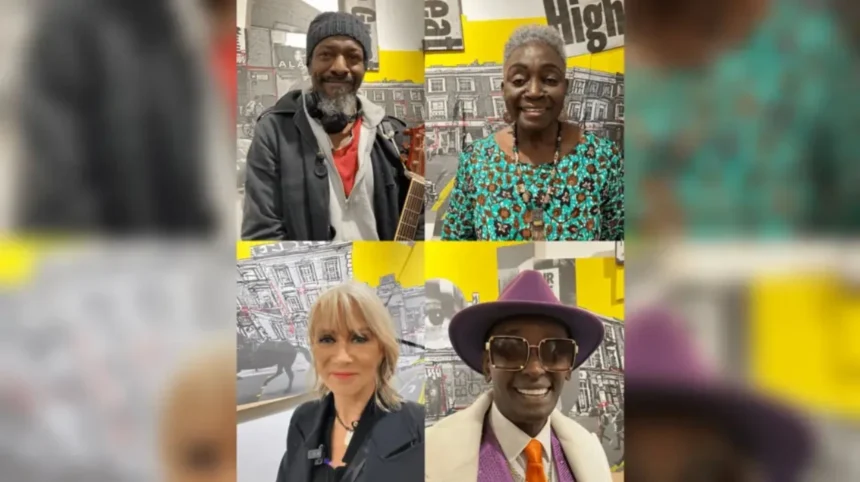
- Community Figures Featured: Prominent Notting Hill community members, including a fourth-generation Portobello market trader, a Notting Hill Carnival director, and local style icons, have been integrated into a new installation by street artist Endless.
- Frieze Week Event: The artwork, titled Endless Frieze, forms part of the annual Frieze London art fair celebrations and takes place at the Cris Contini Contemporary gallery in West London.
- Real-Time Interactive Creation: Live portraits were taken during a special gathering, with photographs being attached instantly onto a large-scale collage wall to capture the live energy of the neighbourhood.
- Shifting Local Landscape: Local participants, including fruit and vegetable stall holder Cheryl Devlin, highlighted the changing economic landscape, rising costs, and loss of long-standing community spaces in Notting Hill.
- Preservation of Cultural Heritage: Cultural figures, such as Allyson Williams MBE, stressed the vital historical link between Caribbean Windrush-generation culture and the identity of West London.
Notting Hill, London (West London Times) October 20, 2026 — Street artist Endless has created Endless Frieze, an interactive artwork at Cris Contini Contemporary gallery in West London as part of Frieze London celebrations, featuring portraits of Notting Hill community figures, including Portobello Market trader Cheryl Devlin, Notting Hill Carnival representative Allyson Williams MBE and local style personalities.
- Key Points
- How Is Notting Hill’s Community Being Celebrated At Frieze London?
- Who Are The Local Personalities Included In The Artwork?
- How Does The Exhibition Capture The Area’s Culture And History?
- What Creative Process Did Artist Endless Apply To The Installation?
- Background Of The Particular Development
- Prediction: How This Development Can Affect Local Communities And The Art Sector
The installation aims to celebrate the area’s cultural heritage and community identity while highlighting concerns about rising living costs, gentrification and the loss of local gathering spaces.
How Is Notting Hill’s Community Being Celebrated At Frieze London?
As reported by Nicky Ford and Ruth Comerford of BBC News, an installation titled Endless Frieze has been established to celebrate the living history, architecture, and personal identity of Notting Hill. The exhibition, hosted in West London, brings together everyday local heroes, market traders, and cultural stalwarts alongside high-profile residents.
The project relies on a live interactive photographic process where subjects were photographed on location, with their portraits immediately pasted into an evolving wall collage. According to Endless, the artwork seeks to bridge the gap between traditional gallery spaces and the local populace, bringing community members directly into the contemporary art world.
Who Are The Local Personalities Included In The Artwork?
The artwork features a varied cross-section of West London residents chosen for their individual impact on the district’s social fabric.
As reported by Nicky Ford and Ruth Comerford of BBC News, among those featured is Cheryl Devlin, a greengrocer whose family has operated a fruit and vegetable stall on Portobello Market for over a century. Devlin, who has worked on the stall since the age of five, recounted her early working life in the neighbourhood:
“I used to stand beside my mum and dad and sell lemons, five for a shilling. And if you didn’t, you didn’t get your dinner; it was really that tough in the ’50s.”
Devlin noted that the market has undergone significant structural transformations over the decades. Where roughly 350 fruit and vegetable traders once operated, the area is now dominated by prepared food stalls and bric-a-brac vendors. She added:
“A lot of people downsize who can’t afford the housing. It’s just tough to live around this area now where it was quite cheap and reasonable.”
Also captured in the work is Jama Elmi, a prominent local figure known as “Notting Hill’s best dressed man.” Describing his participation in the project and his affinity for the neighbourhood, Elmi stated to the BBC reporters:
“I’m in the art, in the fashion, I’m a walking art. Notting Hill, it’s vibrant, the energy, the love, it’s absolutely, I wouldn’t live anywhere else but here.”
How Does The Exhibition Capture The Area’s Culture And History?
The installation incorporates key elements of the area’s rich cultural traditions, notably the Notting Hill Carnival and its musical heritage.
As detailed by Nicky Ford and Ruth Comerford of BBC News, board member of Notting Hill Carnival Limited, Allyson Williams MBE, was included for her decades of service to the event. Williams, who has been involved with carnival organisation since 1975, founded the Genesis Mask Band costume brand with her husband in 1980. Reflecting on her contribution and Trinidadian roots, Williams stated:
“I have been a seamstress, I’ve been a designer. I’ve been bringing the costumes — the designs of my husband and my daughter — bringing the costumes to life. I’m a Trinidadian and so it all started there and it was the Trinidadians who came, who were part of the Windrush generation who came and brought all the art and culture here.”
The exhibition also features Karl Amata from Sound Records on All Saints Road. Highlighting the diminishing number of social spaces for local residents, Amata told the BBC:
“I hope it continues. We need more things like this to bring the community together. Because there’s the lack of it. Everything’s been shut down, the shops, every cultural centre, anywhere people can gather together.”
Fashion designer Karen Millen, founder of the namesake clothing brand, was also featured in the collage. Millen expressed that she felt “very honoured” to participate, adding that Notting Hill remains the “epicentre of where people come for creation really, so I don’t think that will ever go away.”
What Creative Process Did Artist Endless Apply To The Installation?
The creative execution of Endless Frieze relies on spontaneous, real-time assemblage, creating what the artist describes as an organic snapshot of the location.
As reported by Nicky Ford and Ruth Comerford of BBC News, street artist Endless explained that constructing an artwork live in front of an audience involves inherent artistic uncertainties:
“It becomes a frieze, a moment in time of the architecture, the buildings and the people. So it’s really about the energy of the place. Whenever I make any artwork, I plan it and I have a vision, but then it can go either way. There’s like elements of risk even when you’re making a painting. So with this the risk is life, anything could happen. So the camera could go wrong or I could stick it up wrong but that’s part of it. In art we say it’s like a happy accident and that’s when something good happens as well.”
Background Of The Particular Development
Notting Hill has long maintained a dual identity as both a historic working-class Caribbean enclave and an increasingly gentrified, high-value London borough. The annual Frieze London art fair, established in 2003, typically draws global collectors, international galleries, and high-net-worth patrons to Regent’s Park and surrounding gallery hubs. Historically, critics and community groups have argued that major art market events can feel detached from the immediate neighborhoods in which peripheral events take place.
Projects like Endless Frieze represent an ongoing push by street artists and local contemporary galleries to reconnect commercial art fair activity with grassroots street culture. Portobello Market and All Saints Road have faced commercial pressure over recent decades, with rising retail rents, housing costs, and venue closures altering the demographic makeup that originally fostered the area’s artistic identity.
Explore more Local West London Time:
Hounslow Launches £150,000 Community Energy Fund in Hounslow 2026
Heathrow Pitches 17500 Building Jobs Amid Third Runway Doubts: Hillingdon 2026
Prediction: How This Development Can Affect Local Communities And The Art Sector
This development is likely to influence both West London residents and the broader commercial art market in several distinct ways:
- Increased Cultural Inclusion for Local Residents: By embedding market traders, local musicians, and long-standing activists directly onto gallery walls during Frieze Week, the project provides visible validation for working-class and Windrush-generation contributions, bridging the traditional divide between elite art institutions and local populations.
- Heightened Focus on Heritage Preservation: Public attention generated by the inclusion of figureheads like Cheryl Devlin and Karl Amata may spur localized advocacy to protect remaining independent traders, heritage venues, and community gathering spots against further gentrification and retail closures.
- Precedent for Live, Participatory Art Fairs: The commercial success and public engagement of a real-time, risk-based collage model may encourage gallery curators and street artists involved in future international art fairs to adopt participatory, community-driven live formats rather than static exhibition.