

Key Points
- Number of Arrests: Eleven people were arrested following various pro-Palestinian demonstrations that took place throughout London.
- Racial Hatred: There was an arrest of five people outside the office of the Board of Deputies of British Jews in North London as they were accused of inciting racial hatred after chanting slogans demanding intifada.
- Breaches of Police Conditions and Common Assault: Other arrests have taken place at pro-Palestinian protests by students, including five arrests due to breaches of police conditions such as face covering and one person for common assault.
- Significance of the Date: The protests took place on the third anniversary of the 7 October 2023 attack on Israel by Hamas that left about 1,200 people dead and 251 hostages leading to the military offensive in Gaza.
- Reactions of Community and Police Force: It has been said by the Board of Deputies that they will not be threatened or intimidated and that a vigil was held in Whitehall later in the day.
London (West London Times) October 7, 2026 — As reported by staff journalists at the BBC, eleven individuals were arrested across several pro-Palestinian demonstrations held in London on Wednesday. The protests coincided with the third anniversary of the 7 October attack on Israel by Hamas, an assault in which approximately 1,200 people were killed and 251 others were taken hostage. Israel subsequently responded with a military offensive in Gaza that has killed more than 74,000 Palestinians, according to figures from the Hamas-run health ministry.
According to statements from the Metropolitan Police, five people were arrested on suspicion of inciting racial hatred outside the office of the Board of Deputies of British Jews in Camden, north London. Footage from the demonstration showed a few dozen protesters, several wearing face coverings, chanting slogans calling for “intifada”. The term, which became popular during the Palestinian uprising against the Israeli occupation of the West Bank and Gaza Strip in 1987, is viewed by Jewish groups as a call for violence against Jewish people, while pro-Palestinian groups maintain it represents a call for peaceful resistance to Israel’s occupation.
In a statement following the arrests, the Board of Deputies, the UK’s largest Jewish community group, stated that it “would not be threatened or intimidated” and expressed gratitude to the police for their “swift” response. The five individuals arrested at this location remain in police custody. Later on Wednesday, the Board of Deputies held a vigil in Whitehall, central London, to honour the victims of the 7 October attack.
Explore more UK News:
London Mayor Demands Faster E-Bike Regulations Amid Growing Chaos in London 2026
Richmond Crisis Funding Drops Sharply In New UK Council Data Richmond 2026
What Happened at the Student Protests in Central London?
As detailed in coverage by the BBC, additional arrests were made at student pro-Palestinian protests that proceeded despite prior calls from the Metropolitan Police for them to be postponed due to the distress they would cause on a day of mourning for Jewish students and staff.
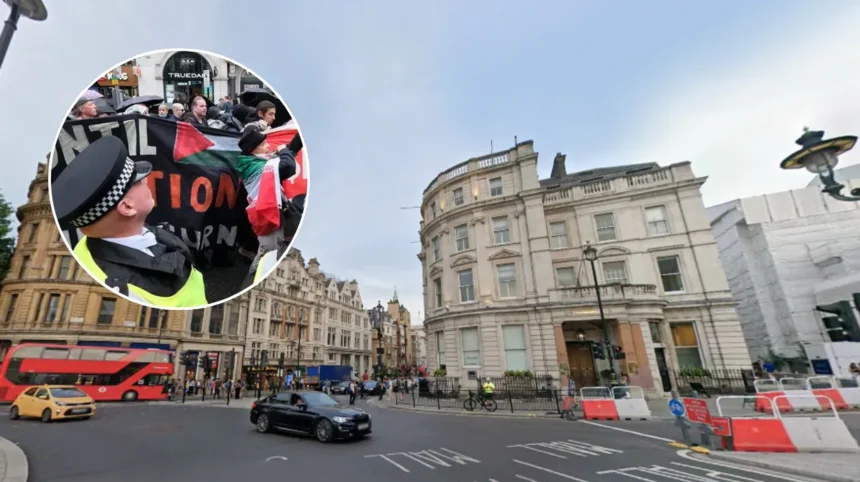
A march attended by around 100 people took place between Lincoln’s Inn Fields and Russell Square, accompanied by police escorts and featuring participants waving flags and holding placards, including one reading “3 years since October 7, 78 years since 1948”. Counter-demonstrators carrying Israeli flags also gathered in Russell Square, leading to minor scuffles between the two groups. Pro-Palestinian protesters were heard chanting “Zionists not welcome here” and “free Palestine from the river to the sea”. While critics argue the latter slogan calls for the destruction of the state of Israel, pro-Palestinian activists dispute this interpretation, stating it calls for an end to Israel’s occupation of the West Bank and the blockade of Gaza.
The Metropolitan Police confirmed that five participants were arrested for breaching conditions imposed on the march, which included a ban on wearing face coverings. Furthermore, one person was detained on suspicion of common assault. The protest ultimately concluded ahead of a police-enforced dispersal time, which authorities had implemented after organisers rejected requests to move the demonstration away from 7 October. The Met stated that officers remained stationed on the ground in central London throughout the remainder of the afternoon.
Background of the Particular Development
The demonstrations and subsequent arrests in London occur against the backdrop of ongoing, polarized global reactions to the Israel-Hamas war, which entered its third year on 7 October 2026. Since the initial 2023 attacks and the subsequent military campaign in Gaza, the United Kingdom has experienced frequent, large-scale public demonstrations concerning the conflict. These events have consistently created significant policing challenges in major urban centers like London, where authorities balance the right to peaceful protest against community safety, public order, and the prevention of hate speech or intimidation directed at ethnic and religious minority groups.
This development highlights the deepening polarization within UK communities and signals a hardening stance by the Metropolitan Police regarding conditions placed on contentious public demonstrations. For the British-Jewish community, student bodies, and pro-Palestinian activist groups, heightened police enforcement and recurring friction during emotionally charged anniversaries suggest that public spaces will remain flashpoints for social tension. Consequently, local authorities and community leaders can expect increased pressure to tighten regulations on protest routes, face coverings, and rhetoric, which may lead to more frequent clashes between demonstrators and law enforcement in upcoming months.