


Key Points
- London Mayor’s Concerns: The London Mayor, Lord Khan, has complained about the slow pace at which the government is regulating dockless e-bike systems, with regulations only set to come into force in 2028.
- Frustrated Operators: Operators of dockless e-bikes have expressed concerns that London is too slow in developing a proper policy on dockless e-bikes.
- Increasing Popularity: Dockless e-bike hire trips have risen by one-third to 37 million in 2025.
- Uncoordinated Regulation: At present, all London Boroughs regulate their dockless e-bike systems using different regulations and memorandums of understanding with different operators such as Lime, Forest, Voi, and Bolt.
- Economic Implication: Councils benefit financially from operators; for example, the City of London is supposed to earn £455,360 in the current year.
- Legislative Process: Even though the English Devolution and Community Empowerment Act 2026 provides powers to develop the framework, the real devolution and implementation process will take until 2028.
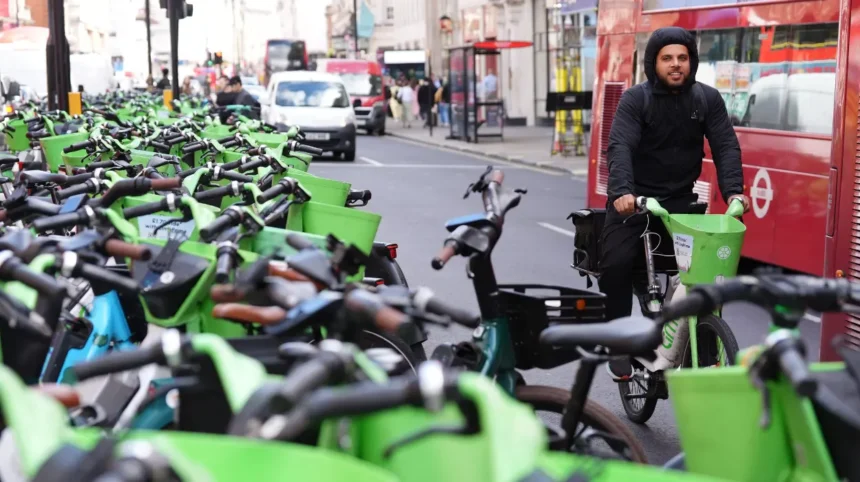
London (West London Times) October 2, 2026 – London Mayor Lord Khan has slammed the government’s timeline for regulating dockless e-bike schemes as sluggish and inadequate, warning that the capital is stuck dealing with a “Wild West” transit environment. While operators like Lime, Forest, Voi, and Bolt report surging demand—with journeys hitting 37 million in 2025—industry leaders and municipal officials alike argue that a fragmented, borough-by-borough approach to parking and safety rules is causing widespread confusion that will only worsen without immediate national intervention.
H1: Why Is London’s Mayor Demanding Faster Regulation For E-Bike Schemes?
As reported by BBC London, London Mayor Lord Khan has stated that waiting until at least 2028 for comprehensive government regulations is “not good enough”. The current legal framework forces individual boroughs to manage dockless micro-mobility through separate Memorandums of Understanding, resulting in an uncoordinated patchwork of guidelines.
Lord Khan told BBC London:
“What we’re saying to the government is we’ll help you speed things along. We’re publishing the framework, working with councils and operators. We’ll work with you, the Department for Transport (DfT) to draft the relevant piece of secondary legislation.”
H2: What Are The Main Complaints From E-Bike Operators About The Capital’s Approach?
E-bike rental operators have echoed the mayor’s frustrations, accusing authorities of lacking a unified strategy while simultaneously profiting from the boom. Latest figures indicate that dockless e-bike hire journeys increased by a third to reach 37 million in 2025, turning the sector into a multi-million-pound business. Local authorities benefit financially under current arrangements; for example, the City of London is expected to be paid £455,360 this year by operators.
Christina Moe Gjerde, vice president at Voi in Europe, highlighted the absurdity of the current borough-by-borough regulatory structure.
As reported by BBC London, Christina Moe Gjerde explained that each London borough maintains its own unique compliance standards for parking and rider behavior. Christina Moe Gjerde stated:
“Picture if it was any other mode of transport like a taxi where every borough you crossed you had to check whether or not you could actually drive through or if you could actually jump out of your taxi.”
Describing the current operational landscape as confusing, Christina Moe Gjerde further noted:
“What we’re missing is a pan-London vision for… another mode of transport in London. I really hope the mayor comes into motion and sets a vision for where we want to go, both as an operator, but also as a Londoner. Take us on a journey together with you in terms of what we want to achieve.”
Christina Moe Gjerde also asserted that the mayor was “sitting on a gold mine” due to high public demand, emphasizing:
“They need to speed things up because it’s going to get worse until it gets better when it comes to parking especially.”
Explore More UK News
Richmond Crisis Funding Drops Sharply In New UK Council Data Richmond 2026
Tesco, Sainsbury’s, Argos, and Asda Issue Urgent Product Recalls in London 2026
What Legislative Powers Exist And When Will Changes Arrive?
Earlier this year, the English Devolution and Community Empowerment Act 2026 provided the transport secretary with the legal capacity to grant Transport for London (TfL) statutory powers. These powers are intended to establish a standardized framework for dockless micro-mobility across the capital.
However, the formal devolution of these powers is moving slower than anticipated and is not projected to take full effect until at least 2028. In response to the delays, a spokesperson for the Department for Transport (DfT) stated that the government plans to launch a public consultation in the coming months before officially setting out new rules and regulations.
Background of the Particular Development
The explosive growth of dockless e-bike schemes across London over recent years has transformed urban mobility, offering zero-emission transport options that millions of residents rely on. However, this rapid commercial expansion has historically outpaced municipal infrastructure. Issues surrounding obstructive pavement parking, rider safety, and abandoned bicycles have sparked friction between communities, local councils, and rental companies. Because transport governance in London has traditionally been divided among 33 distinct local authorities alongside TfL, operators faced varying local bylaws, fees, and operational restrictions. This lack of centralization prompted intense lobbying from both municipal leaders and corporate stakeholders for a unified, statutory framework governed at a city-wide level.
Prediction
The ongoing delays in establishing a centralized regulatory framework for dockless e-bikes are likely to prolong logistical headaches for London residents, local councils, and operators alike. For everyday Londoners, pedestrians, and vulnerable road users, the continuation of the current borough-by-borough system means persistent challenges with cluttered pavements, abandoned cycles, and inconsistent safety standards over the next couple of years. For the local councils and commercial operators, the uncertainty may strain municipal relations and stall long-term investments in green transit infrastructure until the Department for Transport finalizes its secondary legislation and hands statutory oversight over to TfL.