

Key Points
- There was a major break in one of the water mains in West Molesey, Surrey, resulting in water supply problems for an estimated 15,000 households in five boroughs of south London and two Surrey boroughs.
- The affected London boroughs are Kingston upon Thames, Merton, Richmond upon Thames, Sutton, and Wandsworth, while the affected Surrey boroughs are Elmbridge and Spelthorne.
- Water supplies have been re-established for all Thames Water customers, although the engineering team is still at the site undertaking complicated repairs.
- The problems led to the closure of some schools in Surrey, flooding of football pitches, and water pressure issues for residents in the area.
- Politicians such as MP Paul Kohler, MP Monica Harding, and Luke Taylor have been vocal in criticizing Thames Water.
West Molesey (West London Times) September 29, 2026 — Thousands of homes across south London and Surrey experienced severe water disruptions following a major burst water main, prompting sharp political criticism and urgent repair operations.
- Key Points
- Why Did Thousands of Properties Lose Their Water Supply Across South London and Surrey?
- How Did Thames Water Respond to the Complex Pipe Failure?
- How Did Local Residents and Communities Experience the Outage?
- What Are Politicians Saying About Infrastructure and Regulation?
- Background of the Development
Why Did Thousands of Properties Lose Their Water Supply Across South London and Surrey?
The disruption began early on Monday morning, leaving roughly 15,000 properties across multiple boroughs without normal water pressure or entirely dry taps. As reported by PA Media, the massive outage spanned postcode areas across Kingston upon Thames, Merton, uk/local/richmond-upon-thames/richmond/">Richmond upon Thames, Sutton, and Wandsworth in London, as well as Elmbridge and Spelthorne in Surrey.
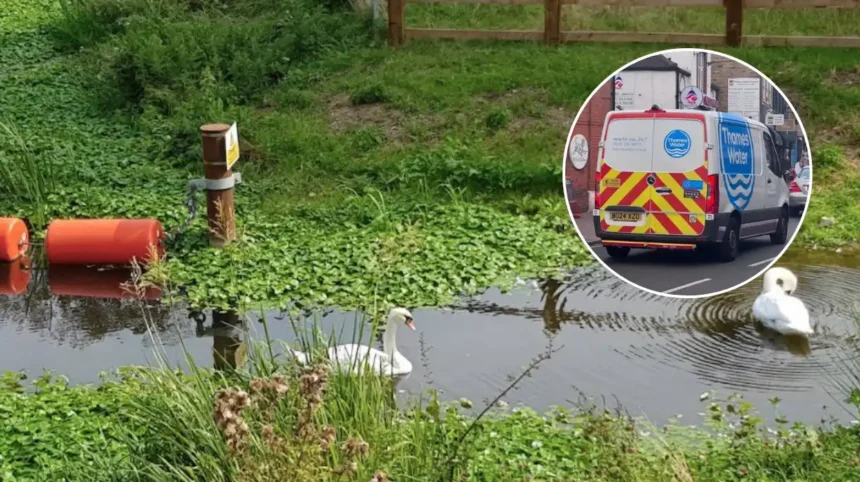
The incident stemmed from a major infrastructure failure near the Island Barn Reservoir in West Molesey, where a primary water main ruptured, flooding nearby grass football pitches and causing widespread pressure drops.
How Did Thames Water Respond to the Complex Pipe Failure?
Thames Water mobilized emergency engineering crews to isolate the damaged pipe and manage the unfolding crisis. Initially, the utility provider estimated that up to 15,000 properties were impacted, a figure that later dropped to 6,000 as initial isolation techniques redirected supplies, before full restoration was achieved.
A spokesperson for Thames Water stated that
“all customers remain in supply and we are continuing to work on repairing the burst pipe in Molesey,”
adding that the company “would like to thank customers for their patience.”
However, utility engineers described the ongoing engineering task as exceptionally complex. Repair work required the removal of several mature trees to grant heavy machinery adequate access to the broken underground pipe.
How Did Local Residents and Communities Experience the Outage?
The sudden loss of water caused immediate logistical hurdles for households, businesses, and educational institutions throughout the affected regions. Two local schools in Surrey were forced to close their doors for the day due to the complete lack of running water.
Local residents voiced deep frustration over the incident. A resident from East Molesey, identified only as Kathy, described waking up to severely diminished water pressure. As reported by PA Media, Kathy stated that she
“woke up very early this morning and the water pressure was low so I filled a load of saucepans,”
before noting that “it went off altogether at about 9am.”
To register her dissatisfaction with utility service standards, Kathy placed Thames Water-branded rubber ducks—which she had recently received at a local summer fair in Surbiton—onto the flooded football pitch near her property, dismissing the novelty items as a “waste of money.”
Explore more Local West London Times News:
ActOne Cinema Celebrates Five Years of Community Success in Acton 2026
Everyone Active Rolls Out Major Leisure Upgrades in Ealing 2026
What Are Politicians Saying About Infrastructure and Regulation?
The burst main ignited a fierce political backlash regarding water infrastructure investment, leakage rates, and regulatory effectiveness across the region.
Paul Kohler, the Liberal Democrat MP for Wimbledon, took to social media to announce that he had formally contacted Thames Water to demand immediate information following reports of outages across Wimbledon, New Malden, Raynes Park, and Morden.
Meanwhile, Monica Harding, the MP for Esher and Walton, demanded immediate accountability. As reported by PA Media, Monica Harding stated:
“We need an urgent response from Thames Water to get water supplies back on as soon as possible and to protect vulnerable communities.”
Harding further emphasized systemic concerns, stating:
“Once the water is flowing again, we need to establish exactly what happened and why. My worry is that decades of underinvestment in our infrastructure and poor regulation may be causing incidences like this. Right now, however, the priority must be getting water back in our taps.”
Luke Taylor, the MP for Sutton and Cheam, issued an even harsher condemnation of the utility provider, declaring that Thames Water was “no longer fit for purpose.” Highlighting broader systemic wastage, Taylor noted:
“Every day Thames Water loses 228 Olympic-sized swimming pools worth of water through leaks.”
Taylor added that while chronic leakage quietly drains resources, acute failures have tangible human consequences, noting that
“today the huge burst pipe in West Molesey means carers can’t wash their loved ones, businesses are shut and schools are closed.”
Background of the Development
The recent infrastructure failure in West Molesey occurs against a backdrop of intensifying public and regulatory scrutiny facing the UK water sector, and Thames Water in particular. Over recent years, major utility providers have faced mounting pressure regarding aging pipe networks, high leakage volumes, and environmental compliance.
London’s subterranean water infrastructure relies heavily on Victorian-era mains that traverse densely populated urban environments, making major repairs technically challenging and prone to sudden disruption. Regulatory bodies and consumer watchdogs have increasingly scrutinized how water companies allocate capital expenditure between network modernization, leakage reduction, and shareholder returns, making sudden supply interruptions flashpoints for wider political debate over utility privatization and public accountability.
This high-profile burst water main and the ensuing political fallout are likely to accelerate regulatory demands for accelerated infrastructure renewal across south London and Surrey’s supply networks. For local residents, businesses, and schools in the affected boroughs, heightened sensitivity around water security may translate into tighter contingency planning and more vocal local opposition to future tariff adjustments if service reliability does not visibly improve. Furthermore, sustained pressure from MPs such as Monica Harding and Luke Taylor will likely force Thames Water to prioritize localized network hardening and faster response protocols in Elmbridge, Spelthorne, and surrounding London boroughs to mitigate the risk of repeat failures.