

Key Points
- Incident Location: Earl’s Court Underground station and a train of the District Line in West London.
- Date and Time of Attack: Friday, 7 August 2026, around 6:45 pm.
- Details of the Attack: The commuter was surrounded by a group of people in a train, was kicked in the head and later followed into the station barriers where he received another attack.
- Action by the Police: The British Transport Police (BTP) has released CCTV pictures of some persons the police want to track down regarding the current investigation.
- How to Contact: Anyone who has information can text 61016, ring 0800 40 50 40, or speak to Crimestoppers anonymously using reference 628 of 7 August.
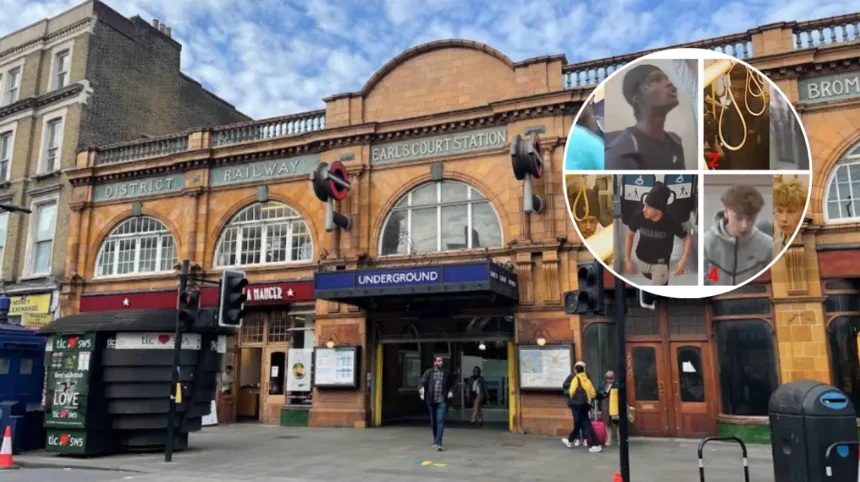
Earl’s Court (West London Times) September 29, 2026 — Detectives managing public safety across the capital’s transit networks have launched a formal high-priority appeal for information following a brazen daytime attack. As detailed in a press release issued by the British Transport Police, law enforcement officers investigating a violent assault that rocked Earl’s Court Underground station have released a series of CCTV stills capturing persons of interest.
The incident unfolded during the evening rush hour on Friday, 7 August 2026. According to official reports, at approximately 6:45 pm, an unidentified male passenger was travelling on a District Line train. Without warning, the victim was cornered and surrounded by a hostile group of people.
As reported by authorized representatives of the British Transport Police, the confrontation quickly escalated into severe physical violence. The group proceeded to assault the commuter, targeting him directly by kicking him in the head. The violence did not cease inside the train carriage. When the victim managed to disembark and escape the train at Earl’s Court Underground station, his attackers pursued him through the station environment right up to the ticket barriers, where they cornered and assaulted him a second time.
Why are the British Transport Police releasing these CCTV images now?
Following weeks of quiet investigative work, detectives have reached a critical juncture where public assistance is imperative to identify the suspects. Law enforcement officials confirmed that the newly published CCTV photographs feature individuals who were present during the sequence of events. Officers maintain that these individuals may hold vital information capable of advancing the inquiry, uncovering the motives behind the attack, and bringing the perpetrators to justice.
The release of these images forms a cornerstone of standard modern British policing protocols, allowing investigators to leverage public recognition when traditional investigative leads—such as Oyster card tracking, local station ticketing data, and onboard digital forensics—yield incomplete identification of transient suspects.
How can members of the public assist with the ongoing investigation?
The British Transport Police have established multiple direct channels for citizens to share information safely and confidentially. Investigators have emphasized that even minor details regarding the identities or whereabouts of the individuals pictured could prove decisive.
As outlined in the official British Transport Police briefing, anyone possessing information about the incident is strongly urged to contact the force by texting 61016 or by calling the dedicated freephone number at 0800 40 50 40. Callers and texters must quote the specific investigation reference number: 628 of 7 August.
For individuals who prefer to maintain total anonymity out of concern for reprisal or personal privacy, independent charity Crimestoppers is accepting confidential tips. Information can be passed to Crimestoppers free of charge by calling 0800 555 111.
Explore more West London Crime News:
Southall Driver Charged After Fatal Ford Mustang Crash in Ealing 2026
Former Bushey Teacher Jailed for Child Abuse Images in Harrow 2026
Background of the Particular Development
The distressing incident at Earl’s Court sits against a backdrop of increasing scrutiny regarding passenger security, antisocial behaviour, and violent crime across the London Underground network. Transport hubs like Earl’s Court—a major interchange serving multiple branches of the District line and the Piccadilly line—handle hundreds of thousands of commuters daily. In recent years, transport authorities, trade unions, and passenger advocacy groups have repeatedly raised concerns about frontline staff safety and passenger vulnerability during peak travel windows.
The British Transport Police, which polices the railways and underground networks across England, Scotland, and Wales, routinely deploys targeted CCTV appeals to tackle transit crime. While overall crime rates on the rail network fluctuate, incidents involving unprovoked group violence or attacks on transit staff and passengers command intense public interest and trigger immediate operational reviews by Transport for London (TfL) security teams. Public appeals of this nature are designed not only to solve specific crimes but also to demonstrate institutional accountability and reassure the travelling public that violent disruptions on public transport will be actively investigated.
How This Development Can Affect Commuters and Regular Tube Users
This high-profile CCTV appeal and the violent nature of the Earl’s Court assault are likely to have a pronounced psychological and operational impact on London Underground commuters, particularly those travelling during evening hours on the District line. For regular passengers, visible reminders of group-based violence on trains can heighten anxieties regarding personal safety, leading to increased vigilance, wariness of large groups congregating near carriage doors, and a heightened perception of vulnerability within confined underground spaces.
Operationally, this development places mounting pressure on Transport for London and the British Transport Police to visibly increase patrols, station staff presence, and security response times at key interchanges like Earl’s Court. Commuters may begin to experience a more pronounced security footprint, including enhanced deployment of uniformed officers and expanded high-definition CCTV monitoring. Ultimately, while such incidents cause short-term alarm, successful public identification of suspects through these appeals reinforces community cooperation, signalling to potential offenders that acts of violence committed within the transit network will face swift public exposure and coordinated law enforcement tracking.