


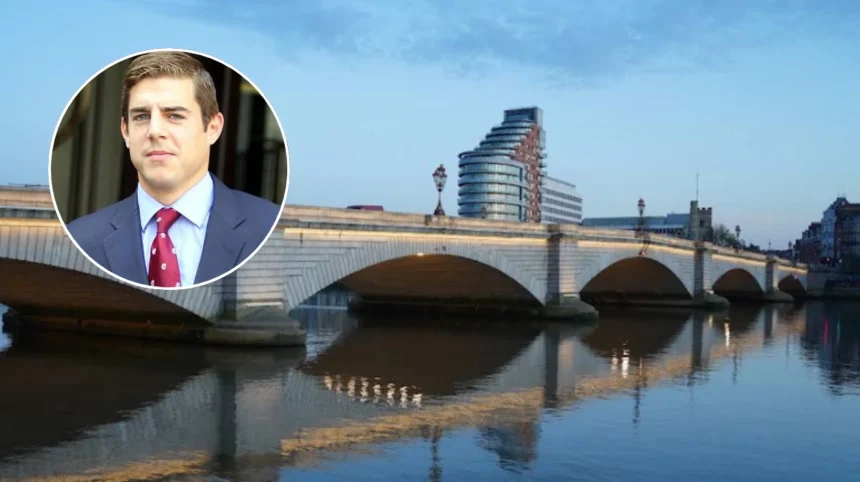
Key Points
- Nicholas Brandram, 44, who was a former British Army soldier and private banker accused of being the notorious “Putney pusher,” died in mysterious circumstances at his house in Chiswick, West London.
- Mr. Nicholas Brandram was pronounced dead on Tuesday evening at about 7:00 pm by Metropolitan Police officers when they found him unconscious.
- Mr. Brandram had been taken into custody in June when information came up for a case that happened after nine years without any movement in a case where a jogger pushed a 33-year-old woman for no reason in front of a double-decker bus on Putney Bridge in May 2017.
- According to BBC news, “Mr. Brandram’s family said that he had committed suicide due to the tremendous pressure that the police investigation had put on him.” Moreover, the family added that “there was no credible evidence of his guilt.”
- The sister of Mr. Brandram explained how he differed physically from the man seen in the CCTV footage, in that the former had blue eyes and a forearm tattoo while the latter had brown eyes and no tattoos.
- Dan Knowles of Metropolitan Police expressed sympathies to the family of Mr. Brandram and appreciated that conducting any investigation takes its toll on people.
London (West London Times) September 18, 2026 — As reported by Ali Watkins of The New York Times, a 44-year-old man arrested earlier this year in connection with the notorious 2017 Putney Bridge attack was found dead at his residential property in West London. The Metropolitan Police confirmed that emergency services rushed to an address in uk/local/hounslow/chiswick/">Chiswick on Tuesday evening following reports of an unresponsive man. Although his passing was sudden, authorities stated that the death is not being treated as suspicious.
The identification of the deceased as Nicholas Brandram brought a tragic turn to a high-profile cold case that had haunted British public consciousness for nearly a decade. Mr. Brandram had been taken into custody in June after investigators received fresh information from a member of the public. While he was released without charge and faced no ongoing bail conditions prior to his death, the Metropolitan Police clarified that their investigation into the physical assault remained active.
What Happened During the Original 2017 Attack on Putney Bridge?
The case harks back to May 5, 2017, when a peaceful morning commute on Putney Bridge turned perilous. Widely circulated CCTV footage captured a male jogger casually running across the bridge before aggressively shoving a 33-year-old woman directly into the path of an oncoming double-decker bus. The victim tumbled backward onto the asphalt, escaping fatal or catastrophic injuries solely due to the exceptional reflexes of the bus driver, who managed to swerve sharply into the adjacent lane.
Roughly a quarter of an hour later, surveillance cameras recorded the same jogger on the opposite side of the bridge. When the distressed victim later confronted him, he completely ignored her. At the time, investigating officer Sgt. Mat Knowles from the Putney Safer Neighbourhoods Team stated, as covered by legacy media outlets:
“The victim was put in extreme danger when she was knocked into the road. It was only due to the superb quick reactions of the bus driver that she was not hit by the vehicle.”
Despite reviewing leads concerning more than 50 individuals, the trail eventually went cold, leaving the public searching for the so-called “Putney pusher”.
Explore more Local West London Times News:
Missing Mum Joanne Sheen Remains Found in Hounslow 2026
St. George’s Shopping Centre Reaches Full Occupancy in Harrow 2026
What Did Mr. Brandram’s Family and Legal Representatives State Regarding the Allegations?
Following confirmation of his death, the BBC reported that Mr. Brandram’s family released a poignant statement on Thursday, asserting that he “took his own life after months of immense pressure caused by a Metropolitan Police investigation” and maintaining firmly that there was “no credible evidence” tying him to the historical assault.
Adding further details during a subsequent BBC radio interview on Friday, Mr. Brandram’s sister, Sophie Voelcker, highlighted clear visual inconsistencies between her brother and the perpetrator captured on camera. As detailed in the interview, she pointed out that Mr. Brandram possessed blue eyes rather than the brown eyes attributed to the suspect, alongside a distinctive and prominent forearm tattoo entirely absent on the man seen in the surveillance recordings.
Mr. Brandram, a former British Army soldier who transitioned into a career in private banking, found himself under intense public and investigative scrutiny following his June arrest. Chief Superintendent Dan Knowles of the Metropolitan Police addressed the tragedy in a public statement, saying:
“Our thoughts are with Mr. Brandram’s family and friends at this deeply distressing time. We recognise the significant impact his death will have on those who knew and loved him. We also understand the strain that being subject to a police investigation can place on individuals and their families.”
Background of the Particular Development
The resurgence of the Putney Bridge investigation in June 2026 marks a notable chapter in modern British criminal inquiries, heavily reliant on digital forensics, public appeals, and cold-case reviews. For nearly nine years, the “Putney pusher” moniker symbolised an elusive urban assailant, exploiting the anonymity afforded by busy metropolitan routines.
When new information triggered the arrest of Mr. Brandram, it demonstrated how historical cases remain perpetually open under British policing guidelines if vital tips emerge. However, the sudden and tragic conclusion to this investigative phase underscores the fragile intersection between high-intensity public accountability, media scrutiny, and the psychological wellbeing of suspects navigating prolonged legal uncertainties before formal charges are ever laid.
This development is expected to heavily influence how law enforcement agencies and regulatory bodies approach the management, welfare, and public disclosure guidelines surrounding high-profile suspects under long-term investigation. For the general public, legal analysts, and media outlets, this case serves as a stark reminder of the immense collateral psychological damage inflicted by prolonged public exposure and uncharged inquiries.
Moving forward, advocacy groups and legal professionals are likely to lobby for stricter protocols regarding suspect anonymity prior to formal charging, aiming to prevent similar psychological crises. Simultaneously, the Metropolitan Police may face increased internal and external scrutiny regarding how they balance the transparency of cold-case revivals with the pastoral care and mental health safeguards owed to individuals whose guilt has not been legally established.